


Tag Archives: Weekend
- Home
- Posts tagged "Weekend" (Page 15)

loading..

Artificial Intelligence with Python 2020
This content is accessible to paid subscribers. To view it please enter your password below or send mike@standardsmichigan.com a request for subscription details.

Gallery: Football Stadiums
This content is accessible to paid subscribers. To view it please enter your password below or send mike@standardsmichigan.com a request for subscription details.

Immigration from Africa to the United States
This content is accessible to paid subscribers. To view it please enter your password below or send mike@standardsmichigan.com a request for subscription details.

“Standard” History
Time has no beginnings and history has no bounds. The way we understand the past is always changing:
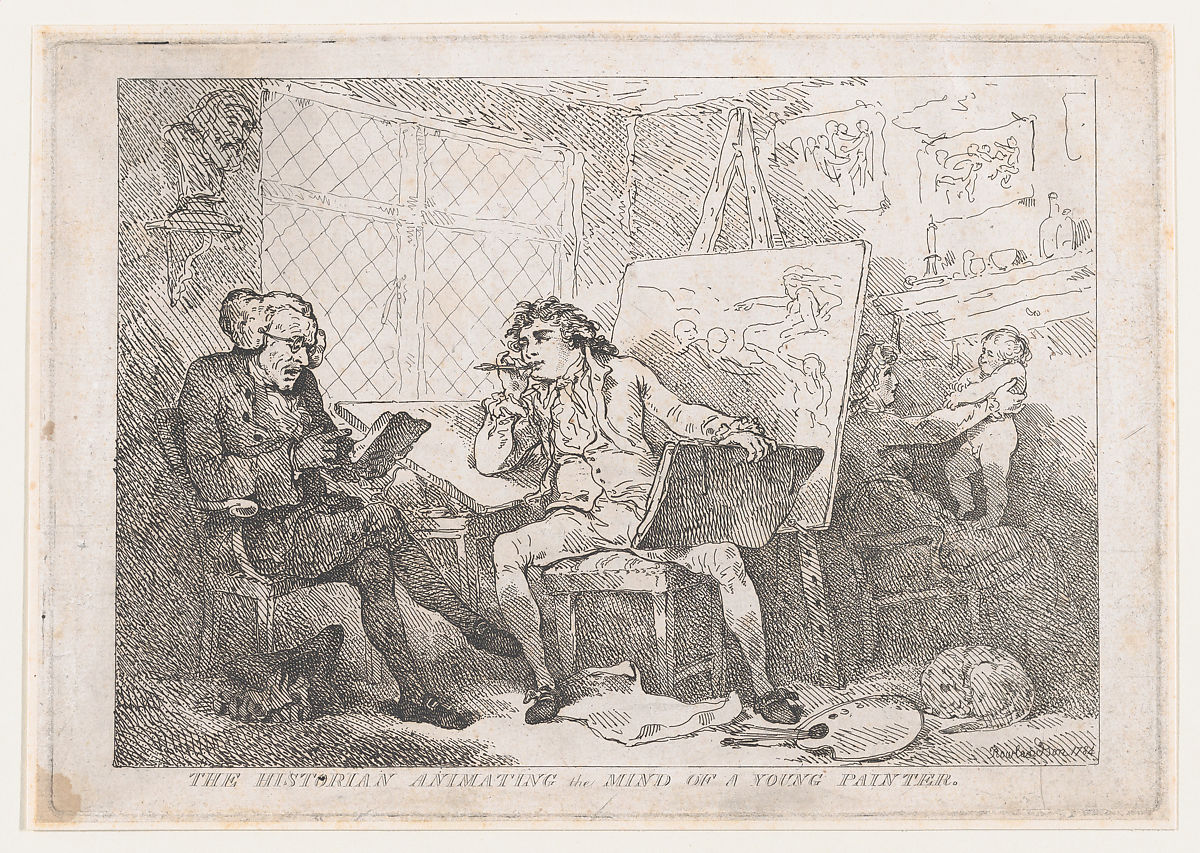
“The Historian Animating The Mind of A Young Painter” 1784 Thomas Rowlandson British
History never says “Goodbye”.
History always says “See you later”
“When Herodotus composed his great work,” Richard Cohen writes at the start of Making History: The Storytellers Who Shaped the Past, “people named it The Histories, but scholars have pointed out that the word means more accurately ‘inquiries’ or ‘researches.’ Calling it The Histories dilutes its originality.
I want to make a larger claim about those who have shaped the way we view our past—actually, who have given us our past. I believe that the wandering Greek’s investigations brought into play, 2,500 years ago, a special kind of inquiry—one that encompasses geography, ethnography, philology, genealogy, sociology, biography, anthropology, psychology, imaginative re-creation (as in the arts), and many other kinds of knowledge, too. The person who exhibits this wide-ranging curiosity should rejoice in the title: historian.”

Soundcloud Podcast: The World in Time


Western Musical Notation
Western music typically uses 12 notes – C, D, E, F, G, A and B, plus five flats and equivalent sharps in between, which are: C sharp/D flat (they’re the same note, just named differently depending on what key signature is being used), D sharp/E flat, F sharp/G flat, G sharp/A flat and A sharp/B flat.
The Western musical notation system, as we know it today, has evolved over centuries and does not have a single point of origin. Its development was a gradual process that took place in various regions of Europe over a long period of time.
The roots of Western musical notation can be traced back to the medieval era, with contributions from different cultures and regions. The use of neumes, which are early symbols used to represent musical notation, began in the Christian Church around the 9th century. These neumes indicated melodic contours but did not specify exact pitches or rhythms.
Over time, the notation system became more sophisticated. By the 11th century, the staff system was developed in Italy, which provided a way to represent pitch more precisely. Guido of Arezzo, an Italian Benedictine monk, made significant contributions to the development of musical notation during this period.
In the subsequent centuries, various enhancements and standardizations occurred, leading to the system we use today. It’s important to note that the evolution of Western musical notation was a collaborative process involving contributions from multiple cultures and regions within Europe.

Architecture and Aesthetic Education
“The most enduring architectural works are those
that speak to the timeless principles of beauty and order.”
— Roger Scruton


Relax this Saturday with some music from Sir Roger Scruton
This piece was composed by Sir Roger for his wife, Sophie. This recording was performed by Bri Ulrich, transcribed by Josh Bauder, and recorded by Emma Davis. We hope you love it as much as we dohttps://t.co/NjdkGpkn71
— Roger Scruton Legacy Foundation (@Scruton_Legacy) March 25, 2023
Class: A Guide Through the American Status System
This content is accessible to paid subscribers. To view it please enter your password below or send mike@standardsmichigan.com a request for subscription details.
What Fine Madness
This content is accessible to paid subscribers. To view it please enter your password below or send mike@standardsmichigan.com a request for subscription details.
New update alert! The 2022 update to the Trademark Assignment Dataset is now available online. Find 1.29 million trademark assignments, involving 2.28 million unique trademark properties issued by the USPTO between March 1952 and January 2023: https://t.co/njrDAbSpwB pic.twitter.com/GkAXrHoQ9T
— USPTO (@uspto) July 13, 2023
Welcome
Standards Michigan Group, LLC
2723 South State Street | Suite 150
Ann Arbor, MI 48104 USA
888-746-3670
DIRECTIONS
 |
 |
|
 |
 |
|
 |
 |
Layout mode
Predefined Skins
Custom Colors
Choose your skin color
Patterns Background
Images Background
error: Content is protected !!
Skip to content