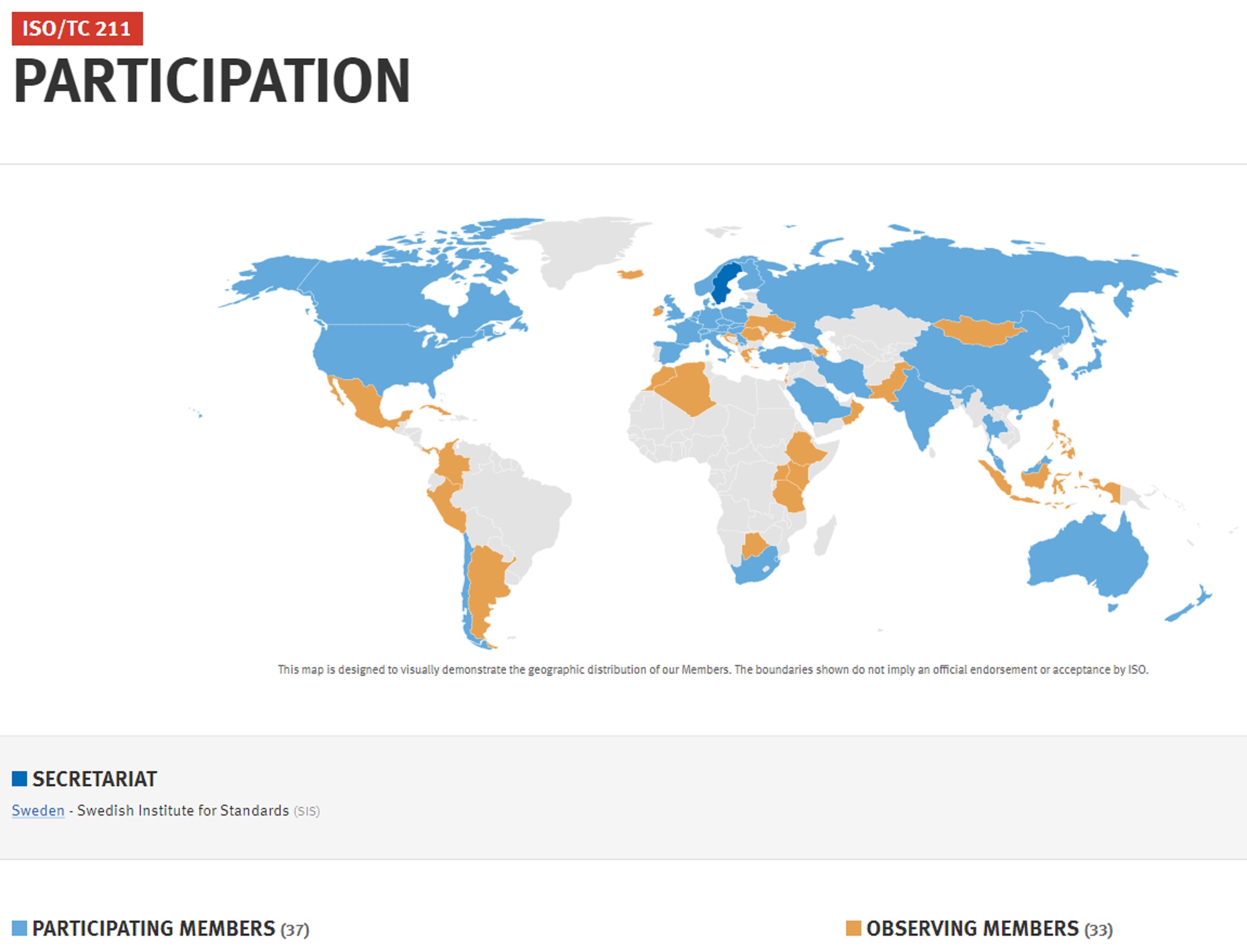
The Swedish Standards Institute for Standards is the Global Secretariat for ISO TC/211 which leads standardization in the field of digital geographic information. Standardization titles developed by this committee aims to establish a structured set of standards for information concerning objects or phenomena that are directly or indirectly associated with a location relative to the Earth. These standards may specify, for geographic information, methods, tools and services for data management (including definition and description), acquiring, processing, analyzing, accessing, presenting and transferring such data in digital / electronic form between different users, systems and locations.
We maintain all ISO projects on the standing agenda of our Global and ICT colloquia which are open to everyone. You may communicate with Jennifer Garner (jgarner@itic.org) if you wish to participate in standards-setting activity from the United States point of view. Keep in mind that our network of education communities outside the United States is significant and long-standing.
Issue: [16-141]
Category: Global, Information & Communications Technology
Colleagues: Mike Anthony, Jim Harvey, Jack Janveja, Richard Robben
This content is accessible to paid subscribers. To view it please enter your password below or send mike@standardsmichigan.com a request for subscription details.
This content is accessible to paid subscribers. To view it please enter your password below or send mike@standardsmichigan.com a request for subscription details.
— Standards Michigan (@StandardsMich) July 1, 2024
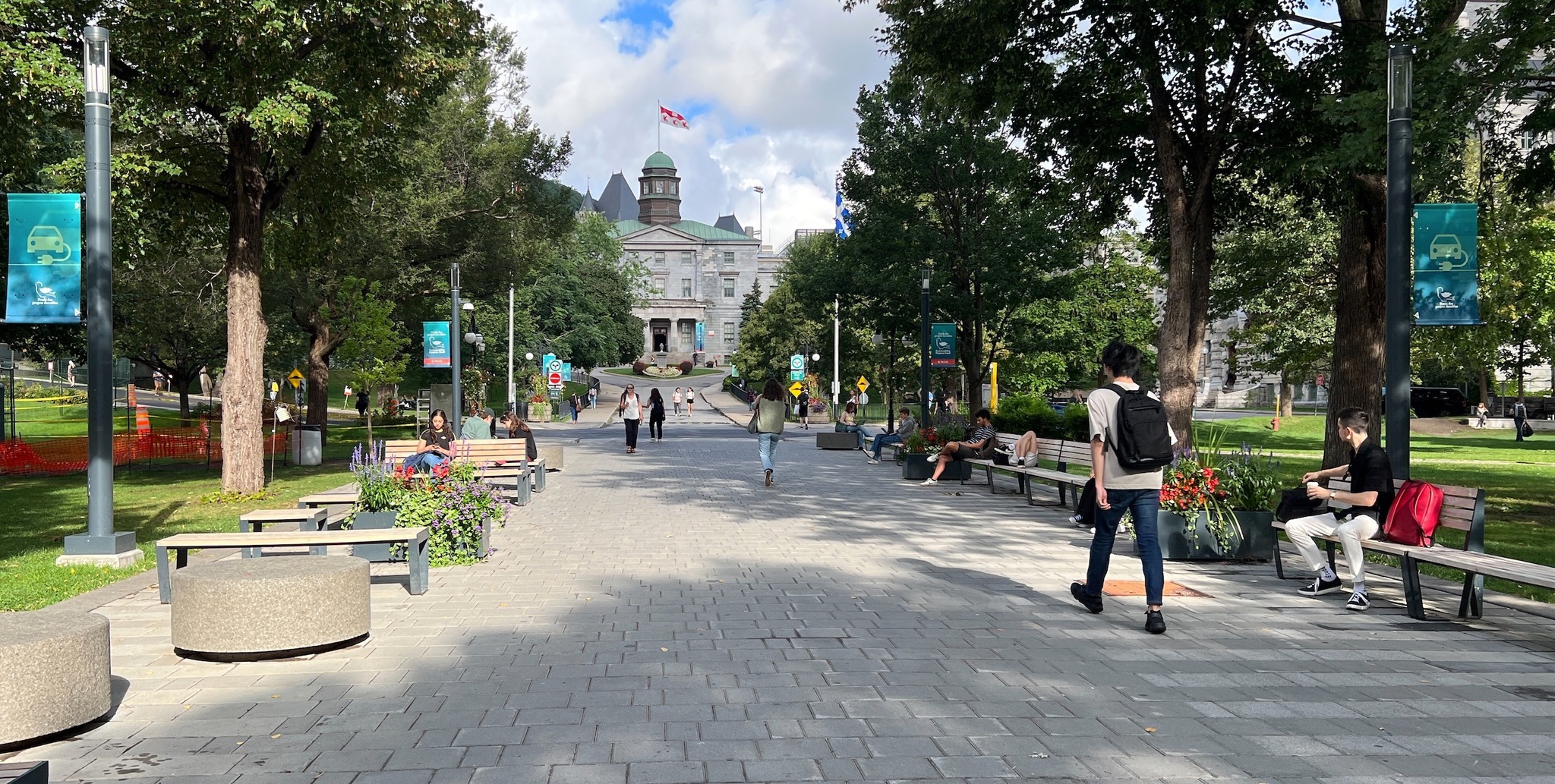
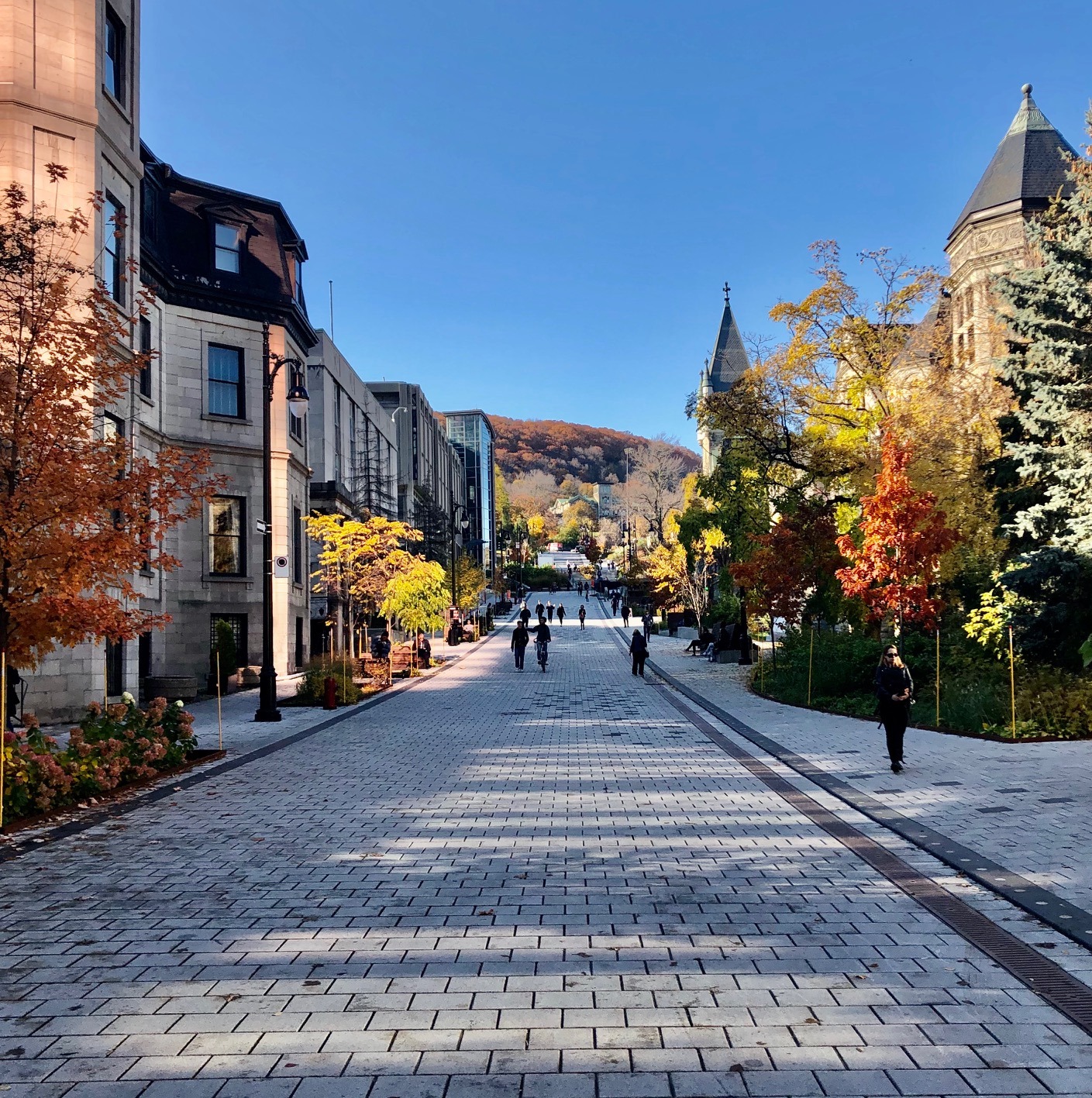
McGill figure parmi les meilleures universités du monde. 🌎 Classée 27e au palmarès 2025 du Center for World University Rankings, elle se situe dans le top 0,2 % des 21 462 établissements évalués
Public consultation on joint ISO standard 80000 that defines quantities and units for space, time, thermodynamics, light, radiation and even the characteristic numbers for each of the foregoing closes October 11th.
Come see ‘Pygmalion’ this weekend at Arno Gustin Hall on campus! University of Mary students bring this classic to life in a riveting weekend of performances. 🎬
Julia is a programming language that has gained popularity in the field of artificial intelligence (AI) and scientific computing for several reasons.
High Performance: Julia is designed to be a high-performance language, often compared to languages like C and Fortran. It achieves this performance through just-in-time (JIT) compilation, allowing it to execute code at speeds close to statically compiled languages. This makes Julia well-suited for computationally intensive AI tasks such as numerical simulations and deep learning.
Ease of Use: Julia is designed with a clean and expressive syntax that is easy to read and write. It feels similar to other high-level languages like Python, making it accessible to developers with a background in Python or other scripting languages.
Multiple Dispatch: Julia’s multiple dispatch system allows functions to be specialized on the types of all their arguments, leading to more generic and efficient code. This feature is particularly useful when dealing with complex data types and polymorphic behavior, which is common in AI and scientific computing.
Rich Ecosystem: Julia has a growing ecosystem of packages and libraries for AI and scientific computing. Libraries like Flux.jl for deep learning, MLJ.jl for machine learning, and DifferentialEquations.jl for solving differential equations make it a powerful choice for AI researchers and practitioners.
Interoperability: Julia offers excellent interoperability with other languages, such as Python, C, and Fortran. This means you can leverage existing code written in these languages and seamlessly integrate it into your Julia AI projects.
Open Source: Julia is an open-source language, which means it is freely available and has an active community of developers and users. This makes it easy to find resources, documentation, and community support for your AI projects.
Parallel and Distributed Computing: Julia has built-in support for parallel and distributed computing, making it well-suited for tasks that require scaling across multiple cores or distributed computing clusters. This is beneficial for large-scale AI projects and simulations.
Interactive Development: Julia’s REPL (Read-Eval-Print Loop) and notebook support make it an excellent choice for interactive data analysis and experimentation, which are common in AI research and development.
While Julia has many advantages for AI applications, it’s important to note that its popularity and ecosystem continue to grow, so some specialized AI libraries or tools may still be more mature in other languages like Python. Therefore, the choice of programming language should also consider the specific requirements and constraints of your AI project, as well as the availability of libraries and expertise in your development team.
ABSTRACT. Many optimization problems in power transmission networks can be formulated as polynomial problems with complex variables. A polynomial optimization problem with complex variables consists in optimizing a real-valued polynomial whose variables and coefficients are complex numbers subject to some complex polynomial equality or inequality constraints. These problems are usually directly expressed with real variables. In this work, we propose a Julia module allowing the representation of polynomial problems in their original complex formulation. This module is applied to power system optimization and its generic design enables the description of several variants of power system problems. Results for the Optimal Power Flow in Alternating Current problem and for the Preventive-Security Constrained Optimal Power Flow problem are presented.
In Irish author Jonathan Swift’s 1726 satire — “Gulliver’s Travels” — Lagado is the capital of Balnibarbi whose king had invested a great fortune on building an “Academy of Projectors” so that it shall contribute to the nation’s development through research.
Gulliver describes pointless experiments conducted there — trying to change human excretion back into food, trying to extract sunbeams out of cucumbers, teaching mathematics to pupils by writing propositions on wafers and consuming them.
“Gulliver’s Travels” 1939 Production | (Max Fleischer (1883 – 1972)
“None are so blind as those who refuse to see” is a proverbial expression that has been used by many authors and public figures throughout history. The exact origin of the phrase is unknown, but it has been attributed to various sources, including the Bible, where Jesus says, “For judgment I am come into this world, that they which see not might see; and that they which see might be made blind” (John 9:39, King James Version).
The phrase has also been attributed to Jonathan Swift, an Irish author and satirist, who wrote in his 1738 work,
“Polite Conversation”: “Blind, sir? I see every day where Lord M– goes upon the bench without his bag, and you tell me he is not blind?”.
However, it is possible that the phrase existed prior to Swift and was simply popularized by him.
New update alert! The 2022 update to the Trademark Assignment Dataset is now available online. Find 1.29 million trademark assignments, involving 2.28 million unique trademark properties issued by the USPTO between March 1952 and January 2023: https://t.co/njrDAbSpwBpic.twitter.com/GkAXrHoQ9T



_-_Nationalmuseum_-_edited.jpg)