Because so much of the #SmartCampus transformation involves electrotechnologies, we walk-through of public commenting opportunities on electrical power, telecommunication, information and communication technology standards twice per month. Coincides with the day of two IEEE Education & Healthcare Facilities Committee teleconferences at 15:00 Central European time and 3:00 PM Eastern time in the Americas.
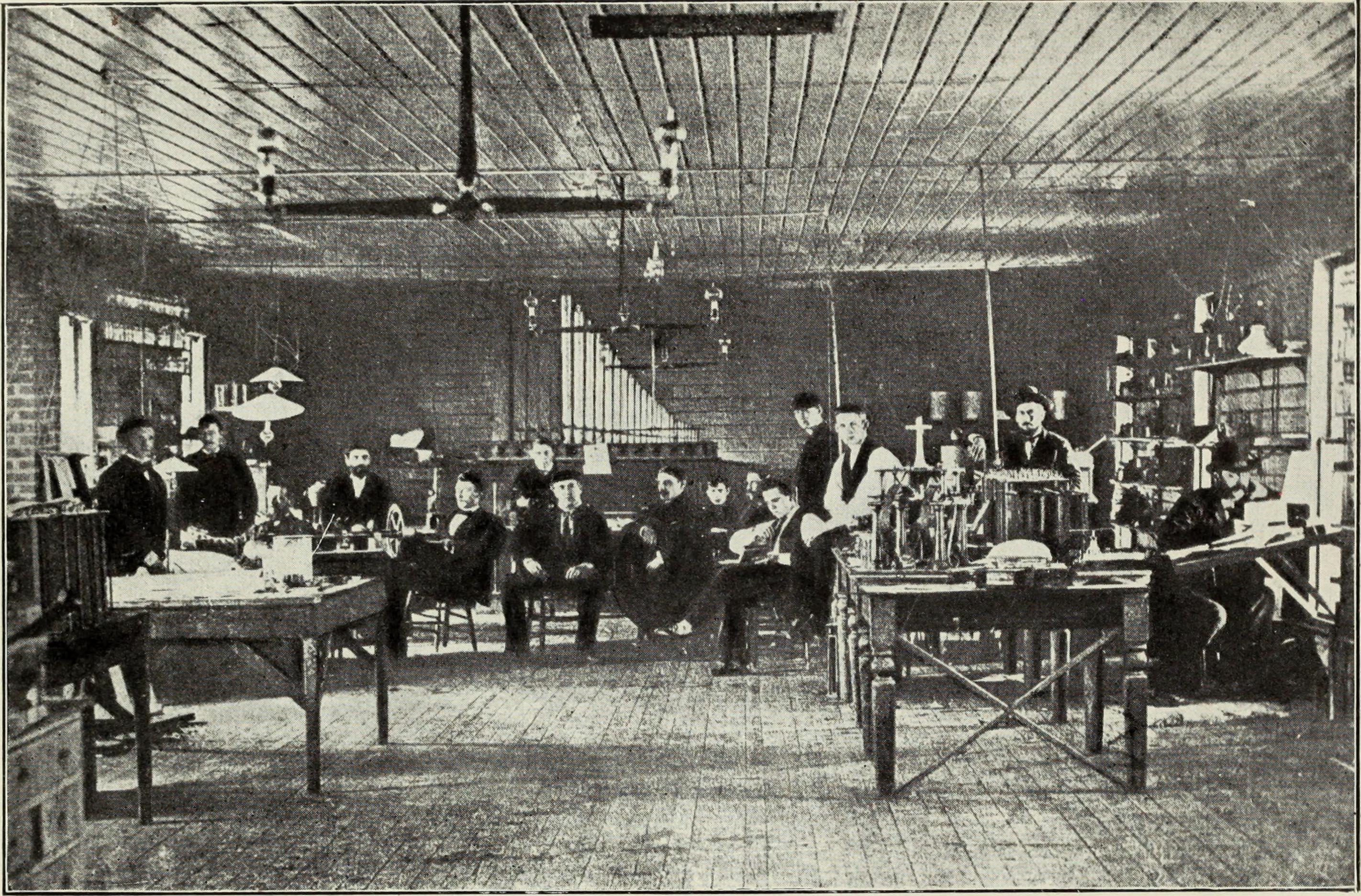
Electrical engineer/inventor Guglielmo Marconi with the spark-gap transmitter (right) and coherer receiver (left) he used in some of his first long distance radiotelegraphy transmissions during the 1890s.

Illumination technologies have had a pattern of consuming about 35 percent of building electrical energy use. That number has been pressed downward with the expanded application of LED luminaires and occupant responsive controls; much of the transformation hastened by the IEEE, IES and ASHRAE best practice catalogs.
Today we run through the development status of these products with specific interest in exterior illumination best practice. This topic also is covered in the 4 time monthly meetings of the IEEE Education & Healthcare Facilities Committee.
Overview of codes and standards relevant to the food service enterprises in K-12 schools, college and university student housing, athletic venues and university-affiliated healthcare systems.
One of the most contentious aspects of best practice discovery and promulgation in any domain, and no less so in educational settlements, is an agreed-upon vocabulary and shared understanding. As we explain elsewhere in this history, when a counter-party disagrees with you, he simply switches out the vocabulary -- i.e. changes definitions or adds or subtracts from the traditional meanings of things. So we approach this topic several times a year to confirm our bearing on the meaning of things.
We begin 2025 by breaking down this topic into four sections
Language 100: Survey of vocabulary in the standards catalogs relevant to building and managing education settlement real assets; including legal terms.
Language 200: Electrotechnology standard catalogs; including computer programming languages.
Language 300: The English as the language of science and innovation; the birthplace of computing and programming, the internet's native tongue, standardization & open source development; etc.
Language 400: Reserved
Just learned that a group of flamingos is called a flamboyance and suddenly the world seems a little brighter. pic.twitter.com/REdU2lpF26
We observe National Poetry Month in the United States and Canada every year with an inquiry into changes in the (meaning of) definitions at the foundation of best practice literature; frequently the subject of sporty debate among experts writing codes and standards for the built environment of education communities.
In the United Kingdom, National Poetry Month is celebrated in October, and it is known as "National Poetry Day" which has been observed since 1994. It is an initiative of the Forward Arts Foundation, which aims to encourage people to read, write and perform poetry.
Other countries also have their own poetry celebrations, such as World Poetry Day, which is observed annually on March 21 by UNESCO (United Nations Educational, Scientific and Cultural Organization) to promote the reading, writing, and teaching of poetry worldwide.
In past years we used a Tamil mnemonic because Tamil is the oldest surviving language and remains the spoken language of 80-odd million people of South Asia. Alas, use of Tamil confounds our Wordpress content management system so in 2024 we began coding this topic in American English
Once median household income is adjusted for cost of living, Utah emerges as the wealthiest state in the nation and Mississippi yet again ranks last. Source: https://t.co/AN3JZqtNnFpic.twitter.com/kv8U3LZlvh
Status check on open source consensus products -- and practical applications -- evolving around distributed ledger technologies for financing, planning, design, operation & maintenance of the #WiseCampus.
Review of best practice literature for the design, construction and maintenance of campus pathways for pedestrians and vehicles within buildings, between them and along the boundary between campus and the "real world".
Last night my twins had their first Homecoming dance. While we were taking photos with each of their lovely dates, I squeezed these in.
I would also like to once again say that I am 3 entire SDs above the average height for American women, you just can’t tell in family pics. 🤣 pic.twitter.com/1WWpAEpvYF
Periodic walk-through of Human Resource best practice catalog for labor markets generally; and units within the education facility industry specifically. We inform our discussion based upon periodic release on the Employment Situation Summary from the US Bureau of Labor Statistics.
The tradition of naming terms after religious feasts is rooted in medieval ecclesiastical calendars. The use of "Hilary" for this period originated in the English legal system during the Middle Ages, where the courts divided the year into four sittings: Hilary, Easter, Trinity, and Michaelmas. Universities like Oxford adopted similar naming conventions, reflecting their historical ties to the church and legal professions.
§
This naming has persisted as a tradition, even as modern calendars have standardized dates. At other UK universities (e.g., Cambridge), the equivalent January-starting term is called Lent term instead.
Alone is where the magic happens…apparently although I got so bored. This 10 mile run was the first time I’ve ran double digits since October 2021! The last two miles felt dreadful however, it’s done. I’m now going to smash a 🍕 #ukrunchat#trainingpic.twitter.com/fUP43c5yGi
Periodic walk-through of Human Resource best practice catalog for labor markets generally; and units within the education facility industry specifically. We inform our discussion based upon today's release on the Employment Situation Summary from the US Bureau of Labor Statistics.
For an advance agenda send a request to bella@stanardsmichigan.com. Use the credentials at the upper right of our home page to log in.
Alone is where the magic happens…apparently although I got so bored. This 10 mile run was the first time I’ve ran double digits since October 2021! The last two miles felt dreadful however, it’s done. I’m now going to smash a 🍕 #ukrunchat#trainingpic.twitter.com/fUP43c5yGi
August 15, 1914. The United States assumed and completed the Panama Canal after France’s 1880s attempt collapsed amid bankruptcy, disease, and engineering failure. President Theodore Roosevelt secured the route by supporting Panama’s 1903 independence from Colombia and negotiating the Hay–Bunau-Varilla Treaty, which granted the U.S. control of a 10-mile Canal Zone. America purchased French assets for $40 million and paid Panama $10 million plus an annuity.
U.S. Army engineers, led first by John Stevens and then Colonel George Goethals, abandoned a sea-level design for a lock-and-lake system. They created Gatun Lake—the world’s largest artificial lake at the time—and excavated nearly 240 million cubic yards of earth. Physician William Gorgas’s sanitation campaign virtually eliminated yellow fever and malaria, slashing the death toll that had doomed the French. At a cost of about $375 million—the most expensive U.S. construction project to that date—the canal opened on 15 August 1914, linking the Atlantic and Pacific and transforming global trade and naval strategy.