
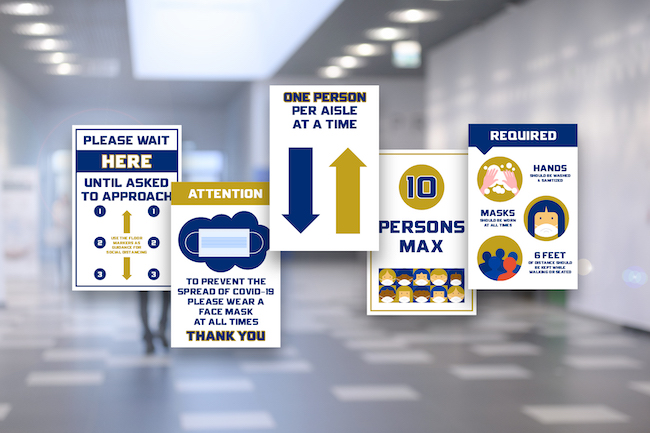
Our first impression of a community is its visual environment, which is reflected from the pretty integration of built and natural forms. College campuses are oases of beauty; or used to be were it not for sign pollution. With increase in education community construction + advances in sign-making technology + growth of the administrative state + hottened litigation environment, signage has become visual “pollution” to many and, to others, a likely permanent pandemic era cultural affinity to be controlled and told what to do.
The education industry provides a natural home for “hall monitors”; personality types with close relatives in the standards conformance and compliance community.
International students enrolling in U.S. colleges encounter Academic English — the formal register of lectures, textbooks, papers, and discussions. This variety often embeds assumptions that diverge sharply from the American Founding’s emphasis on limited government, individual liberty, natural rights, and skepticism of centralized authority.
The Founders designed a republic of enumerated powers, checks and balances, and federalism to restrain government and protect personal sovereignty. They viewed government as a necessary but dangerous servant. Deference was owed primarily to law and reason, not to elites or the state.
Modern university discourse, however, frequently frames issues through lenses that normalize expansive government. Terms like “equity,” “systemic oppression,” “social justice,” “sustainability,” and “public good” recur in required writing, readings, and class analysis. These presuppose that societal problems demand coordinated state or institutional intervention and expert guidance.
International students, often writing in a second language, must master not only grammar but also these rhetorical conventions to succeed. Essays commonly reward framing arguments around collective victimhood, institutional reform, or government solutions, while skepticism of authority or defense of limited government can be marked down.
This creates subtle acculturation. Students absorb a version of English that subtly legitimizes big government as moral progress — contrasting the Founding’s core warning: unchecked power threatens liberty. Proficiency thus includes ideological fluency in progressive norms dominant in humanities and social sciences.
In short, many international graduates internalize habits of thought prioritizing collective authority and equity over the Founders’ individualism and restraint — shaping future global elites away from the Republic’s original limited-government ethos.
How many signs are too many signs and how can leading practice discovery and promulgation among accredited standards developers contribute to solutions? It may well be that there is no other industry on earth than the American education “industry” that is so replete with signage. After Title, Scope and Purpose, and after Definitions, the topic of signage is found in a surprising number of titles and deserves a dedicated colloquium of its own.
Join us today when we sweep through the surprisingly large catalog of titles devoted to signage. Use the login credentials at the upper right of our home page.