


Presentation & Report | The 2026 Summer Energy Market and Electric Reliability Assessment
The Commission voted on a series of mostly consent agenda items focused on electric reliability, market rules, compliance, infrastructure, and related matters. Some of them are relevant to large, sometimes privatized, campus power systems:
Major initiative to accelerate large-load interconnections. The Commission’s headline action was the issuance of six “show cause” orders directing every jurisdictional RTO/ISO (except Texas/ERCOT) to justify or reform how they connect very large electric loads, particularly AI data centers. The objective is to reduce delays while protecting grid reliability and ensuring that costs are appropriately assigned.
Large customers expected to bear infrastructure costs. FERC made clear that new large loads should generally pay for the transmission and distribution upgrades needed to serve them, rather than shifting those costs onto existing retail customers. This principle is expected to influence future tariff filings nationwide
Encouragement of customer-owned generation. The Commission encouraged tariff structures that would allow large customers to supply some or all of their own electricity—such as on-site generation, microgrids, or other behind-the-meter resources—to reduce impacts on the bulk power system.
MISO emergency demand-resource improvements. The Commission conditionally accepted tariff revisions from MISO that improve the visibility, dispatch, and operation of demand-side resources during grid emergencies beginning with the 2028–2029 planning year. This strengthens reliability during extreme system conditions.
A clear policy shift toward speed-to-power. The June meeting signaled perhaps the strongest policy emphasis in years on rapidly connecting new electric demand while maintaining reliability. The Commission characterized the integration of very large loads—especially AI-related facilities—as a national priority and indicated that existing interconnection practices may no longer be adequate
For universities, research campuses, hospitals, semiconductor manufacturers, and data center developers, the June 2026 meeting represents a significant shift in federal policy. Rather than treating large-load requests as exceptional cases, FERC is moving toward standardized, faster interconnection procedures coupled with clearer cost-allocation rules. Institutions planning major campus expansions or new energy-intensive facilities should monitor the forthcoming tariff revisions from their regional transmission organizations, as these changes could substantially affect project schedules, interconnection costs, and opportunities to incorporate on-site generation or microgrids.
Power transformers and distribution transformers will face supply deficits of 30% and 10% in 2025
March 19, 2026
Key Reliability & Cybersecurity Actions. FERC approved important updates to Critical Infrastructure Protection (CIP) Reliability Standards. These included modernized rules for virtualization (allowing secure use of virtual machines), enhanced security management controls for low-impact cyber systems (CIP-003-11), and refinements to the definition of “control center” to better protect high-risk assets. The changes aim to strengthen the bulk-power system against rising cyber threats and extreme weather while reducing unnecessary administrative burdens.
Electric Rate and Complaint Resolutions. The Commission resolved several long-running rate complaints, including setting a base return on equity (ROE) of 9.57% for New England Transmission Owners. It addressed complaints involving spot market sales exceeding price caps in the WECC region and cost allocation issues in MISO related to DOE emergency orders. Several tariff revisions and generator interconnection filings were also accepted.
Other Actions. FERC modernized Electric Quarterly Report (EQR) filing requirements, authorized multiple asset transactions and dispositions, and approved several natural gas pipeline, storage, and abandonment projects. A presentation on the 2025 State of the Markets Report was also delivered.
FERC’s involvement in CHP plants at universities and hospitals depends on and how the facility interacts with the bulk electric power system and wholesale markets. In many cases, FERC’s role is indirect—but it can become significant under certain conditions. We cover this topic separately in our periodic US Department of Energy Combined Heat & Power eCATALOG
Next Open Meeting: May 21. Keep in mind that much “bandwidth” is devoted to administrative issues; the technical specifics of primary interest to us referenced in case dockets that are referenced here: FERC Online
December 18. The public meetings are dominated by administrative procedures and mutual admiration. Technical issues that require in-depth, expert-level understanding of complex laws, rules, guidelines, and precedents beyond surface-level awareness appear deeper into the FERC website. There you will generally find:
- Nuanced interpretation of statutes and agency decisions
- Awareness of historical context and evolving policies
- Insight into how rules interact with technical, economic, and operational realities
- Impacts of changes and navigate compliance strategically
As interest and time allows we can pick through technical specifics regarding FERC oversight of interstate electricity with the IEEE colleagues.
Ω
Ω
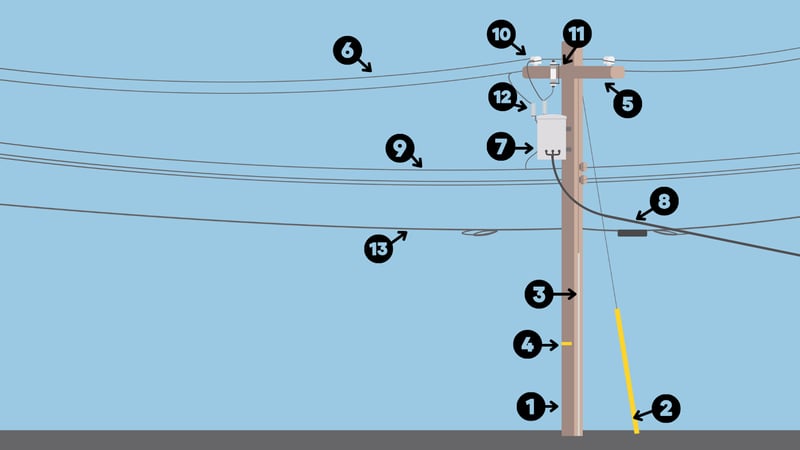
Midwest Energy Communications: What’s On a Utility Pole?





