


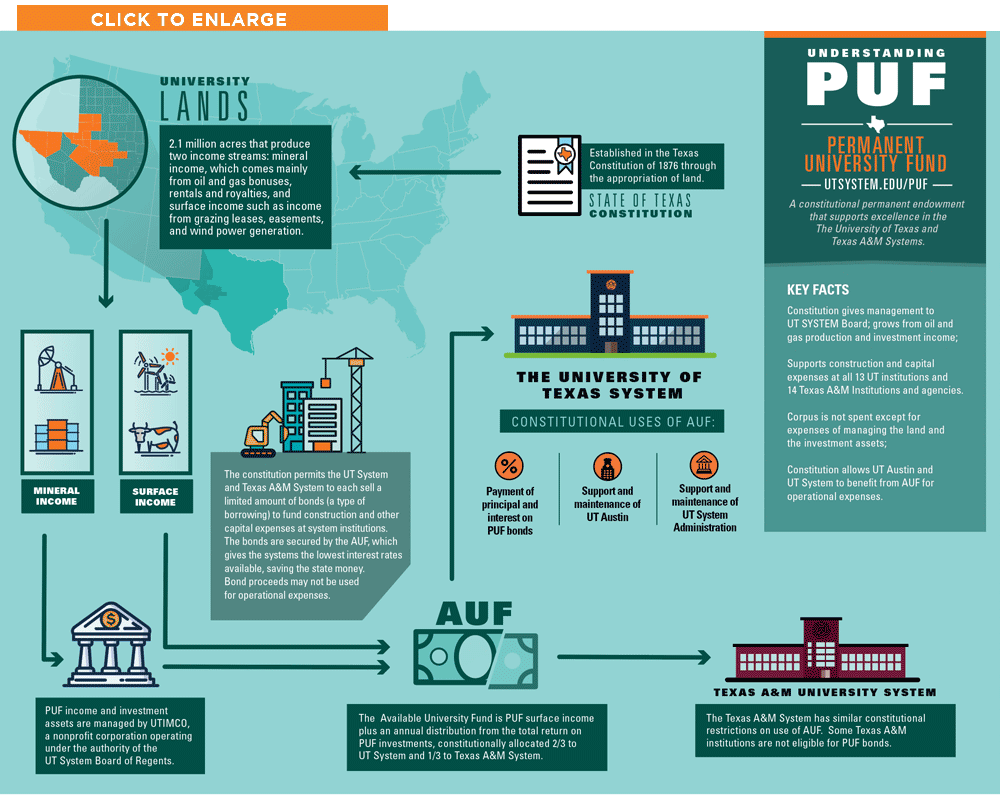
The Permanent University Fund is Texas’s most powerful tool for higher education capitalization. Established by the Texas Constitution of 1876, the PUF dedicates 2.1 million acres of state land—primarily in West Texas—to support institutions in the University of Texas and Texas A&M University systems. Its core purpose is to provide a stable, perpetual source of funding for academic excellence, research, faculty recruitment, student programs, and campus infrastructure without relying solely on taxpayer dollars.
Early land grants proved largely unproductive until the 1923 discovery of oil at the Santa Rita No. 1 well on university land in Reagan County. Mineral royalties were constitutionally protected as principal, allowing the fund to grow rapidly rather than being spent immediately. By the 1930s, the PUF generated significant income. A constitutional split allocated two-thirds of available funds to the UT System and one-third to the Texas A&M System. Over decades, prudent investment and resource revenues transformed the endowment into a major financial pillar for public higher education.
As of early 2026, the PUF’s invested assets exceed $42.5 billion, managed by UTIMCO. Mineral income from oil, gas, and other leases adds to the principal, while surface leases (grazing, wind) and investment returns flow into the Available University Fund (AUF). Annual distributions—typically around 5% and capped at 7% of market value—support bond debt service for construction and enrich academic programs across dozens of campuses serving hundreds of thousands of students. The PUF remains one of the largest public university endowments in the nation, safeguarding Texas’s competitive edge in higher education for generations to come.

Conroe Texas Post Office Mural c. 1937





