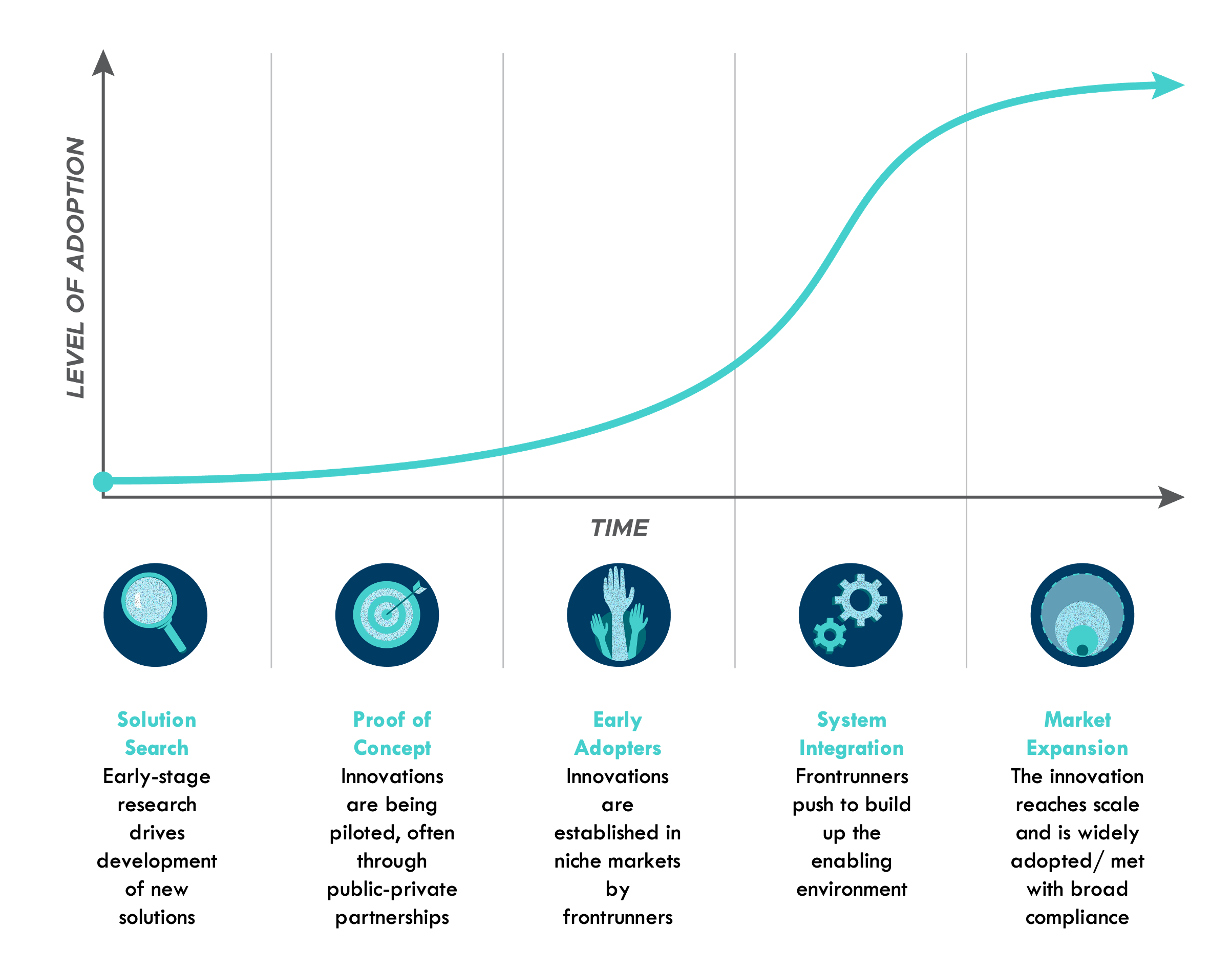
Electrotechnologies typically begin at the lower end of the Innovation S-Curve, where electrical engineers, scientists, and university researchers demonstrate that new ideas are technically possible. During this formative stage, experimentation is encouraged and regulation is intentionally limited so that promising technologies can mature through research, testing, and practical experience.
As innovation accelerates, the technology enters its rapid growth phase. Performance improves, costs decline, and commercial markets emerge. Engineers remain the principal innovators, but manufacturers, contractors, testing laboratories, insurers, and standards development organizations—including IEEE, NFPA, IEC, ASHRAE, and UL—become increasingly important. Consensus standards establish common technical expectations for safety, interoperability, and reliability while allowing manufacturers to continue improving products through competition and innovation.
Once a technology becomes widely deployed throughout schools, universities, hospitals, industries, utilities, and public infrastructure, the focus naturally shifts from invention to governance. Legislatures adopt technical standards into law, regulatory agencies oversee compliance, courts resolve disputes, and attorneys interpret statutory and contractual responsibilities. Building officials, utility commissions, insurers, and government agencies increasingly shape how mature technologies are installed, maintained, and operated.
This progression does not represent engineering yielding to law. Rather, it reflects the normal evolution of successful technology. Engineers create innovation, standards organizations transform engineering knowledge into broadly accepted practice, and legal institutions provide the predictability and public confidence necessary for technologies that have become indispensable to modern society.
The enduring challenge is maintaining the proper balance between innovation and oversight. Excessive regulation can delay technological progress, while insufficient governance can compromise safety and public trust. The most successful electrotechnologies therefore complete the Innovation S-Curve by combining engineering excellence with consensus standards, prudent regulation, and a continuing commitment to the public welfare.