Category Archives: Coffee

Loading
loading...

Texas Coffee School

Standards Texas

Texas Building Codes

Opening and operating a small coffee shop in Texas requires adherence to various codes and standards to ensure safety, legality, and quality service.  Students get a front row view of the competing requirements of safety and economy even before the cafe atmospheric and economic viability make their passion a going concern.

1. Business Licenses and Permits:

  • Business License: Obtain a general business license from your local city or county authority. Requirements and fees vary by location.
  • Certificate of Occupancy: This certifies that your building complies with zoning laws and is safe for occupancy. It’s typically issued after necessary inspections.
  • Food Handler’s License: All employees involved in food preparation or service must obtain this certification within 60 days of employment.
  • Seller’s Permit: Required for businesses selling tangible goods subject to sales tax. You can register for this permit through the Texas Comptroller’s Office.

2. Health and Safety Regulations:

  • Texas Food Establishment Rules: These rules outline standards for food safety, including employee hygiene, equipment sanitation, and food handling procedures.
  • County and City Health Department Regulations

3. Building and Construction Codes:

  • Building Codes: Ensure compliance with local building codes, which cover structural integrity, electrical systems, plumbing, and fire safety.
  • Zoning Regulations: Verify that your chosen location is zoned appropriately for a food establishment.
  • Accessibility Standards: Adhere to the Americans with Disabilities Act requirements to ensure your facility is accessible to all patrons.

4. Additional Considerations:

  • Signage Permits: Obtain permits for exterior signs, as many municipalities have regulations governing signage size, lighting, and placement.
  • Waste Disposal: Comply with local ordinances regarding waste management, including grease disposal and recycling.
  • Insurance: While not a code or standard, securing appropriate insurance (e.g., general liability, property, and workers’ compensation) is crucial for protecting your business.

There’s enough “content” in the foregoing list of considerations to meet the requirement for an Associates Degree at any community college.

Starting and running a privately held coffee shop within a building located in the campus proper — think the franchise chains like Starbucks — is another layer of complexity in our session on Joint Use Agreements.

Temple of Zeus

Consolidated Financial Statements – June 2024: Net Position $19.548B (Page 4)

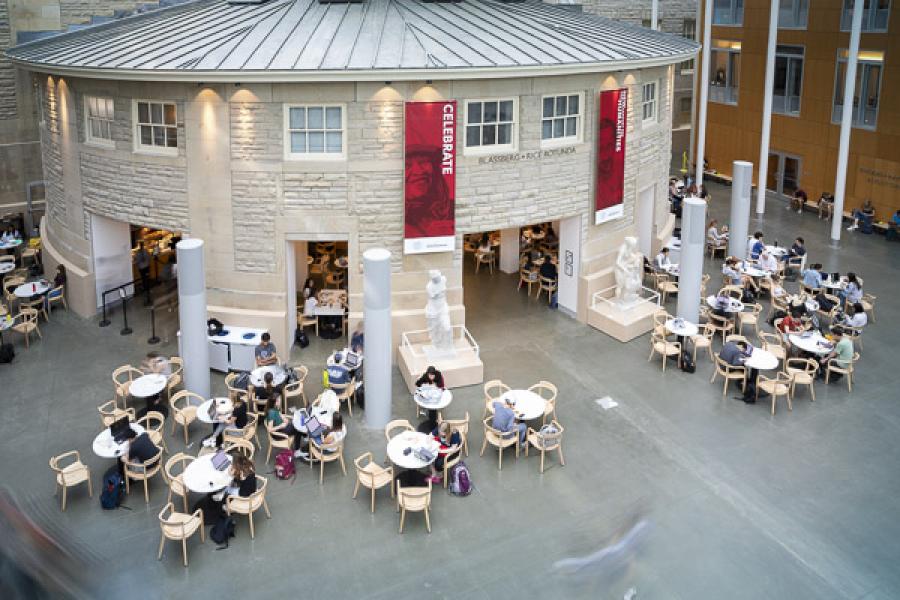
The Temple of Zeus is a popular café located in the Groos Family Atrium of Klarman Hall at Cornell University in Ithaca, New York. Established in 1964, it began as a modest coffee and donut operation in a basement storage room in Goldwin Smith Hall, designed as a neutral space for students and faculty to meet. The café’s name comes from plaster casts of statues from the Temple of Zeus in Olympia, purchased by Andrew Dickson White in 1881, some of which still decorate the Arts & Sciences Career Development Center and Klarman Hall atrium.

Since moving to Klarman Hall in 2016, the café has grown significantly, serving nearly 900 customers daily. It offers a menu focused on healthy, locally sourced food, including creative soups (like Choklay’s Lentil, Tomato Garlic, and Curried Cauliflower), made-to-order sandwiches, salads, and baked goods. Beverages include locally roasted Copper Horse Coffee and Gimme Coffee, with a discount for bringing your own mug. The café is known for its vegetarian and vegan options, yogurt from Ithaca Milk, and seasonal fruit from local growers.

The current space is bright and spacious with 170 seats, a stark contrast to its original dingy basement setting with recycled Navy ROTC furniture. It’s a vibrant hub for students and faculty, fostering a communal atmosphere. The café employs four full-time staff, two student managers, and 50 student workers, and is managed by Keith Mercovich, who emphasizes high-quality, healthy food. It operates Monday through Friday, 8:00 AM to 3:00 PM, and is closed on weekends.

Historically, it was a gathering spot for notable faculty like Archie Ammons and Roald Hoffmann, and it remains a cherished part of Cornell’s campus culture, with a 2017 petition ensuring its name remained unchanged despite rumors of a potential rename. The café also faced a temporary closure in 2020 but reopened with a simplified menu focusing on classics like soups and scones.

Drip, espresso, americano, latte…

This content is accessible to paid subscribers. To view it please enter your password below or send mike@standardsmichigan.com a request for subscription details.

Friday Morning Coffee

This content is accessible to paid subscribers. To view it please enter your password below or send mike@standardsmichigan.com a request for subscription details.

Cafe Prego

Lunds universitet Bokslut 2023 § Lunds universitet 1580’s

Department of Archaeology and Ancient History

Blåbärssoppa


The Science and Technology of Ready-to-Drink Coffee

Chapman University Net Position 2024: $2.279B  | Orange County Building Codes and Regulations

Chapman University in Collaboration with the CA Dairy Innovation Center Presents:

Chapman University’s 90-acre campus in Orange, California, blends historic charm with modern innovation, reflecting a design philosophy of accessibility, beauty, and community. The campus, set in the historic Old Towne Orange district, features a mix of Classical Revival and contemporary architecture. Key historic buildings, originally part of Orange Union High School, include Wilkinson Hall (1905), Reeves Hall (1913), Smith Hall (1913), and Memorial Hall (1921), all listed on the National Register of Historic Places. These structures, designed by architects like C.B. Bradshaw and Frederick Eley, showcase symmetry and classical elements, with Memorial Hall’s 1,000-seat auditorium being a standout.

The Keck Center for Science and Engineering (2018), inspired by Frank Lloyd Wright, spans 140,000 square feet with 45 labs and an outdoor amphitheater. The Sandi Simon Center for Dance (2023) and Musco Center for the Arts (2016), with acoustics by Yasuhisa Toyota, have earned architectural awards. Doti Hall (2013) integrates seamlessly with historic structures around Bert Williams Mall, enhancing the campus’s cohesive aesthetic.

Infrastructure supports a vibrant student life, with 175+ student organizations and a 12:1 student-to-faculty ratio. The campus offers 24-hour security, modern dorms, and dining facilities, though weekend dining hours draw some criticism. Recent expansions, like the Fowler School of Engineering’s Swenson Family Hall, and planned updates to the Specific Plan, including increased enrollment and housing, ensure Chapman remains a dynamic, student-focused environment

Dodge College of Film & Media Arts

East Village Café

“The aroma of coffee is the scent of civilization.”
The Spectator, No. 91


Gingerbread Latte & Mince Pie

GOV.UK University Design Forum 


Charles Hansom Architect

Instant Coffee & Meals Ready to Eat

“Company A, 93rd New York Volunteers” | 1863 Winslow Homer

The History of Instant Coffee

Instant coffee is a staple in many people’s lives. Whenever you need a quick pick me up without having to go through the struggle of making an entire cup of coffee from scratch, instant coffee is there and ready. The earliest version of instant coffee was invented in the 18th century in Britain. It was called a “coffee compound” and was patented by the British government. In the United States, instant coffee was developed in 1853. It was tested during the Civil War in cake form, but instant coffee didn’t really take off until later. In 1901, Dr. Satori Kato was able to manufacture a stable powdered coffee, using a process he developed for making instant tea. In 1909, George Constant Louis Washington was able to get a patent and start the mass production of instant coffee, though the coffee was a novelty, it didn’t taste great.

Even though the coffee didn’t taste great, that didn’t stop it from being a staple among soldiers. The coffee got popular, and the mass production really blew up during World War 1. Caffeine provided the boost that soldiers needed while they were away at war and getting ready for battle. Instant coffee made getting that boost easy for soldiers and even after the war was over, still wanted the same instant coffee. Among some soldiers it was nicknamed, “cup of George.”

Instant coffee for the military was a large profitable market that G. Washington Coffee, Nescafe, and others had capitalized on. From 1939 to 1945, during World War 2, Nescafe and other brands of instant coffee supplied large quantities to the military. During one year of the war the U.S. military bought more than one million cases of Nescafe, which was their entire annual output of Nestle’s U.S. plant.

Nescafe became the most popular brand of instant coffee and was able to grow in popularity very quickly because of their new method of creating instant coffee. Around 1938, by co-drying coffee extract along with an equal amount of soluble carbohydrate they improved the taste. This made it better than the G. Washington Coffee because it was much more enjoyable.

There are two basic methods for producing instant coffee, freeze-drying and spray-drying. In freeze-drying, the coffee extract is frozen to about – 40°C and cut into granules. The frozen granules are then dried at low temperature and under vacuum. The quality of the aroma and flavor are protected by the very low temperature and gentle drying conditions. For spray-drying, in spray-drying the coffee extract is sprayed into a stream of hot air at the top of a tall cylindrical tower. As the droplets fall, they dry, becoming a fine powder by the time they reach the bottom. The powder may then be texturized into granules to facilitate dosage and dissolution. The quality of the aroma and flavor are preserved thanks to the very fast drying occurring during this process.

There are loads of instant coffee brands that people can choose from. Nescafé, Starbucks VIA, Maxwell House, Folgers, Robert Timms, International Roast, and Kava are a couple of popular brands, but there’s a bunch more at the grocery store. It’s all about finding which one you enjoy the most and then you’re able to have coffee whenever you need it.

Why did the Free City State Disappear?

Related:

Spoon University: My Case for Instant Coffee

“The Coffee Bearer” 1857 John Frederick Lewis

Iced Pistachio Latte

This content is accessible to paid subscribers. To view it please enter your password below or send mike@standardsmichigan.com a request for subscription details.

The Brew

This content is accessible to paid subscribers. To view it please enter your password below or send mike@standardsmichigan.com a request for subscription details.

Layout mode
Predefined Skins
Custom Colors
Choose your skin color
Patterns Background
Images Background
Standards Michigan
error: Content is protected !!
Skip to content