QWERTY: This is the most common keyboard layout used in English-speaking countries. The name “QWERTY” comes from the first six letters on the top row of keys. This layout was originally designed to prevent typewriter keys from jamming by placing commonly used keys further apart.
AZERTY: This is a keyboard layout used primarily in French-speaking countries. The letters are arranged differently from QWERTY, with the A and Z keys switched, and some additional special characters included.
QWERTZ: This is a keyboard layout used primarily in German-speaking countries. It is similar to QWERTY, but with some letters rearranged and some additional special characters included.
Dvorak Simplified Keyboard: This is an alternative keyboard layout designed to increase typing speed and efficiency. It places the most commonly used letters in the home row, and the least used letters on the outer edges of the keyboard.
Colemak: This is another alternative keyboard layout designed for increased typing efficiency. It also places the most commonly used letters in the home row, but has a slightly different arrangement than Dvorak.
Unicode: This is a standard for encoding characters from a wide range of writing systems, including Latin, Cyrillic, Arabic, and Chinese, among others. It allows for the input and display of text in multiple languages and scripts on the same keyboard.
This content is accessible to paid subscribers. To view it please enter your password below or send mike@standardsmichigan.com a request for subscription details.
This content is accessible to paid subscribers. To view it please enter your password below or send mike@standardsmichigan.com a request for subscription details.
Requiem, Op. 9: Duruflé’s “Requiem” is his most renowned composition. It incorporates the Gregorian Chant melodies for the “Dies Irae” and “In Paradisum” sections. While not hymns in the traditional sense, these chants are significant components of the Catholic liturgy.
Four Motets on Gregorian Themes, Op. 10: In this choral composition, Duruflé takes inspiration from Gregorian Chant and includes pieces such as “Ubi caritas et amor” and “Tota pulchra es.” These are not hymns but rather choral settings of Latin liturgical texts.
Fugue on the Theme of the “Carillon des Heures de la Cathédrale de Soissons”: This composition for organ is based on a hymn-like theme, although it is not a hymn in the traditional sense. It showcases Duruflé’s skill as an organist and composer.
Prelude on the Introit of the Epiphany (for organ): Duruflé composed this piece for organ, incorporating the Gregorian Chant “O Lux Beata Trinitas,” which is associated with the Epiphany in the liturgical calendar.
We do not advocate in this standard but we track it along with about 20 of the 21,000 ISO standards. We mention it now because in tracking live public consultation notices we see opportunities that may interest other parts of the education industry — notably academic units and business schools; as well as the many technology transfer units in many research universities charged with generating licensing revenue. The landing page for the US TAG is linked below:
You are encouraged to communicate directly with Dr. Brett Trusko, President and CEO, International Association of Innovation Professionals, 4422 Castlewood Street, Suite 200, Sugar Land, TX 77479; phone: 925.858.0905; e-mail: brett@iaoip.org. We also refer this standard to the standing agenda of our Global and Human Resource teleconferences. See our CALENDAR for the next online meeting; open to everyone.
Issue: [17-303]
Category: Academics, International
Contact: Mike Anthony (mike@standardsmichigan.com), Christine Fischer (chrisfis@umich.edu)
Recent communication from International Association of Innovation Professionals (IAOIP) indicates that it continues to welcome participation from the US education industry. There are many academic programs and faculty devoted to international studies and innovation that could offer students a front-row seat for the development of international technology policy.
We are happy to explain the opportunity to faculty and staff any day during our daily 11 AM online meetings. You may also communicate directly with Dr. Brett Trusko, President and CEO, International Association of Innovation Professionals, 4422 Castlewood Street, Suite 200, Sugar Land, TX 77479; phone: 925.858.0905; e-mail: brett@iaoip.org
The education industry — notably the academic segment of the higher education industry — is notably absent in US leadership positions in international standards. We have been in this space as a user interest for a long time (See ABOUT) and the shortage of education industry engagement (especially the user-interest) has not gone is unnoticed or written about.* While the majority of the 1800-odd colleges and universities have academic programs that claim leadership in international and/or innovation studies, only Georgia Tech and the University of Texas Medical Branch are US TAG administrators for the American National Standards Institute; the US member body to the Geneva Secretariats.
Université de Genève
Comments are due May 14th. To obtain a copy of the TAG application or to offer comments, please contact: Dr. Brett Trusko, President and CEO, International Association of Innovation Professionals, 4422 Castlewood Street, Suite 200, Sugar Land, TX 77479; phone: 925.858.0905; e-mail: brett@iaoip.org by May 14, 2018 (please copy jthompso@ansi.org).
Issue: [17-303]
Category: Academics, International
Contact: Mike Anthony (mike@standardsmichigan.com), Christine Fischer (chrisfis@umich.edu)
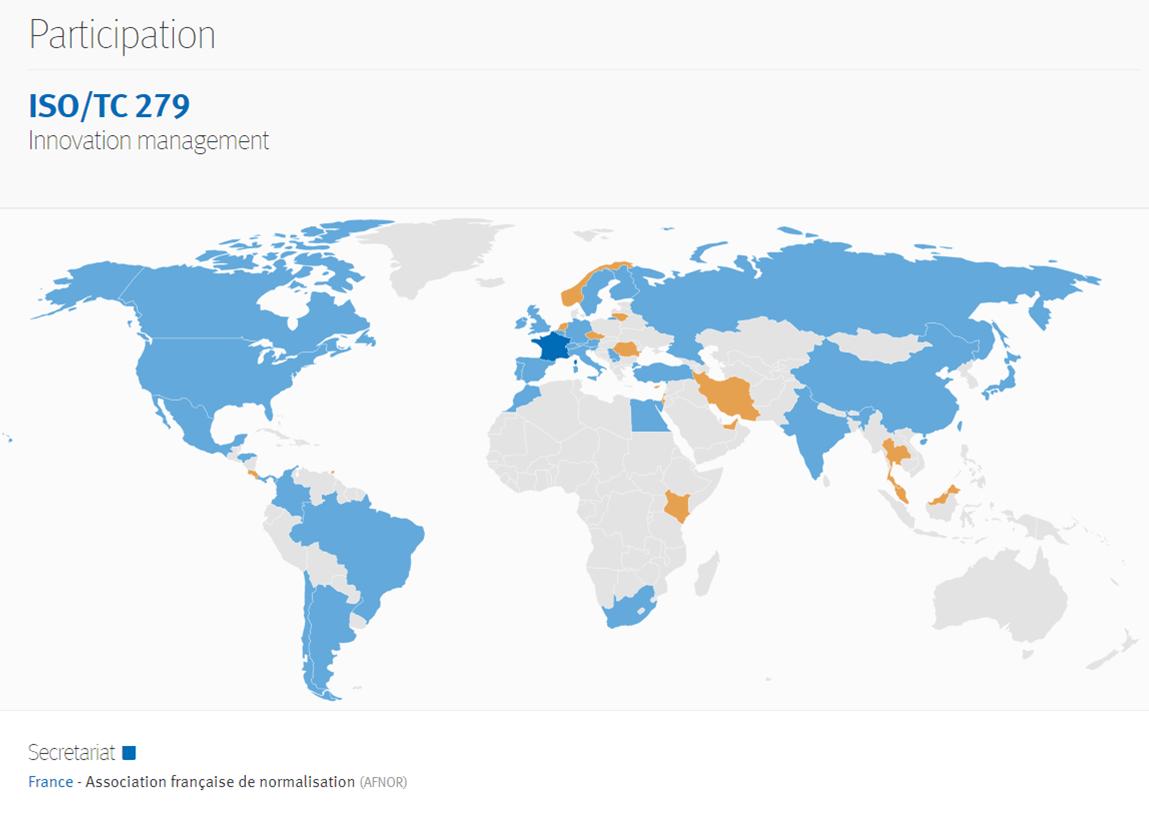
The American National Standards Institute (ANSI) has been informed that the American Society for Quality (ASQ), the current ANSI-accredited U.S. Technical Advisory Group Administrator (U.S. TAG) for the work of Technical Committee 279 of the International Organization for Standardization wishes to relinquish their role as U.S. TAG Administrator. The global Secretariat for TC 279 is the AFNOR Group — the national standardization body for France. The participating nations are shown in the map below:
(Click on Image for more information)
ISO/TC 279 operates under the following scope: Standardization of terminology tools and methods and interactions between relevant parties to enable innovation. From its Executive Summary:
“Yes we can innovate through standardisation. Standardization does not mean cloning. Standards on innovation management will allow organisations to share their best practices in innovation management. This will facilitate collaboration and also develop the capability to innovate and to bring innovations successfully to market. Today we face new challenges never met before by mankind: guaranteeing the sustainability of our activities in keeping our Earth habitable. Sustainable development (economic, ecologic, social sustainability) cannot be considered as ‘nice to have’, it is essential. It has to be viewed as a source of innovations, economic development and competiveness. It impacts innovation management and has to be taken into account at an early stage. Innovation is a key to global competitiveness and human or technological progress over the coming decades. Management Standards on innovation will break down the existing cultural, structural or organisational obstacles among/between organisations. These standards will provide best practices to support implementation of innovation policies as well in Small to Medium Enterprises (SMEs) as in worldwide groups including public institutions, universities, research centres or non-profit organisations. (Note in ISO, SME can mean Subject Matter Expert)
To achieve this goal the work will focus on a management system for innovation. To define this management system, experts will address: terminology, tools and methods such as but not limited to open innovation, design innovation, strategic intelligence, creativity management and also self-assessment of innovation management. Expectations for these standards are so high that there is no time to reinvent the wheel. TC 279 has to benefit from the previous work, including existing innovation literature, existing innovation standards, case studies, academic works, reports…) Summoning up the innovation community is a key factor. To make more and more stakeholders aware of this initiative communications action (communication kits, presence on social networks, press releases, events…) needs a special care.”
Organizations interested in serving as the U.S. TAG Administrator or participating on a U.S. TAG should contact ANSI’s ISO Team (isot@ansi.org)
Issue: [17-303]
Category: Academics, International
Contact: Mike Anthony (mike@standardsmichigan.com), Christine Fischer (chrisfis@umich.edu)
Université de Toulouse, Laplace, UMR 5213 (CNRS, INPT, UPS), 118 rte de Narbonne, Toulouse, France
Abstract: With the advent of Solid State Lighting came a renewed interest in the study of flicker. Potential effects include brightness enhancement, but also discomfort, ocular fatigue, phantom and stroboscopic effects. Both IEEE and IEC developed new metrics, but at the time of writing no firm consensus has been reached. Yet previous lamp studies in the Laplace laboratory showed that various flicker phenomenon are present on different lamps, but this feature is not documented. This paper focus on flicker changes w.r.t. applied voltage. The Indonesian power grid network is indeed characterized by large voltage variations; our purpose is to detect which lamps may exhibit too elevated flicker levels during out of nominal excursion and map such behavior with other electrical characteristics.
This content is accessible to paid subscribers. To view it please enter your password below or send mike@standardsmichigan.com a request for subscription details.
This content is accessible to paid subscribers. To view it please enter your password below or send mike@standardsmichigan.com a request for subscription details.
New update alert! The 2022 update to the Trademark Assignment Dataset is now available online. Find 1.29 million trademark assignments, involving 2.28 million unique trademark properties issued by the USPTO between March 1952 and January 2023: https://t.co/njrDAbSpwBpic.twitter.com/GkAXrHoQ9T