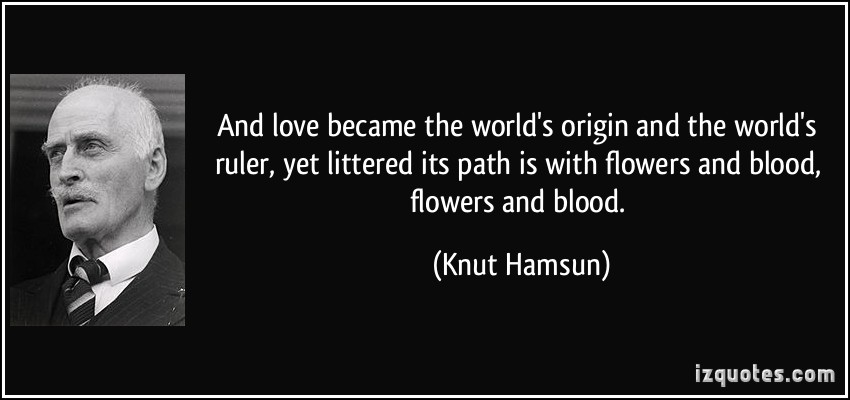
In Lutheran memorial the traditional hymn does not treat death as defeat or a meritorious climb, but as the last stage of God’s gracious drawing. Its quiet, stepwise melody and repeated refrain make it especially suited to funerals: a humble prayer of trust rather than triumphant victory, ending in the hope of being “hjemme hos deg.”
“Architectural Landscape with a Canal” 1783 / Hubert Robert
The construction industry is one of the largest employers in any community. Many labor unions in the United States support construction of education facilities. The so-called “multiplier effect” cited by economists means that when you add one person working in the construction industry you create two additional jobs in other sectors. With an annual construction spend of $75-10 billion, the education industry contributions mightily to the economy of host communities. Any spend at that rate — the largest non-residential building construction in the United States — presents opportunity higher effectiveness and better profitability for all sides involved in a construction project just by doing a few simple things well:
Provide general terminology; especially important when equipment (fenestration, environmental air systems, elevators, generators) originate from offshore manufacturers Organization of information in the processes of design, manufacture and construction
Provide geometric requirements for buildings, building elements and components including modular coordination and its basic principles, general rules for joints, tolerances and fits, performance and test standards for sealants;
Provide general rules for other performance requirements, including functional and user requirements related to service life, sustainability, accessibility and usability; Procurement processes, methods and procedures.
A paradigm shift is is well underway in the use of building information. Improved capital efficiency can be achieved with better data handling and information flows between project actors; falling into the wheelhouse of ISO TC 59; described in the links below:
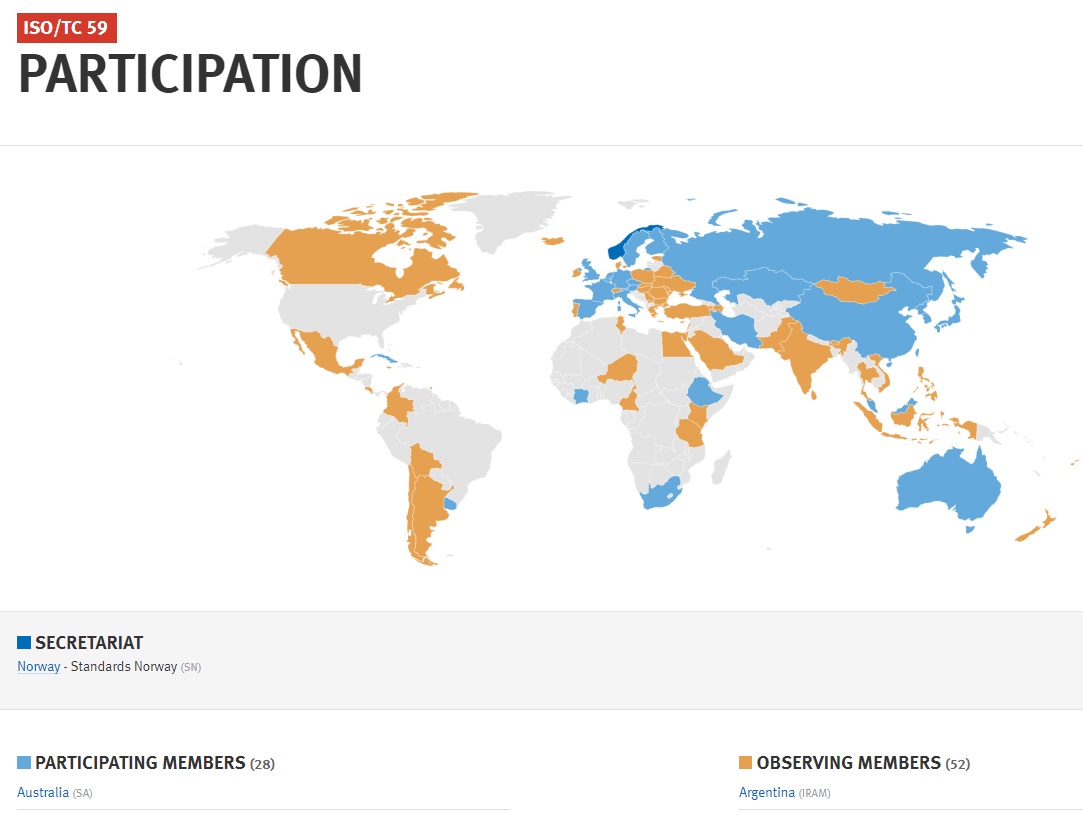
CLICK ON IMAGE | Norway is the Global Secretariat | ASTM International is ANSI’s US Technical Advisory Group Administrator
While parts of the scopes of various subcommittees may already be familiar to construction professionals — Building Information Modeling (BIM), for example — the bulk of the work product remains fairly high-level. We will keep an eye on it.
You may do so on your own by communicating directly with ANSI’s ISO Team and/or either of ANSI’s US Technical Advisory Group Administrators:
For TC/59/SC 8 (Sealants)
ASTM International
David Lee / 2128 W Evergreen Ave / West Conshohocken, PA 19428-2959 / Phone: (610) 832-9585 / Email: dlee@astm.org
For TC/59/SC 13 (BIM)
American Society of Heating, Refrigerating and Air-Conditioning Engineers, Inc.
Brian Cox / Training & Safety Office / 30 Hart Street Room 301 / Atlanta, GA 30329 / Phone: (404) 636-8400 / Email: bcox@ashrae.org
Kennedy School Construction / Harvard University
Because this topic cuts across all building industry disciplines we maintain this committee’s titles on standing agendas of several colloquia; Construction Spend,E Pluribus Unum, Model Building Code and Global teleconferences. See our CALENDAR for the next online meeting; open to everyone.
Issue: [15-211]
Category: Management
Colleagues: Mike Anthony, Christine Fischer, Jack Janveja, Richard Robben
In the late 1960s, the discovery of massive North Sea oil reserves transformed Norway from a modest fishing, shipping, and hydroelectric economy into one of the world’s richest nations. Oil revenues funded an expansive welfare state and created the world’s largest sovereign wealth fund. This “outsized good fortune” should temper any sense of moral or cultural superiority some Norwegians express toward America. Striking oil is no guarantee of success — see Venezuela or Nigeria. Norway also benefited from American technology, open markets, and capital.
The United States further provided critical security: liberating Norway in WWII and leading NATO during the Cold War, allowing Norway to focus on welfare rather than heavy defense. No student debt! Arrogance ignores contingency. Norway’s success rests on oil rents, a small homogeneous population, high trust, and luck — not inherent superiority. America’s innovations and security role helped create the global order that enabled such fortunes in Norway specifically and Western Europe generally. Recall the American role in the destruction of the German heavy water refinement plants in November 1943 (The Heroes of Telemark) which bears an uncanny resemblance to the present USA Operation Epic Fury in Iran.
Gratitude and humility suit these discussions better than condescension.
This content is accessible to paid subscribers. To view it please enter your password below or send mike@standardsmichigan.com a request for subscription details.
New update alert! The 2022 update to the Trademark Assignment Dataset is now available online. Find 1.29 million trademark assignments, involving 2.28 million unique trademark properties issued by the USPTO between March 1952 and January 2023: https://t.co/njrDAbSpwBpic.twitter.com/GkAXrHoQ9T