

Responsible Use of Positioning, Navigation, & Timing Services



The global standards for heat tracing systems are developed by IEC Technical Committee 27. The scope of work for this committee is reproduced below:
Standardization in the field of industrial equipment and installations intended for electroheating, electromagnetic processing of materials and electroheat based treatment technologies Note: The scope of interest covers industrial installations with the use of the following equipment: – equipment for direct and indirect resistance heating; – equipment for electric resistance trace heating; – equipment for induction heating; – equipment using the effect of EM forces on materials; – equipment for arc heating, including submerged arc heating; – equipment for electroslag remelting; – equipment for plasma heating; – equipment for microwave heating; – equipment for dielectric heating; – equipment for electron beam heating; – equipment for laser heating; – equipment for infrared radiation heating. The list presents typical examples of equipment and its applications and is not exhaustive.
CLICK HERE for the link to the TC 27 Strategic Business Plan
Titles in this committee’s bibliography appears to be stable. As with all IEC titles, they are relatively narrow in scope compared with the titles promulgated by most US standards developing organizations. Our interest lies primarily in the application of this technology within and around education community buildings.
While heat tracing generally goes un-noticed it is an essential part of cold weather safety. It is wise to keep pace with its evolution with innovation in materials and controls with the lead.
We maintain this committee’s work on the standing agenda of our seasonal Snow & Ice colloquia; along with US standards developed by UL, IEEE, NEMA, NFPA, ICC, ASHRAE and a few others. We also collaborate with the IEEE Education & Healthcare Facilities Committee on this topic. See our CALENDAR for the next online meeting; open to everyone.







Issue [18-332]
Category: Electrical
Colleagues: Mike Anthony, Lorne Clark, Jim Harvey
Solidity is a high-level, statically-typed programming language used for developing smart contracts on the Ethereum blockchain. Smart contracts are self-executing contracts with the terms of the agreement between buyer and seller written directly into lines of code. Solidity was specifically designed for the Ethereum platform, and it is the most widely used language for creating Ethereum-based smart contracts.
The code below shows how delegated voting can be done so that vote counting is automatic and completely transparent at the same time.

Photograph by Carol M. Highsmith. Library of Congress,
/// @title Voting with delegation.
contract Ballot {
    // This declares a new complex type which will
    // be used for variables later.
    // It will represent a single voter.
    struct Voter {
        uint weight; // weight is accumulated by delegation
        bool voted;  // if true, that person already voted
        address delegate; // person delegated to
        uint vote;   // index of the voted proposal
    }

    // This is a type for a single proposal.
    struct Proposal {
        bytes32 name;   // short name (up to 32 bytes)
        uint voteCount; // number of accumulated votes
    }

    address public chairperson;

    // This declares a state variable that
    // stores a `Voter` struct for each possible address.
    mapping(address => Voter) public voters;

    // A dynamically-sized array of `Proposal` structs.
    Proposal[] public proposals;

    /// Create a new ballot to choose one of `proposalNames`.
    constructor(bytes32[] memory proposalNames) {
        chairperson = msg.sender;
        voters[chairperson].weight = 1;

        // For each of the provided proposal names,
        // create a new proposal object and add it
        // to the end of the array.
        for (uint i = 0; i < proposalNames.length; i++) {
            // `Proposal({...})` creates a temporary
            // Proposal object and `proposals.push(...)`
            // appends it to the end of `proposals`.
            proposals.push(Proposal({
                name: proposalNames[i],
                voteCount: 0
            }));
        }
    }

    // Give `voter` the right to vote on this ballot.
    // May only be called by `chairperson`.
    function giveRightToVote(address voter) public {
        // If the first argument of `require` evaluates
        // to `false`, execution terminates and all
        // changes to the state and to Ether balances
        // are reverted.
        // This used to consume all gas in old EVM versions, but
        // not anymore.
        // It is often a good idea to use `require` to check if
        // functions are called correctly.
        // As a second argument, you can also provide an
        // explanation about what went wrong.
        require(
            msg.sender == chairperson,
            "Only chairperson can give right to vote."
        );
        require(
            !voters[voter].voted,
            "The voter already voted."
        );
        require(voters[voter].weight == 0);
        voters[voter].weight = 1;
    }

    /// Delegate your vote to the voter `to`.
    function delegate(address to) public {
        // assigns reference
        Voter storage sender = voters[msg.sender];
        require(!sender.voted, "You already voted.");

        require(to != msg.sender, "Self-delegation is disallowed.");

        // Forward the delegation as long as
        // `to` also delegated.
        // In general, such loops are very dangerous,
        // because if they run too long, they might
        // need more gas than is available in a block.
        // In this case, the delegation will not be executed,
        // but in other situations, such loops might
        // cause a contract to get "stuck" completely.
        while (voters[to].delegate != address(0)) {
            to = voters[to].delegate;

            // We found a loop in the delegation, not allowed.
            require(to != msg.sender, "Found loop in delegation.");
        }

        // Since `sender` is a reference, this
        // modifies `voters[msg.sender].voted`
        sender.voted = true;
        sender.delegate = to;
        Voter storage delegate_ = voters[to];
        if (delegate_.voted) {
            // If the delegate already voted,
            // directly add to the number of votes
            proposals[delegate_.vote].voteCount += sender.weight;
        } else {
            // If the delegate did not vote yet,
            // add to her weight.
            delegate_.weight += sender.weight;
        }
    }

    /// Give your vote (including votes delegated to you)
    /// to proposal `proposals[proposal].name`.
    function vote(uint proposal) public {
        Voter storage sender = voters[msg.sender];
        require(sender.weight != 0, "Has no right to vote");
        require(!sender.voted, "Already voted.");
        sender.voted = true;
        sender.vote = proposal;

        // If `proposal` is out of the range of the array,
        // this will throw automatically and revert all
        // changes.
        proposals[proposal].voteCount += sender.weight;
    }

    /// @dev Computes the winning proposal taking all
    /// previous votes into account.
    function winningProposal() public view
            returns (uint winningProposal_)
    {
        uint winningVoteCount = 0;
        for (uint p = 0; p < proposals.length; p++) {
            if (proposals[p].voteCount > winningVoteCount) {
                winningVoteCount = proposals[p].voteCount;
                winningProposal_ = p;
            }
        }
    }

    // Calls winningProposal() function to get the index
    // of the winner contained in the proposals array and then
    // returns the name of the winner
    function winnerName() public view
            returns (bytes32 winnerName_)
    {
        winnerName_ = proposals[winningProposal()].name;
    }
}

Time Synchronization of Medium Voltage Substation IEDs Using Modbus and Python
Abstract: Energy demand and supply all over the world is increasing in size and complexity. Anomalous conditions caused by failures in electrical components, human errors and environmental conditions result in electrical faults that can interrupt electricity flow. Substation automation requires precise time synchronization for a variety of Intelligent Electronic Devices for fault diagnosis. The quest for accurate and sequential time stamping of events compels power utility companies to adopt various techniques of time synchronization with an accuracy of a millisecond or a microsecond. Some works adopt the use of time synchronization techniques using protocols such as Network Time Protocol, Precision Time protocol, Simple Network Time Protocol and many more. This work presents time synchronization of IEDs using Modbus protocol and python programming language for a local substation. The system records the output data into a database and displays it on an application software. The time synchronization system was successful alternative for off network systems.
Related:
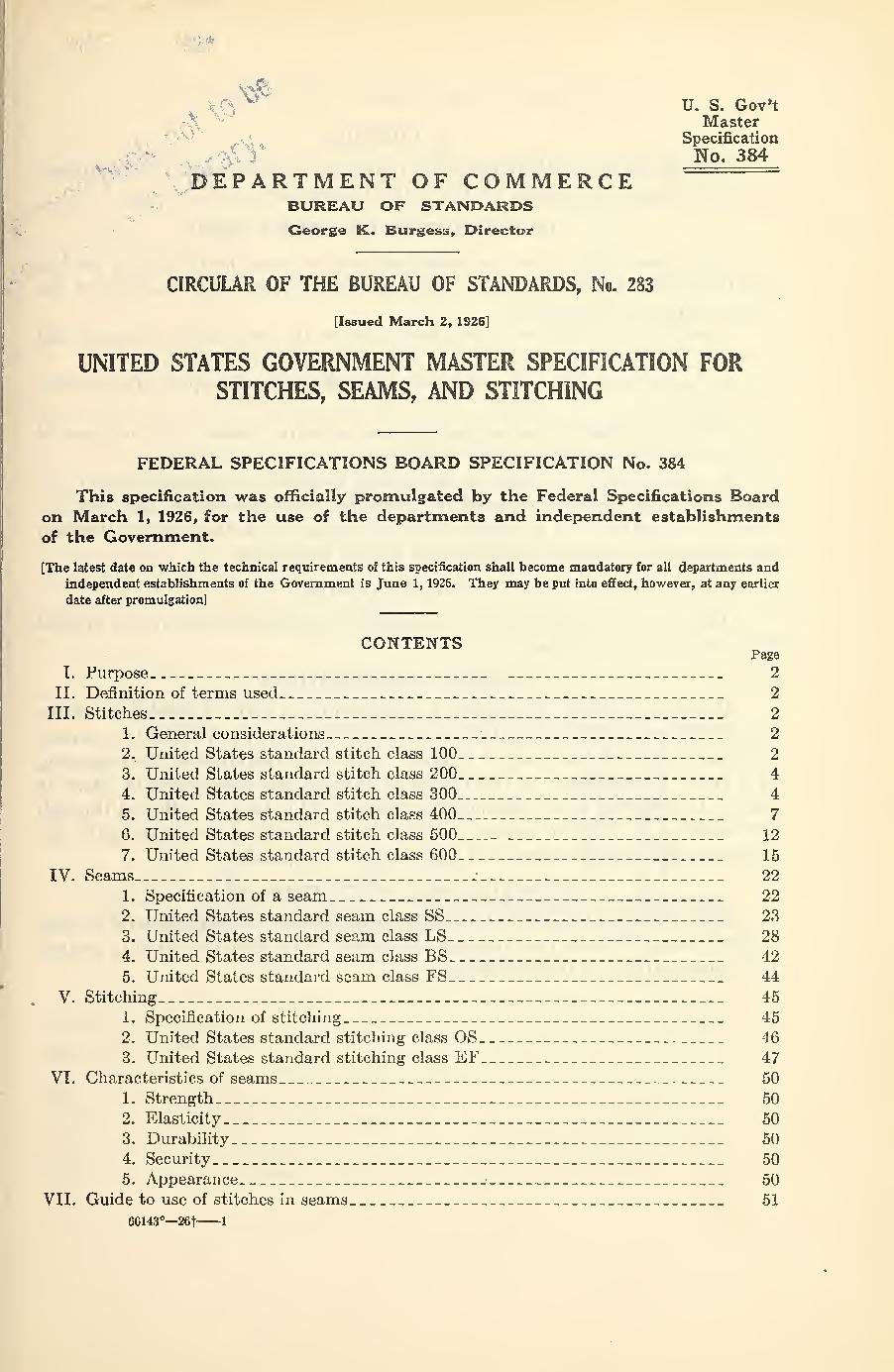

Standard stitch work – standards for men’s clothing sizes trace back to the Civil War, but no one even attempted to fix the sizes for women until almost a century later, when they called on NIST. #NYFW pic.twitter.com/dFQVGknU3w
— National Institute of Standards and Technology (@NIST) February 13, 2021
New update alert! The 2022 update to the Trademark Assignment Dataset is now available online. Find 1.29 million trademark assignments, involving 2.28 million unique trademark properties issued by the USPTO between March 1952 and January 2023: https://t.co/njrDAbSpwB pic.twitter.com/GkAXrHoQ9T
— USPTO (@uspto) July 13, 2023
Standards Michigan Group, LLC
455 East Eisenhower Parkway, Suite 300
Ann Arbor, MI 48108 USA
888-748-3670
 |
 |
|
 |
 |
|
 |
 |