
Tag Archives: WK52

Loading
loading..

Standards for American Prosperity


Crucial Role of Standards for American Prosperity Highlighted in CSIS Roundtable Session with S. Joe Bhatia


Here are some of the ways in which government regulations impede economic growth:

  1. Increased costs: Regulations can impose additional costs on businesses, which can affect their ability to operate efficiently and compete in the marketplace. For example, regulations can require businesses to invest in new technologies or processes to comply with environmental or safety standards, which can increase their expenses.
  2. Reduced innovation: Some people believe that regulations can stifle innovation and entrepreneurship, as businesses may be hesitant to invest in new products or technologies that could be subject to strict regulations. This can limit the potential for new businesses to emerge and grow.
  3. Slowed job growth: Regulations can increase the cost of doing business, which can lead to reduced hiring and slower job growth. This can be particularly challenging for small businesses that may not have the resources to comply with regulatory requirements.
  4. Reduced competition: Regulations can sometimes create barriers to entry for new businesses, which can reduce competition and limit economic growth. This can be particularly true in industries that are heavily regulated, such as healthcare and finance.
  5. Reduced trade: Regulations can make it more difficult for businesses to operate in international markets, as they may face additional regulatory requirements and trade barriers. This can limit economic growth and reduce opportunities for businesses to expand their operations.

It is important to note that regulations can also have benefits, such as protecting consumers and the environment, promoting fair competition, and fostering innovation. It’s essential to strike a balance between regulatory requirements and economic growth to ensure that businesses can thrive while also protecting public health and safety. 

The U.S. Standards System effectively provides a “shadow government” that runs parallel to the elected government so that a balance of informed voices are present in formulating what Montesquieu called the “necessary laws”.   See our ABOUT.

More

NIST: Procedures for the Development of American National Standards

ANSI Essential Requirements: Due process requirements for American National Standards

Office of Management & Budget Circulars in Numerical Sequence

Bonfire

“The prettiest sight I know,

Worth all your roses and snow,

Is the blaze of light on a Saturday night”

– E. Nesbit, ‘Saturday Song’


“Under Construction” State of the University Letter 2025

2021 International Fire Code

NFPA 1 Fire Code

Center for Campus Fire Safety


The Princeton Bonfire (a cherished campus tradition celebrating a sweep of football victories over Big Three rivals Harvard and Yale) has not yet occurred in 2025, as it depends on the outcomes of those games. The relevant schedule is:

  • vs. Harvard: October 25, 2025 (home game at Princeton Stadium)
  • vs. Yale: November 15, 2025 (home game at Princeton Stadium)

If Princeton wins both (securing the “Big Three” title), the bonfire is traditionally lit on the Sunday evening immediately following the Yale game—that is, November 16, 2025, around 7 p.m. on Cannon Green. It would feature student-built stacks of wood, speeches, the Princeton University Band, and communal festivities.


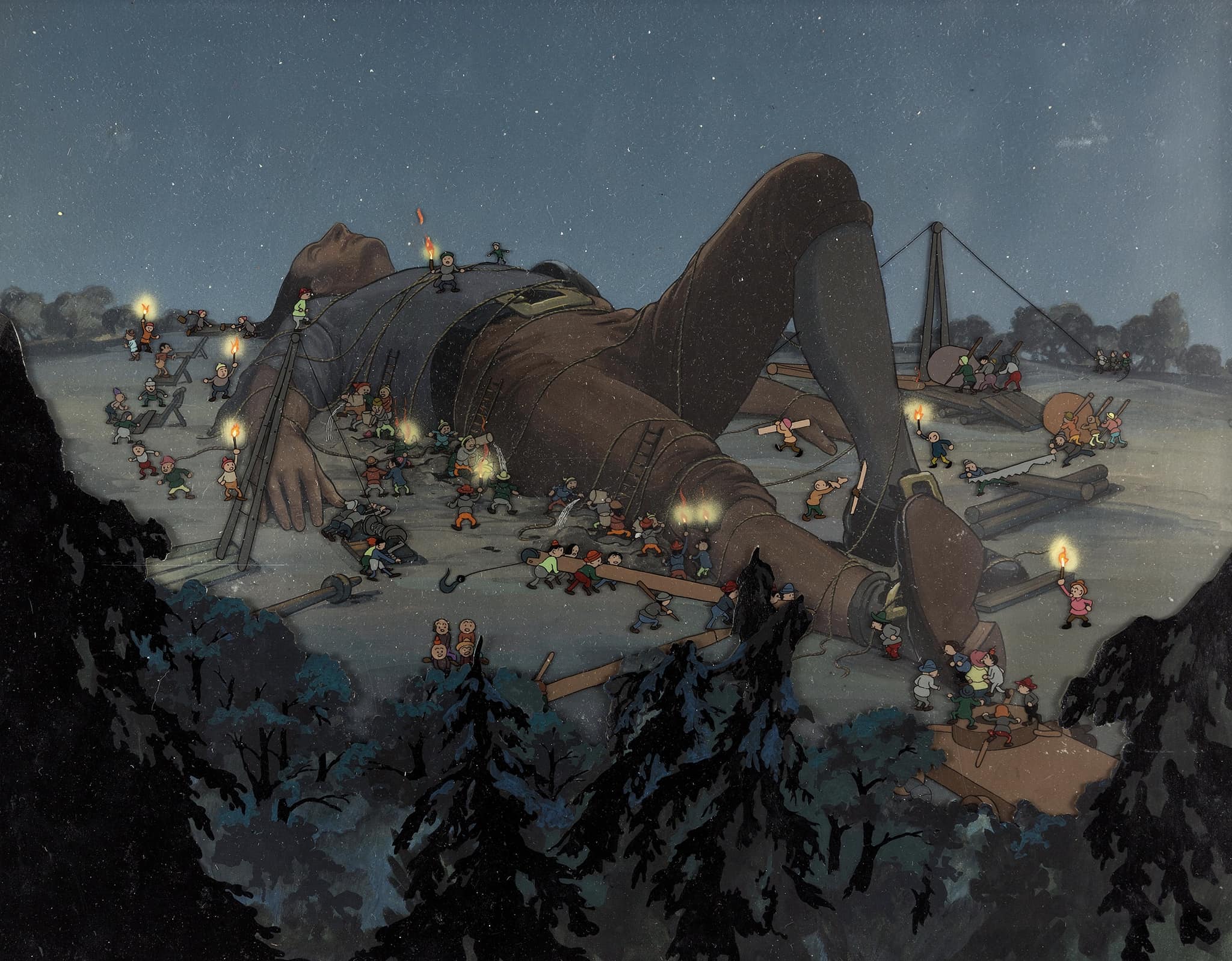
Gulliver visits the Great Academy of Lagado

In Irish author Jonathan Swift’s 1726 satire — “Gulliver’s Travels” — Lagado is the capital of Balnibarbi whose king had invested a great fortune on building an “Academy of Projectors” so that it shall contribute to the nation’s development through research.

Gulliver describes pointless experiments conducted there — trying to change human excretion back into food, trying to extract sunbeams out of cucumbers, teaching mathematics to pupils by writing propositions on wafers and consuming them.

“Gulliver’s Travels” 1939 Production | (Max Fleischer (1883 – 1972)

“None are so blind as those who refuse to see” is a proverbial expression that has been used by many authors and public figures throughout history. The exact origin of the phrase is unknown, but it has been attributed to various sources, including the Bible, where Jesus says, “For judgment I am come into this world, that they which see not might see; and that they which see might be made blind” (John 9:39, King James Version).

The phrase has also been attributed to Jonathan Swift, an Irish author and satirist, who wrote in his 1738 work,

“Polite Conversation”: “Blind, sir? I see every day where Lord M– goes upon the bench without his bag, and you tell me he is not blind?”.

However, it is possible that the phrase existed prior to Swift and was simply popularized by him.

Internet Archive: Gulliver’s Travels

Gallery: Other Ways of Knowing Climate Change

Eric Weinstein: We need a scientific revolution

https://youtu.be/fHCBn7usz9s?si=YUjBR6ZJYKBInbUN Christmas Tree Research MSU

Winter Week 1 | December 29 – January 4 (Home for the Holidays)

«Зимний день» 1934 Konstantin Gorbatov


Monday | December 29 | Colloquium 16:00 UTC

Colloquy (December)


Tuesday | December 30 | Colloquium 16:00 UTC

Electrotechnology OEMS

2028 National Electrical Safety Code


Wednesday | December 31 | Colloquium 16:00 UTC


University of Michigan


Thursday | New Year’s Day | January 1


Friday January 2| Down for Maintenance & Upgrades


Saturday January 3


Sunday January 4


https://www.facebook.com/photo.php?fbid=1490134305252884&set=pb.100027689876910.-2207520000&type=3

Grand Rapids Catholic Central | Kent County Michigan

Coffee

“The morning cup of coffee has an exhilaration about it which the cheering influence
of the afternoon or evening cup of tea cannot be expected to reproduce.”
– Oliver Wendell Holmes Sr. (The Autocrat of the Breakfast Table, 1858)

Norges Teknisk-Naturvitenskapelige Universitet

As the U.S. member body to the International Organization for Standardization (ISO), the American National Standards Institute (ANSI) encourages its members and relevant stakeholders to participate in discovering standardization solutions in a broad range of technologies and markets with like-minded experts in other national standards bodies.  The full sweep of ANSI’s participation in consensus documents developed by the ISO is described in the link below:

ISO Programs – Overview

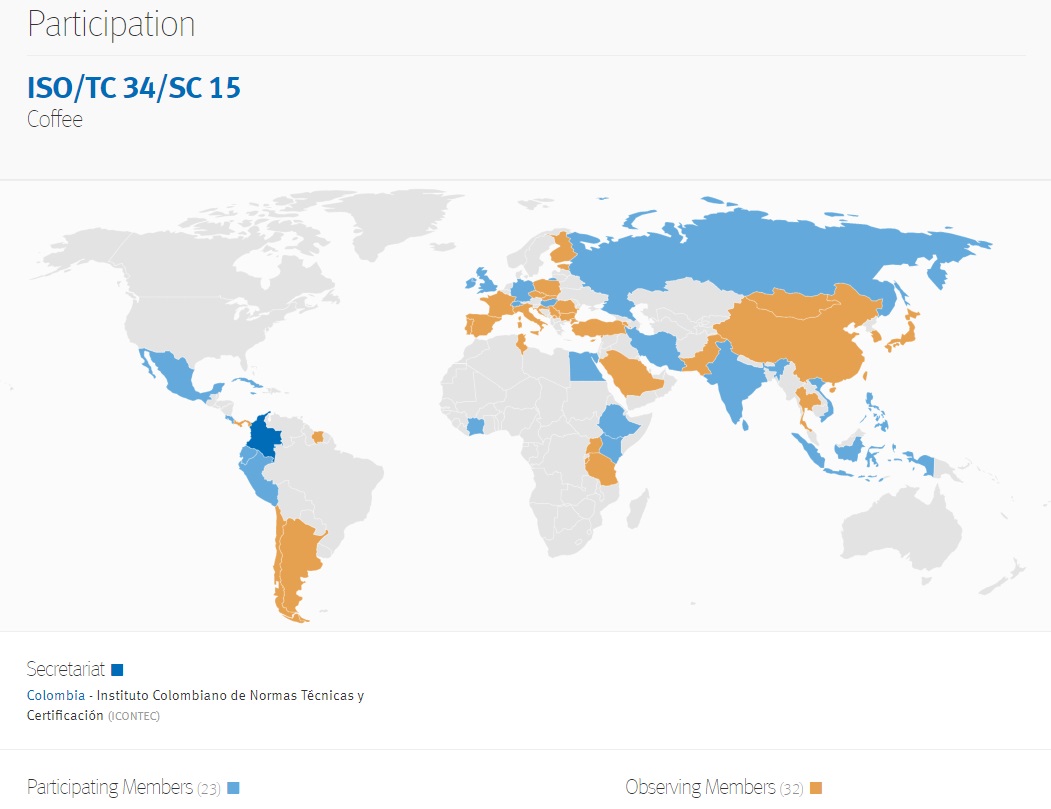
Today we revisit a product familiar to daily life at home and in business: coffee.   The ISO administers leading practice discovery and promulgation in the global coffee value chain through parent Technical Committee 34 (TC34) with the Association Française de Normalisation as the global Secretariat with the Associação Brasileira de Normas Técnicas as the twinned Secretariat*.  Subcommittee 15 oversees standardization in the field of coffee and coffee products, covering the coffee chain from green coffee to consumption, in particular. Standardization includes terminology, sampling, test methods and analysis, product specifications and requirements for packaging, storage and transportation

From the ISO/TC 34 prospectus:

Business Plan ISO TC34 Food Products

Sample from ISO Online Browing Platform: (Expect strong access firewalls)

Coffee and coffee products — Vocabulary

Coffee — Sensory analysis — Vocabulary

Roasted ground coffee — Determination of moisture content

The Secretariats for this subcommittee is currently held by Colombia (ICONTEC) but, with ANSI announcing in 2019 that it is relinquishing its role as the US Technical Advisory Group Administrator in 2019, there has been no US stakeholder participating.  In 2019 ANSI posted an invitation for another US-based stakeholder to assume the voice of the United States:

ANSI Standards Action Page 34

ANSI US TAGs to the International Organization for Standardization

Apart from the passion that young people have for fair trade in any market, we see this as an opportunity for faculty and students to gain insight into the geo-politics of food supply generally and the subtleties of coffee markets.   Business schools, agricultural colleges, international studies program developers who may be, and should be, interested in a leadership opportunity on behalf of the United States should communicate directly with ANSI’s ISO Team ((isot@ansi.org).

We devotes an hour every month to review public commenting opportunities on all international standards.  The work products of TC 34 appears on the standing agenda of both our Global and Food teleconferences.   See our CALENDAR for the next online meeting.


Issue: [19-46]

Category: Academic, International

Colleagues: Mike Anthony, Christine Fischer

ISO Guidance on Twinning


LEARN MORE:

“The Golden Cup” Coffee Standards

“Gold Cup History & Future”


Layout mode
Predefined Skins
Custom Colors
Choose your skin color
Patterns Background
Images Background
Standards Michigan
error: Content is protected !!
Skip to content