


University of Notre Dame | St. Joseph County Indiana
The standards ecosystem spans electrical engineering, networking, acoustics,
lighting, interoperability and cybersecurity. Today, at the usual hour, we
sort through the technical standards that make these enterprises safe and
sustainable. Use the login credentials at the upper right of our home page.
The most relevant standards organizations are:
- Society of Motion Picture and Television Engineers (SMPTE)
- Audio Engineering Society (AES)
- Advanced Media Workflow Association (AMWA)
- Video Services Forum (VSF)
- IEEE Standards Association
- National Electrical Code (NFPA 70)
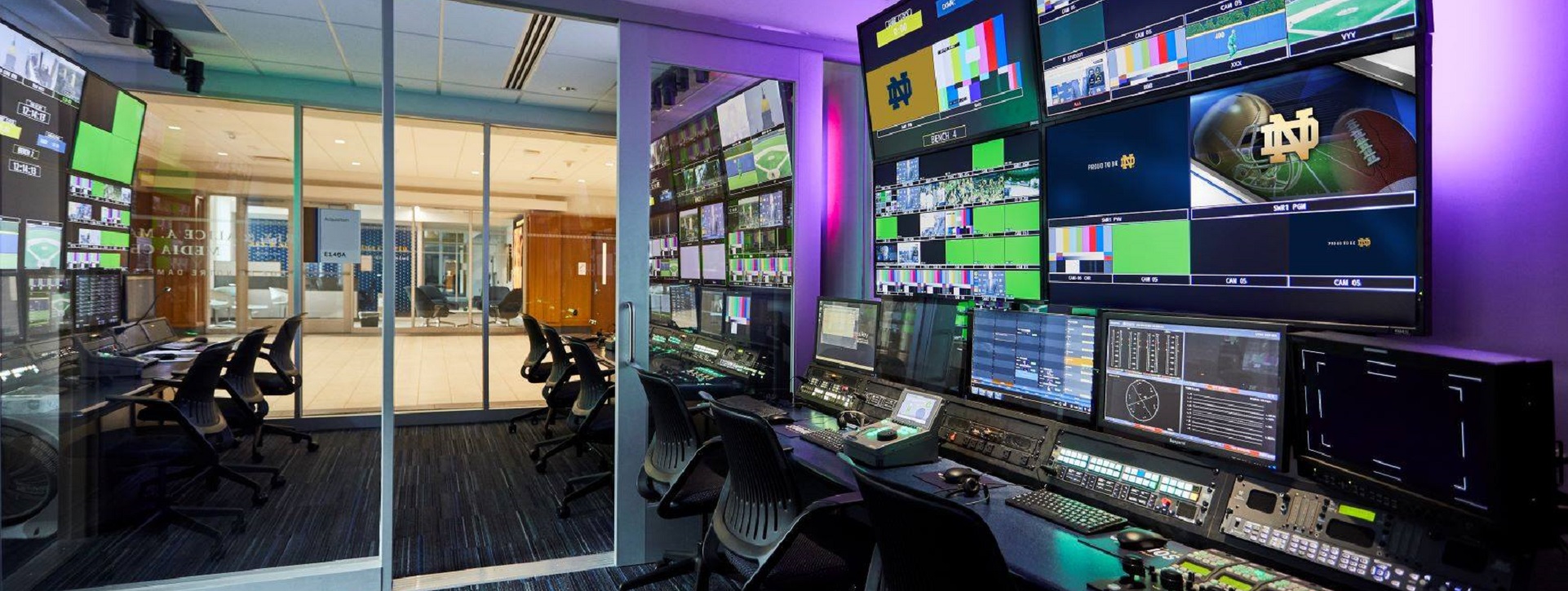
For campus engineers, the dominant broadcast transport standard is SMPTE 2110 which replaces traditional SDI wiring with Ethernet/IP networks while maintaining
frame-accurate synchronization.
The standard encompasses:
- Uncompressed video transport
- PCM audio transport
- Timing through IEEE 1588 Precision Time Protocol (PTP)
- Metadata
- Subtitles and captions
- Traffic shaping
- Synchronization across production networks
SMPTE ST 2110 has become the foundation for modern broadcast facilities.
Instead of simply televising football games, many institutions now produce:
- Linear television
- ESPN+ productions
- Conference network programming
- Documentaries
- Recruiting content
- Podcasts
- Social media
- NIL athlete content
- Instructional programming
The engineering challenge is therefore much broader than installing cameras.
Infrastructure now includes:
- ST 2110 IP media networks
- Redundant fiber backbones
- Synchronized timing systems
- Large storage arrays
- GPU rendering farms
- Cloud contribution
- 25/40/100 Gb Ethernet
- Precision HVAC
- UPS systems
- Broadcast lighting
- Acoustically isolated studios
Relata:





