Author Archives: mike@standardsmichigan.com

Loading
loading...

Canadian Parliament Debate on Standards Incorporated by Reference

What happened to Canada?

“The Jack Pine” | Tom Thomson (1916) | National Gallery of Canada


Originally posted January 2014

In these clips — selected from Canadian Parliamentary debate in 2013 — we observe three points of view about Incorporation by reference (IBR); a legislative drafting technique that is the act of including a second document within a main document by referencing the second document.

This technique makes an entire second (or referenced) document a part of the main document.  The consensus documents in which we advocate #TotalCostofOwnership concepts are incorporated by reference into legislation dealing with safety and sustainability at all levels of government.  This practice — which many consider a public-private partnership — is a more effective way of driving best practices for technology, and the management of technology, into regulated industries.

Parent legislation — such as the Higher Education Act of 1965, the Clean Air Act and the Energy Policy Act – almost always require intermediary bureaucracies to administer the specifics required to accomplish the broad goals of the legislation.  With the gathering pace of governments everywhere expanding their influence over larger parts of the technologies at the foundation of national economies; business and technology standards are needed to secure that influence.  These standards require competency in the application of political, technical and financial concepts; competencies that can only be afforded by incumbent interests who build the cost of their advocacy into the price of the product or service they sell to our industry.  Arguably, the expansion of government is a reflection of the success of incumbents in business and technical standards; particularly in the compliance and conformity industries.

About two years ago, the US debate on incorporation by reference has been taken to a new level with the recent statement released by the American Bar Association (ABA):

16-164-Incorporation-by-Reference-ABA-Resolution-and-Report

The American National Standards Institute responded to the ABA with a statement of its own.

16-164-ANSI-Response-to-ABA-IBR-06-16 (1)

The incorporation by reference policy dilemma has profound implications for how we safely and economically design, operate and maintain our “cities-within-cities” in a sustainable manner but, admittedly, the results are only visible in hindsight over a time horizon that often exceed the tenure of a typical college or university president.

A recent development — supporting the claims of ANSI and its accredited standards developers — is noteworthy:

The National Institute for Standards and Technology (NIST) manages a website — Standards.GOV — that is a single access point for consensus standards incorporated by reference into the Code of Federal Regulations: Standards Incorporated by Reference Database.   Note that this database does not include specific reference to safety and sustainability codes which are developed by standards setting organizations (such as NFPA, ICC, IEEE, ASHRAE and others) and usually incorporated by reference into individual state public safety and technology legislation.


LEARN MORE:


Campus Electric Bulk Distribution

Today we will also cut through these transcripts:

2026 Code Panel 6 Public Input Report

2026 Code Panel 6 Public Comment Report

College and university campuses distribute electric energy in tranches of 10 to 250 megawatts; typically at voltages above 1000 VAC and are generally regarded as load-side services (or regulated utility customers). Two fairly stable sections of the National Electrical Code set the standard of care for these systems — Part III of Article 110 and Article 495.

We will examine them during today’s High Voltage Electric Service colloquium.

FREE ACCESS: 2023 National Electrical Code

We collaborate closely with the IEEE Education & Healthcare Facilities Committee which meets online 4 times per month in European and American time zones.  Ahead of the August 2024 public comment deadline we will examine transcripts of technical action on this topic:

2026 National Electrical Code Workspace

Community Risk Assessment

First Draft Meeting Minutes | January 13, 2026

Château de Meudon

We have advocated education community risk management concepts since 2007; primarily in NFPA Standard 1300 — Standard on Community Risk Assessment and Community Risk Reduction Plan Development (formerly NFPA 1600).  The content of this title is close-coupled with FEMA’s National Incident Management System.   

Recently the National Fire Protection Association Standards Council moved to consolidate its community risk management titles as described below.  

“NFPA 1660 is in a custom cycle due to the Emergency Response and Responder Safety Document Consolidation Plan (consolidation plan) as approved by the NFPA Standards Council.  As part of the consolidation plan, NFPA 1660 (combining Standards NFPA 1600, NFPA 1616, and NFPA 1620) is open for public input with a closing date of November 13, 2020.”

Thus, NFPA 1600 is being sunsetted as a separate consensus product, its substance rolled into the new NFPA 1660.  CLICK HERE for the new landing page for NFPA 1660.

Two links below provide a sense of the back-and-forth in the technical committee meetings:

1600_F2018_EMB_AAA_FD_PIResponses

1600_F2018_EMB_AAA_SRReport

Discussion about school and university security are noteworthy.

As described on its title page, this product will be reconfigured as NFPA 1660 Standard on Community Risk Assessment, Pre-Incident Planning, Mass Evacuation, Sheltering, and Re-entry Programs.   The title suggests that NFPA 1660 is being developed to meet market need for conformance and teaching tools.  You may track movement in the concepts in the links below; many of them administrative:

Emergency Management and Business Continuity

Mass Evacuation and Sheltering

Pre-Incident Planning 

NFPA 1660 will likely require one or two more revision cycles to stabilize

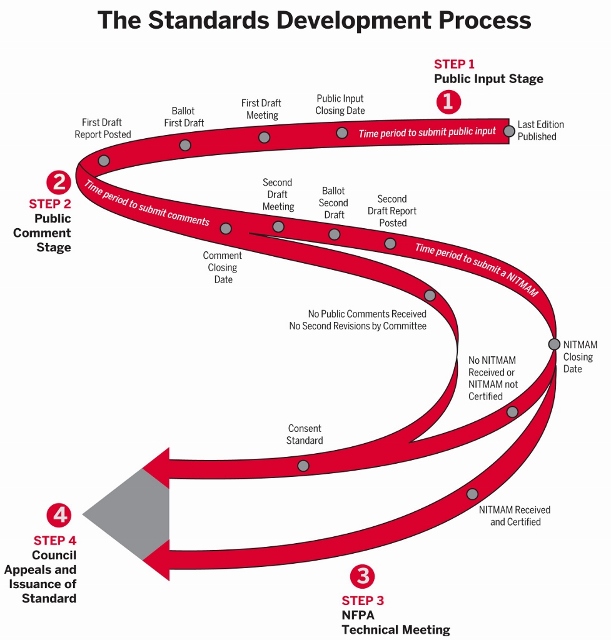
Public consultation on the Second Draft (NITMAM) closes September 9th.  You may submit public input directly to NFPA by CLICKING HERE.  We will have hosted several Security colloquia ahead of this deadline during which we will drill into technical and policy specifics.

University of Tennessee


We maintain this title on our periodic Security, Disaster and Risk colloquia during which time  our thoughts on the economic burden of the expanding constellation of risk management standards will be known.  Thoughts that we are reluctant to write.   See our  CALENDAR for the next online meeting; open to everyone.

Issue: [13-58] and [18-151]

Category: Security, Risk

Colleagues: Mike Anthony, Robert G. Arno, Jim Harvey, Richard Robben

MORE >> Disaster Resiliency and NFPA Codes and Standards

ARCHIVE / Emergency Management and Business Continuity


Data Center Wiring

The bookwheel, also known as a revolving bookcase, was invented by an Italian scholar and polymath named Agostino Ramelli. Ramelli was born in 1531 in Ponte Tresa, a town in present-day Italy, and he lived during the Renaissance period.

Ramelli’s invention, described in his work titled “Le diverse et artificiose machine del capitano Agostino Ramelli” (The Various and Ingenious Machines of Captain Agostino Ramelli), was published in 1588. This book showcased a collection of 195 mechanical devices.  

Ramelli’s work contributed to the growing interest in mechanical inventions during the Renaissance period. His bookwheel design remains a fascinating example of early engineering and ingenuity, highlighting the desire for knowledge and practical solutions in the pursuit of learning and scholarly endeavors.

2026 NEC Articles 645-646-647 Information Technology Equipment, et. al First Draft Report

2026 NEC Articles 645-646-647 Information Technology Equipment, et. al Second Draft Report

“Bookwheel” Early Data Center

The standard of care for wiring safety for data centers —  a continually expanding presence in education communities even before the pandemic  — is established in National Electrical Code Articles 645 (Information Technology Equipment), Article 646 (Modular Data Centers) and Article 647 (Sensitive Electronic Equipment).   You will notice that these articles cover the topic comprehensively and bear the imprint of competing Producer-Interest groups.  There are no User-Interest representatives on Code-Making Panel 12 that represent the final fiduciary in education communities even though education communities are one of the largest markets for information and communication technology systems.

The current version of NFPA 70 is linked below:

2026 National Electrical Code

2023 National Electrical Code

Transcripts  of technical committee action during the 2026 revision (CMP-16) are linked below because they will inform our recommendations for the 2026 National Electrical Code.  Keep in mind that the Technical Correlating Committee is moving content around the Code in order to make the NEC easier to use by experts.

CMP-16 First Draft Report | Public Input with Committee Response 

CMP-16 Second Draft Report

The transcripts of technical committee action during the 2023 revision are linked below because they will inform our recommendations for the 2026 National Electrical Code.

Code‐Making Panel 12 Public Input Report

Code-Making Panel 12 Public Comment Report

National Electrical Code CMP-12

We will use these in our exploration of what we might propose for improvements in the 2026 revision.  Public comment on the First Draft of the 2026 Edition will be received until August 28th.

The issues that have been in play in these articles of the NEC are familiar to veterans of the “food fight” – occupancy classification, cable specifications, fire protection, ventilation, energy consumption, surge protection, licensing of engineers. etc.  We look for market-making excesses by opposing stakeholders that seek to limit their risk while raising the (financial) risk to education communities.

We encourage our colleagues to participate in the NFPA code development process directly.  We also encourage stakeholders in education communities — students, faculty and staff  to join us during any of the teleconferences we co-host with the IEEE Education & Healthcare Facilities Committee 4 times monthly in both European and American time zones.   See our CALENDAR for the next online meeting.

"One day ladies will take their computers for walks in the park and tell each other, "My little computer said such a funny thing this morning" - Alan Turing


Related standards:

NFPA 75: Standard for the Fire Protection of Information Technology Equipment

2024 International Building Code: Special Detailed Requirements Based on Occupancy and Use

2024 International Building Code: Section 304.1 Business Group B

2029 National Electrical Code Panel 3

Electrical Safety Stack

At the request of IEEE Joint IAS/PES Standards Michigan, Mike Anthony moved to CMP-3 from CMP-15.

Articles Under CMP 3

  • Article 300 — General Requirements for Wiring Methods and Materials
  • Article 335 — Instrumentation Tray Cable (in some references for the 2029 cycle)
  • Article 590 — Temporary Installations (being relocated/renumbered in the 2026 cycle, e.g., potentially to Article 140 in Chapter 1, as temporary wiring is not treated as a special occupancy)
  • Article 720 — Limited-Energy System Installations (new/general article covering wiring methods for limited-energy systems)
  • Article 721 — Limited-Energy Power Sources
  • Article 722 — Limited-Energy Cable (covers cables for power-limited, fault-managed, etc.)
  • Article 723 — Raceways, Cable Routing Assemblies, and Cable Trays for Limited-Energy Systems (newly created in the 2026 cycle)
  • Article 725 — Class 2 and Class 3 Remote-Control, Signaling, and Power-Limited Circuits
  • Article 726 — Class 4 Fault-Managed Power Circuits and Equipment
  • Article 727 — Instrumentation Tray Cable
  • Article 728 — Fire-Resistive Cable Systems
  • Article 760 — Fire Alarm Systems (power-limited and non-power-limited portions)

CMP 3 also handles associated content in: Chapter 9 — Tables, including Tables 11(A) & (B) and Tables 12(A) & (B) (related to conductor properties and other supporting tables for the above topics).


  • Notes on Changes and Scope
    CMP 3 focuses on general wiring rules, cable types, raceways/trays for low-energy applications, and signaling/communications-related wiring (distinct from higher-power utilization equipment or special occupancies handled by other panels).
  • In the 2026 NEC cycle, there has been significant reorganization of Chapter 7 to consolidate limited-energy systems under articles like 720–726 (and related ones), moving away from older structures. This includes new articles for raceways/cable trays specific to limited-energy systems and adjustments to scopes for clarity.
  • Article 206 (Non-Power-Limited Remote-Control and Signaling Circuits) appears in some 2026-related references as newly designated or relocated material handled in this area.
    Temporary installations (Article 590) are transitioning out of “special” categories in restructuring efforts.

During today’s sessions of the IEEE E&H Committee and our own we will prepare draft proposals relevant to the safety and sustainability agenda of the USA education facility industry.  Use the login credentials at the upper right of our home page.


Brown University Electrical Design Criteria | Information Technology Resources Policy


Posted December 20, 2025

The University of Michigan has supported the voice of the United States education facility industry since 1993 — the second longest tenure of any voice in the United States.  That voice has survived several organizational changes but remains intact and will continue its Safer-Simpler-Lower Cost-Longer Lasting priorities on Code Panel 3 in the 2029 Edition.

Today, during our customary “Open Door” teleconference we will examine the technical concepts under the purview of Code Panel 3; among them:

Article 206 Signaling Circuits

Article 300 General Requirements for Wiring Methods and Materials

Article 335 Instrumentation Tray Cable

Article 590 Temporary Installations

Chapter 7 Large sections of limited energy cabling for signaling and information technology

Chapter 9 Conductor Properties Tables 11A & B, Tables 12A&B

Public Input on the 2029 Edition will be received until April 9, 2026.

Related:
  • Since the lifespan of educational buildings make the building core and shell susceptible to multiple changes not typically associated with commercial buildings, additional pathways should be placed in areas where the core and shell components of the facility are likely to re-main for extended periods of time
  • It is recommended that all areas of an educational building have wireless coverage unless prohibited

English for Technical Professionals

IEEE English for Technical Professionals is a 14-hour online learning program designed to provide non-native English speakers with a working knowledge of English techniques and vocabulary that are essential for working in today’s technical workplace.


IEEE English for Technical Professionals

“It is a trite but true observation, that examples work more forcibly on the mind than precepts: and if this be just in what is odious and blameable, it is more strongly so in what is amiable and praiseworthy. Here emulation most effectually operates upon us, and inspires our imitation in an irresistible manner. A good man therefore is a standing lesson to all his acquaintance, and of far greater use in that narrow circle than a good book.

But as it often happens that the best men are but little known, and consequently cannot extend the usefulness of their examples a great way; the writer may be called in aid to spread their history farther, and to present the amiable pictures to those who have not the happiness of knowing the originals; and so, by communicating such valuable patterns to the world, he may perhaps do a more extensive service to mankind than the person whose life originally afforded the pattern…”

— Henry Fielding “The History of the Adventures of Joseph Andrews and of his Friend Mr. Abraham” (1742)


Electropedia: The World’s Online Electrotechnical Vocabulary

Standards January: Language

National Electrical Definitions

NFPA Glossary of Terms

International Building Code Chapter 2: Definitions

International Electrotechnical Commission: Electropedia

Because electrotechnology changes continually, definitions (vocabulary) in its best practice literature changes continually; not unlike any language on earth that adapts to the moment and place.

The changes reflect changes in technology or changes in how the technology works in practice; even how the manufacturers create adaptations to field conditions by combining functions.   Any smart electrical component has a digital language embedded in it, for example.

Consider the 2023 National Electrical Code.  Apart from many others the NEC will contain a major change to Article 100 (Definitions); the subject of elevated debate over the past three years.

When we refer “language” we must distinguish between formal language, informal language, colloquial language and dialect which may differ the language spoken, language written at the office and language used on the job site.  “Terms of art”

2026 National Electrical Code | CMP-1 Second Draft Report 

FREE ACCESS: 2020 National Electrical Code (NFPA 70)

2023 NEC Public Input Report CMP-1 (868 pages)

2023 NEC Second Draft Public Comment Report (914 pages)

Are these terms (or, “terms of art”) best understood in context (upstream articles in Chapters 4 through 8) — or should they be adjudicated by the 14 Principals of Code Making Panel 1?   The answer will arrive in the fullness of time.   Many changes to the National Electrical Code require more than one cycle to stabilize.

Code Making Panel 1 has always been the heaviest of all NEC panels.  As explained n our ABOUT, the University of Michigan held a vote in CMP-1 for 20+ years (11 revision cycles) before moving to the healthcare facilities committee for the IEEE Education & Healthcare Facilities Committee.  Standards Michigan continues its involvement on behalf of the US education facility industry — the second largest building construction market.  There is no other pure user-interest voice on any technical committee; although in some cases consulting companies are retained for special purposes.

To serve the purpose of making NFPA 70 more “useable” we respect the Standards Council decision to make this change if it contributes to the viability of the NFPA business model.  We get to say this because no other trade association comes close to having as enduring and as strong a voice:  NFPA stands above all other US-based SDO’s in fairness and consideration of its constituency.  The electrical safety community in the United States is a mighty tough crowd.

If the change does not work, or work well enough, nothing should prohibit reversing the trend toward “re-centralizing” — or “de-centralizing” the definitions.

Public comment on the First Draft of the 2026 Edition will be received until August 28, 2024. 

Technical Committees meet during the last half of October to respond to public comment on the First Draft of the 2026 National Electrical Code. 

Electrical Contractor: Round 1 of the 2023 NEC: A summary of proposed changes (Mark Earley, July 15, 2021)

Electrical Contractor: 2023 Code Article and Definition Revisions: Accepting (NEC) change, part 2 (Mark Earley, March 15, 2022)

Lamb & Mint

Home

Lamb & mint: A classic pairing

Facilities Services


Hot Cross Buns & Eagle Coffee

Hot Cross Buns | Nursery Rhymes | Super Simple Songs

Hot cross buns (Library of Congress) are a traditional Easter treat dating back centuries, symbolizing both the end of Lent and the crucifixion of Jesus. These spiced sweet buns, often containing raisins or currants and marked with a cross on top, are typically eaten on Good Friday.

The cross represents the crucifixion, while the spices symbolize the spices used to embalm Jesus. Sharing hot cross buns fosters community and reflects on the religious significance of Easter, marking a solemn yet celebratory time in Christian tradition.

Link to Dining Services specialty at the Mean Greens Cafe at Maple Street Hall and recipes in other education settlement traditions.

Eagle Cafe Eagle Cawfee


Texas Croissants & Wyoming Cowboy Coffee

Microwave Brown Rice Bowl

Institute of Culinary Education: Hot Cross Buns

Weston College: Perfect Hot Cross Bun Recipe

Algonquin College: A Sweet Easter Tradition


Commercial Kitchens

Kitchen Wiring

Kitchen Exhaust

Food hygiene practices: Ergonomics versus safety

Ventilation for Commercial Cooking Operations

Hot Cross Buns

Colloquy (April)

Gallery: Doctoral Dissertations

About

American School and University: Northern Kentucky University plans to expand its main science research building


Layout mode
Predefined Skins
Custom Colors
Choose your skin color
Patterns Background
Images Background
Standards Michigan
error: Content is protected !!
Skip to content