


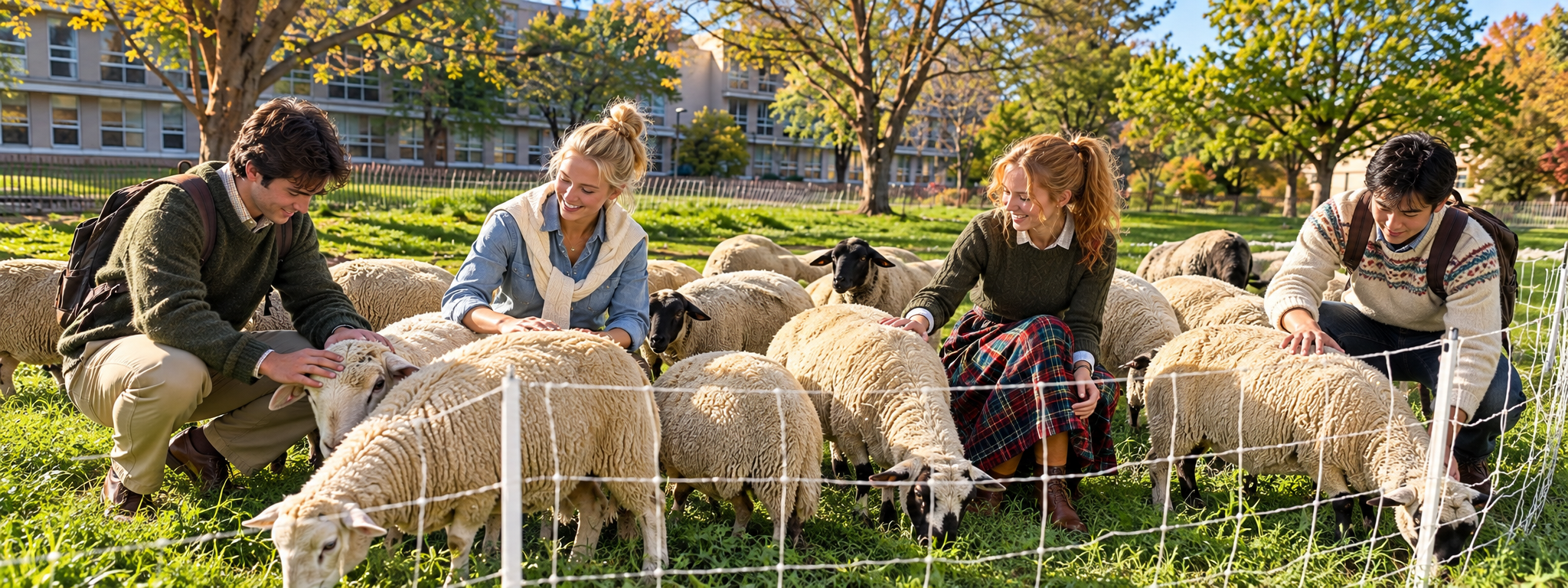
University of California Davis Sheep Mowers

Trinity College / Toronto Aperiodic walk-through of code and standards revisions that are incorporated by reference in state and local regulations, into education facility design guidelines and construction contracts. Use the login credentials at the top right of our home page. https://standardsmichigan.com/design-guidelines-construction-specifications/ “He who does not speak foreign languages — Johann Wolfgang von Goethe “The Tower of Babel” 1563 / Pieter Bruegel the Elder Here’s a rough breakdown of the top languages on the web: English: 55.4% – Russian: 6.6% – Japanese: 5.4% – Spanish: 5.2% – Chinese: 4.6% One of the most contentious aspects of best practice discovery and promulgation in any domain, and no less so in educational settlements, is an agreed-upon vocabulary and shared understanding. As we explain elsewhere in this history, when a counter-party disagrees with you, he simply switches out the vocabulary — i.e. changes definitions or adds or subtracts from the traditional meanings of things. So we approach this topic several times a year to confirm our bearing on the meaning of things. Attention Is All You Need | Ashish Vaswani, et. al We begin 2025 by breaking down this topic into four sections Language 100: Survey of vocabulary in the standards catalogs relevant to building and managing education settlement real assets; including legal terms. Language 200: Electrotechnology standard catalogs; including computer programming languages. Language 300: The English as the language of science and innovation; the birthplace of computing and programming, the internet’s native tongue, standardization & open source development; etc. Language 400: Reserved Just learned that a group of flamingos is called a flamboyance and suddenly the world seems a little brighter. pic.twitter.com/REdU2lpF26 — Dr. Catharine Young (@DrCatharineY) November 16, 2025 In the United Kingdom, National Poetry Month is celebrated in October, and it is known as “National Poetry Day” which has been observed since 1994. It is an initiative of the Forward Arts Foundation, which aims to encourage people to read, write and perform poetry. Other countries also have their own poetry celebrations, such as World Poetry Day, which is observed annually on March 21 by UNESCO (United Nations Educational, Scientific and Cultural Organization) to promote the reading, writing, and teaching of poetry worldwide. In past years we used a Tamil mnemonic because Tamil is the oldest surviving language and remains the spoken language of 80-odd million people of South Asia. Alas, use of Tamil confounds our Wordpress content management system so in 2024 we began coding this topic in American English https://youtube.com/shorts/iEhbwbUTukE?si=bUQHwT14GbxNL_5b https://standardsmichigan.com/%e0%ae%ae%e0%af%8a%e0%ae%b4%e0%ae%bf-2/ Latin Phrases You Should Know. pic.twitter.com/Erq61gVW29 — Learn Latin (@latinedisce) May 5, 2024 Once median household income is adjusted for cost of living, Utah emerges as the wealthiest state in the nation and Mississippi yet again ranks last. Source: https://t.co/AN3JZqtNnF pic.twitter.com/kv8U3LZlvh — Simon Kuestenmacher (@simongerman600) January 3, 2025 https://standardsmichigan.com/hegemon-ohio-county-dublin/ https://standardsmichigan.com/hegemon-fairfield-county/ https://standardsmichigan.com/hegemon-rueil-malmaison/ “Composition in red, yellow, blue and black” (1921) | Piet Mondrian Status check on open source consensus titles evolving around distributed ledger technologies for financing, planning, design, operation & maintenance of the #WiseCampus. print(“Wise Campus”). The rapid growth of AI training and inference drives hyperbolic demand for data center capacity, creating a classic boom-bust dilemma on large university campuses. Overbuild: Universities rushing to construct hyperscale or AI-focused data centers risk massive stranded capital if AI progress slows, federal funding dries up, or cheaper cloud alternatives dominate. These facilities require enormous power (often 100–500+ MW), water cooling, and land—resources that could lock campuses into 20–30-year commitments while diverting funds from core academic missions. Critics fear a repeat of the 1990s fiber-optic glut, leaving half-empty “ghost” buildings. Underbuild: Failing to invest sufficiently risks losing top AI faculty and students to better-equipped peers (Stanford, MIT, CMU), forfeiting federal grants (e.g., NSF, CHIPS Act), and diminishing national competitiveness. In a winner-take-all AI race, campuses without GPU clusters and high-performance networking quickly fall behind in recruiting and research output. Universities are thus caught between fear of wasteful mega-projects and fear of irrelevance. https://standardsmichigan.com/rellis-data-and-research-center/ “Washington money” 2012 Robert Silvers Today we pick through a few tax-free bond offerings that finance education community construction with a eye toward reducing construction cost and life-cycle maintenance through building codes and standards. Use the login credentials at the upper right of our home page. https://standardsmichigan.com/tax-free-bonds/ Once median household income is adjusted for cost of living, Utah emerges as the wealthiest state in the nation and Mississippi yet again ranks last. Source: https://t.co/AN3JZqtNnF pic.twitter.com/kv8U3LZlvh — Simon Kuestenmacher (@simongerman600) January 3, 2025 Reflection on the degree to which large research universities are Non-Government Organizations (Quangos, in the United Kingdom) or Hedge Funds with a side operation in education. “Mack the Knife” (original German title: “Die Moritat von Mackie Messer”) seems like a jaunty swing tune, especially in Louis Armstrong’s or Bobby Darin’s famous versions, but its lyrics are actually about a charming, elegant, and utterly ruthless gangster/criminal named Macheath (“Mack the Knife”) from Bertolt Brecht and Kurt Weill’s 1928 play The Threepenny Opera (Die Dreigroschenoper). This popular jazz standard disguises the cynical statement about how money, greed, corruption, robbery, and murder are intertwined — and how the biggest crooks wear suits and are celebrated instead of punished. “For a nation to try to tax itself into prosperity is like a man standing in a bucket and trying to lift himself up by the handle.” — Paraphrase by Winston Churchill University endowments are comprised of money or other financial assets that are donated to academic institutions. Charitable donations are the primary source of funds for endowments. Endowment funds support the teaching, research, and public service missions of colleges and universities. In the case of endowment funds for academic institutions, the income generated is intended to finance a portion of the operating or capital requirements of the institution. Today we will pick through few reports where safety and sustainability claims are listed and described. https://standardsmichigan.com/schenkingen/ https://standardsmichigan.com/beaujolais-nouveau/ Université de Bourgogne | Bourgogne-Franche-Comté ANSI Accredited Standards Development Organization based in St. Joseph County Michigan Students! It’s not too soon to start working on your submissions for the AIM student oral/poster presentation competition! The deadline is Jan. 18. https://t.co/qULe6eUq1P pic.twitter.com/1I2k24fxFd — ASABE.org (@ASABEorg) November 18, 2025 The 2026 AIM Sponsorship Guide is here! Partner with ASABE to showcase your company at the world’s premier gathering of agricultural and biological engineers. From technical communities to student competitions and event hosting, we’ll help you. https://t.co/u3auHpVNJB pic.twitter.com/611gVxsS9T — ASABE.org (@ASABEorg) November 13, 2025 Overview of codes and standards relevant to the food service enterprises in K-12 schools, college and university student housing, athletic venues and university-affiliated healthcare systems. https://standardsmichigan.com/food-standards-monthly/ 
Design & Contracts



Language 200 Electrxotechnology
knows nothing about his own.“ 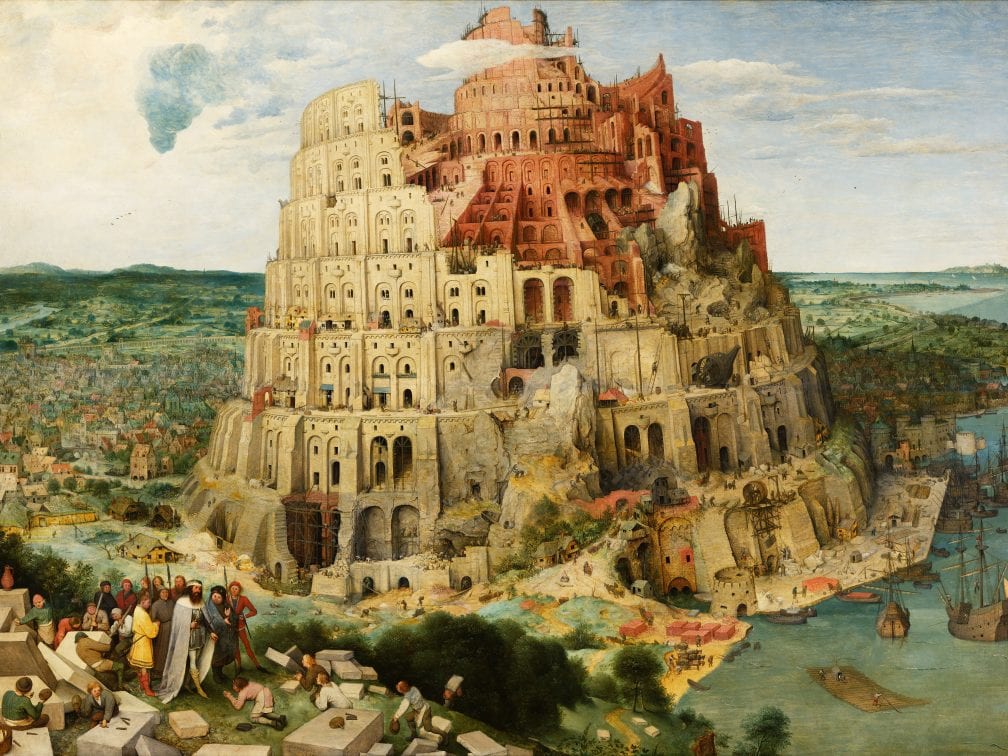

We observe National Poetry Month in the United States and Canada every year with an inquiry into changes in the (meaning of) definitions at the foundation of best practice literature; frequently the subject of sporty debate among experts writing codes and standards for the built environment of education communities.
Hegemon Electric

Data Centers : Boom and Bust

Tax-Free School Bonds
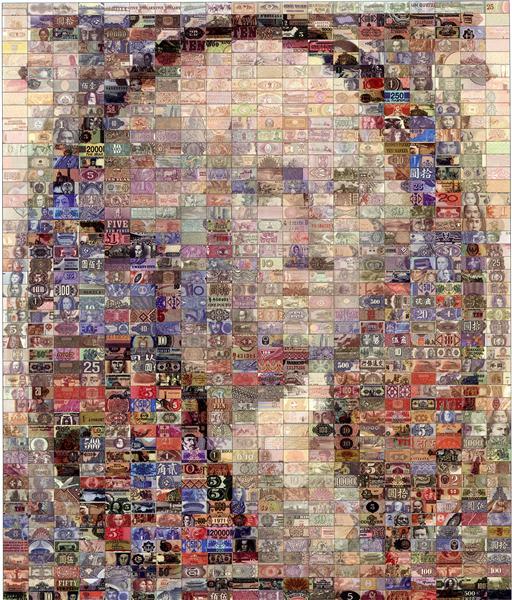

"Mack the Knife" Columbia University Uptown Vocal

Schenkingen

Beaujolais Nouveau Day


@ASABEorg
Lorem ipsum
Nourriture d'automne



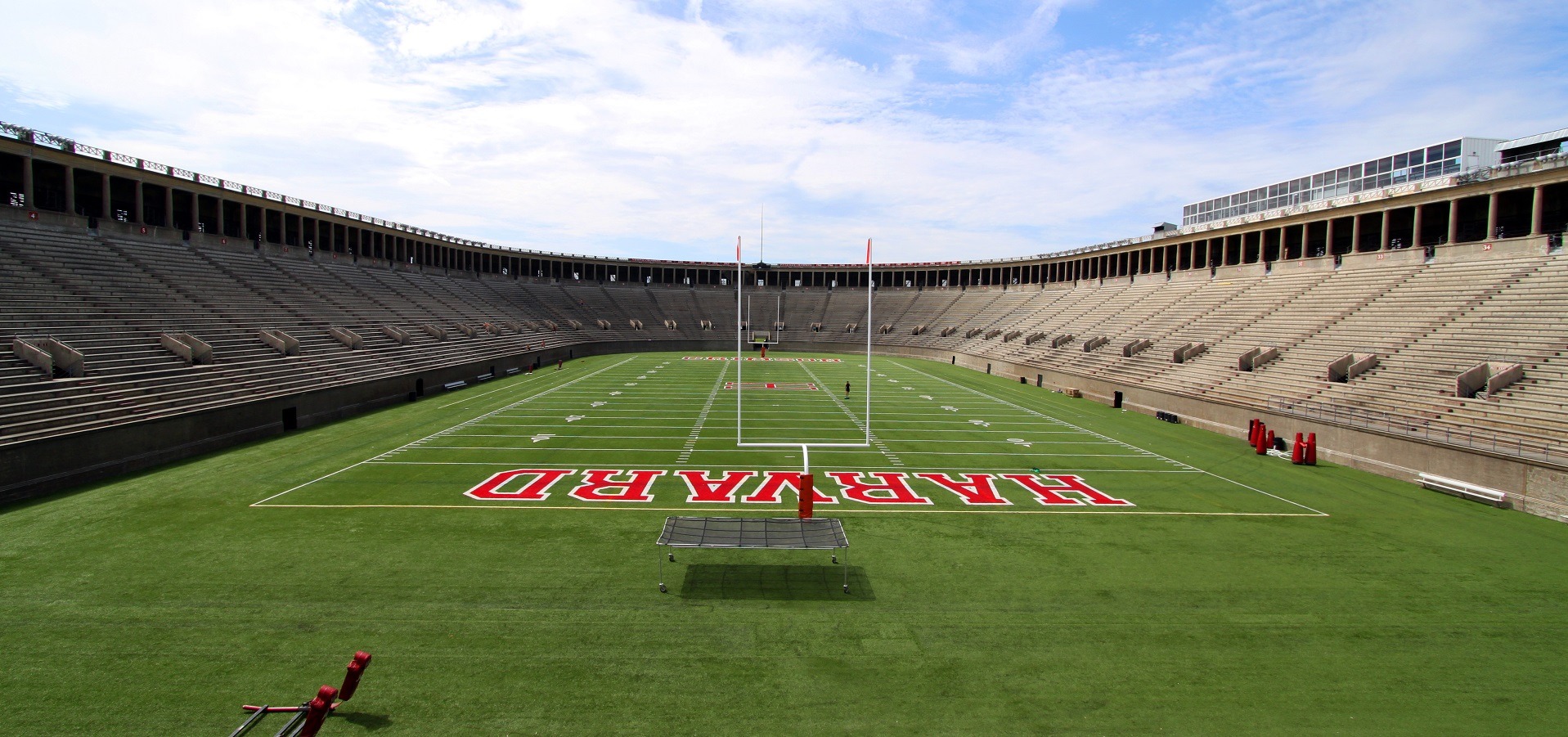


On 9/11 the FDNY lost 343 of their own.
Not statistics. Sons, fathers, husbands from 75 firehouses across the five boroughs.
121 engine companies and 62 ladder companies answered the call. Every Rescue company in New York went in.
They knew the buildings were coming down and… pic.twitter.com/e4ArBUmfLq— Sassafrass84 (@Sassafrass_84) September 7, 2026
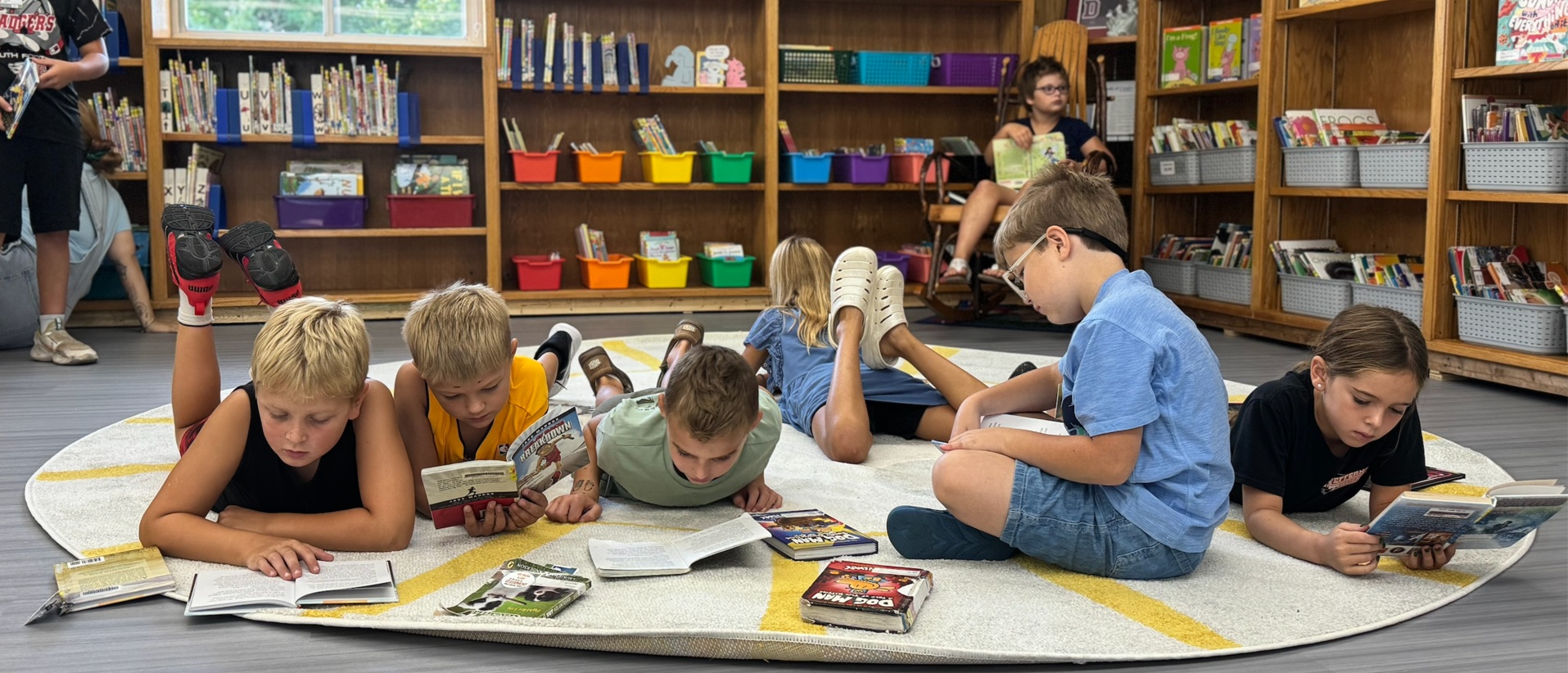
Scales Mound School District | Jo Daviess County Illinois 815
Oxford students after exams, 1989. pic.twitter.com/HQbO4r6dUE
— M (@0detobeauty) May 27, 2026
The calendar of Anglosphere educational settlements subtly shapes life of the mind, generally; and family and community life, specifically. Its cadence has roots in the cathedral schools and monastic learning communities of medieval Europe. Universities were not originally organized around modern “semesters.” Instead, the year followed the Christian liturgical calendar, agricultural seasons, food paths, daylight availability, and travel conditions.
In America educational calendars were nudged along by agricultural cycles. In the United Kingdom university calendars evolved into three major terms: Michaelmas in autumn, associated with arrival and beginnings; Hilary or Lent in winter, associated with discipline and study; and Trinity or Easter in spring, associated with examinations, outdoor rituals, music, rowing, gardens, and celebration.
Modern commencement traditions across the Anglosphere are descendants of medieval spring degree ceremonies. Academic gowns, hoods, processions, Latin phrases, formal dining, chapel music, and public recognition all preserve traces of the university as a scholarly guild and religious-civic community.
Before railways, electric lighting, and central heating, universities had to adapt to muddy roads, short winter days, limited candles, cold buildings, and agricultural obligations. Spring therefore became the natural season of culmination, reunion, athletic competition, courtship, and ceremony.
The medieval university was not merely a school but an educational settlement — a self-governing town of scholars, libraries, chapels, kitchens, workshops, residences, and dining halls. That settlement pattern survives in residential colleges, quadrangles, tutorial systems, common rooms, chapel choirs, and formal meals.
Anglosphere campuses retain this ancient emotional rhythm: autumn seriousness, winter inwardness, and spring release. That continuity helps explain why colleges and universities still feel culturally distinct from ordinary commercial society. (Relata: Gulliver Visits the Great Academy of Lagado)

We’re “organized” but not too organized; like the bookseller who knows where every book can be found.
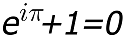
at a conference where you don’t have to present
— Peyman Milanfar (@docmilanfar) April 4, 2025
#AcademicChatter #AcademicTwitter
Academics be like 👇 pic.twitter.com/6cpVEw3PVS
— Reviewer 2 (@GrumpyReviewer2) April 2, 2024






