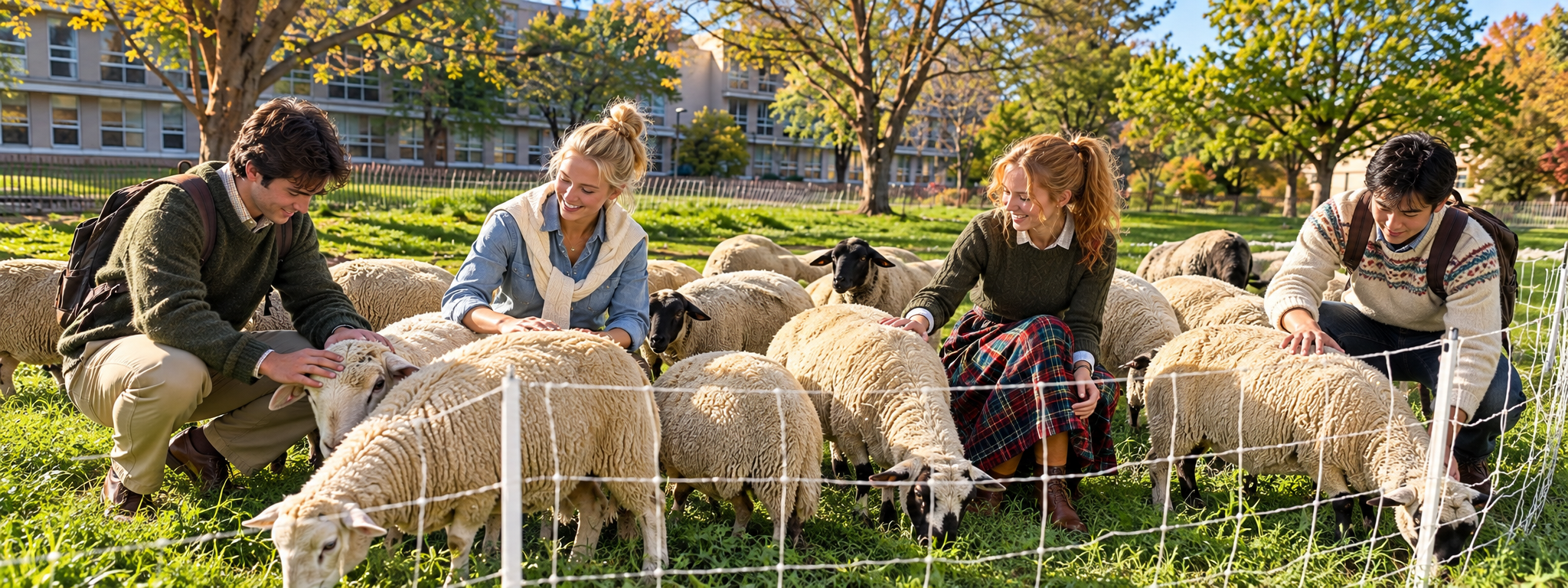
University of California Davis Sheep Mowers

“The Country School” | Winslow Homer Today at 11 AM EDT we review the status consensus products (codes, standards, guidelines, recommendations and safety legislation) that set the standard of care for the design, manufacture and maintenance of interior fixtures such as carpet, furniture, bookshelves and ceiling tiles, plumbing fixtures. Waste management, laboratory fixtures, recycling amenities — i.e. things are not nailed down — are on the agenda. Also we track elevated interest and market-making by conformity interests in the manufacturing and material recycling far up the value chain. In large research universities, it is common for building service personnel engaged in keeping facilities clean and tidy to constitute the largest proportion of permanent employees; thus some consideration must be given to occupational safety. Use the login credentials at the upper right of our home page. “The Country School” | Winslow Homer Today at 11 AM EDT we review the status consensus products (codes, standards, guidelines, recommendations and safety legislation) that set the standard of care for the design, manufacture and maintenance of interior fixtures such as carpet, furniture, bookshelves and ceiling tiles, plumbing fixtures. Waste management, laboratory fixtures, recycling amenities — i.e. things are not nailed down — are on the agenda. Also we track elevated interest and market-making by conformity interests in the manufacturing and material recycling far up the value chain. In large research universities, it is common for building service personnel engaged in keeping facilities clean and tidy to constitute the largest proportion of permanent employees; thus some consideration must be given to occupational safety. Use the login credentials at the upper right of our home page. 
Interiors


Interiors


On 9/11 the FDNY lost 343 of their own.
Not statistics. Sons, fathers, husbands from 75 firehouses across the five boroughs.
121 engine companies and 62 ladder companies answered the call. Every Rescue company in New York went in.
They knew the buildings were coming down and… pic.twitter.com/e4ArBUmfLq— Sassafrass84 (@Sassafrass_84) September 7, 2026

Scales Mound School District | Jo Daviess County Illinois 815
Oxford students after exams, 1989. pic.twitter.com/HQbO4r6dUE
— M (@0detobeauty) May 27, 2026
The calendar of Anglosphere educational settlements subtly shapes life of the mind, generally; and family and community life, specifically. Its cadence has roots in the cathedral schools and monastic learning communities of medieval Europe. Universities were not originally organized around modern “semesters.” Instead, the year followed the Christian liturgical calendar, agricultural seasons, food paths, daylight availability, and travel conditions.
In America educational calendars were nudged along by agricultural cycles. In the United Kingdom university calendars evolved into three major terms: Michaelmas in autumn, associated with arrival and beginnings; Hilary or Lent in winter, associated with discipline and study; and Trinity or Easter in spring, associated with examinations, outdoor rituals, music, rowing, gardens, and celebration.
Modern commencement traditions across the Anglosphere are descendants of medieval spring degree ceremonies. Academic gowns, hoods, processions, Latin phrases, formal dining, chapel music, and public recognition all preserve traces of the university as a scholarly guild and religious-civic community.
Before railways, electric lighting, and central heating, universities had to adapt to muddy roads, short winter days, limited candles, cold buildings, and agricultural obligations. Spring therefore became the natural season of culmination, reunion, athletic competition, courtship, and ceremony.
The medieval university was not merely a school but an educational settlement — a self-governing town of scholars, libraries, chapels, kitchens, workshops, residences, and dining halls. That settlement pattern survives in residential colleges, quadrangles, tutorial systems, common rooms, chapel choirs, and formal meals.
Anglosphere campuses retain this ancient emotional rhythm: autumn seriousness, winter inwardness, and spring release. That continuity helps explain why colleges and universities still feel culturally distinct from ordinary commercial society. (Relata: Gulliver Visits the Great Academy of Lagado)

We’re “organized” but not too organized; like the bookseller who knows where every book can be found.
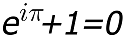
at a conference where you don’t have to present
— Peyman Milanfar (@docmilanfar) April 4, 2025
#AcademicChatter #AcademicTwitter
Academics be like 👇 pic.twitter.com/6cpVEw3PVS
— Reviewer 2 (@GrumpyReviewer2) April 2, 2024