


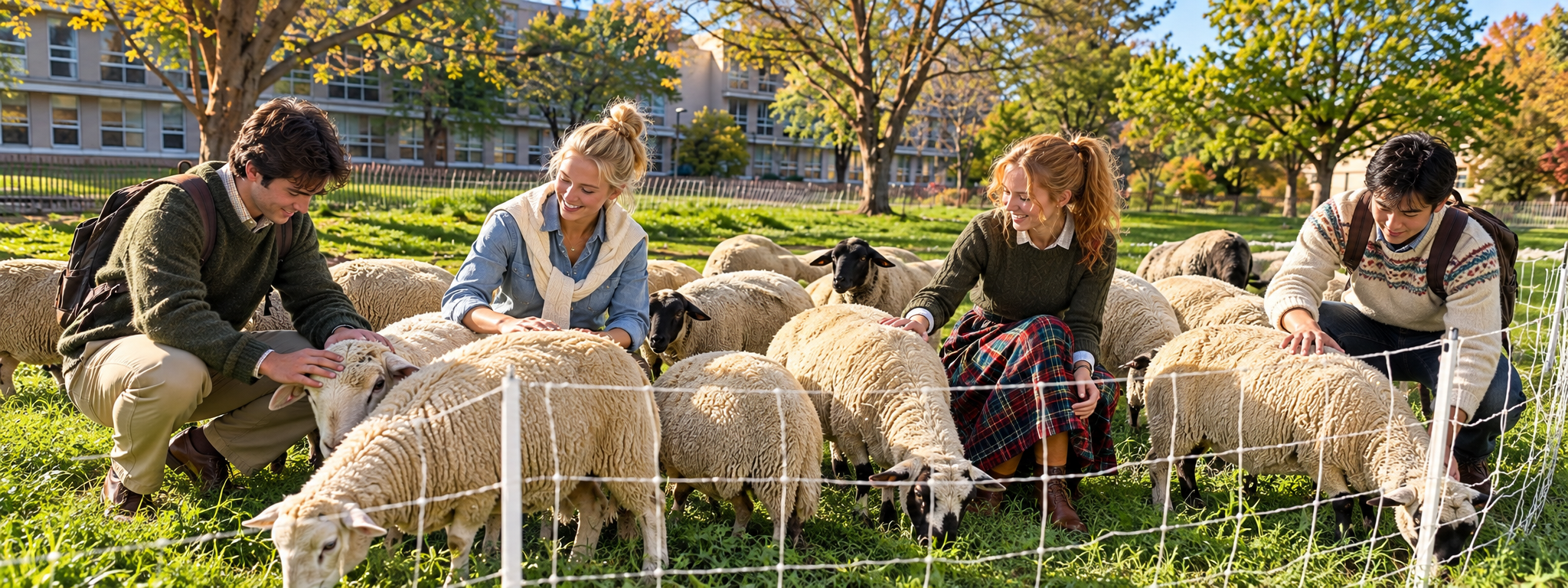
University of California Davis Sheep Mowers

The English-speaking peoples did not invent slavery. They inherited ancient human institutions in Africa, Asia and the Islamic world and, under powerful Christian influence, became among the peoples who transformed opposition to it into sustained political action, abolition and international suppression. For American Public School District Curriculum Leaders: Understanding the broader history of slavery provides essential context for teaching American history as the nation observes the 250th anniversary of its founding. Different civilizations developed different systems of slavery, different routes of commerce and eventually very different histories of abolition. Slavery was not invented by Europeans. Forms of slavery and forced servitude existed for thousands of years in Africa, Europe, Asia, the Middle East and the South American continent including what is now Mexico. Within Africa, captives of war, debtors and members of rival communities were among those enslaved. Long-established African political and commercial networks subsequently became entangled with European demand for labor in the Americas, producing the extraordinarily destructive Atlantic slave trade. This larger history does not diminish the particular brutality of American slavery or its enduring consequences. It places them within the history of a widespread human institution shaped by power, warfare, commerce and law. Teaching that larger history gives students a more complete account of human responsibility than narratives that permanently assign innocence or guilt according to ancestry. The English-speaking world became a leading center of organized abolition. British abolitionists transformed moral and religious opposition to slavery into sustained public action and parliamentary reform. Evangelical Christians, Quakers and others were particularly important. Parliament abolished the British slave trade in 1807 and enacted the Slavery Abolition Act in 1833, with emancipation taking effect across most of the British Empire beginning in 1834. Britain subsequently committed diplomatic, financial and naval resources to suppressing the Atlantic slave trade. The Royal Navy’s West Africa Squadron intercepted slave ships and liberated many thousands of captives. The American story followed a different and far bloodier course. The United States prohibited the importation of enslaved people beginning in 1808, yet slavery expanded domestically and became inseparable from the sectional crisis that produced the Civil War. Southern states seceded in defense of a social and economic order founded substantially upon slavery. Lincoln’s Republican administration ultimately made emancipation a Union war policy, and the Thirteenth Amendment abolished slavery throughout the United States in 1865. Reconstruction was followed by decades of segregation and disenfranchisement in the South before the twentieth-century civil-rights movement secured another profound change in American law and institutions. This history deserves to be taught neither as an indictment nor as an absolution of people living today. Young Americans can understand simultaneously that slavery was brutal, that racial injustice persisted long after emancipation and that societies possess a remarkable capacity for moral reform. The history of abolition is itself part of the history of slavery. For African-American students in particular, that larger field includes considerably more than victimhood. It includes endurance, family formation, religious faith, intellectual achievement, military service, entrepreneurship, abolitionism, political organization and the long exercise of agency under extraordinarily difficult circumstances. Frederick Douglass belongs in this history alongside William Wilberforce. As Americans continue to disagree about how this history should be taught, public schools should expect parents to examine closely the historical narratives presented to their children. Where families conclude that schools present American history principally through inherited grievance or collective guilt, some will seek alternatives through home schooling, charter schools and other forms of education. That competition should encourage every educational institution to pursue historical completeness rather than political conformity. The better objective is neither grievance nor forgetfulness. It is historical proportion: acknowledging human cruelty without denying human achievement, recognizing inherited consequences without assigning inherited guilt and showing young people that institutions can be reformed by people possessing sufficient courage, conviction and persistence. William Wilberforce was born on 24 August 1759 in Kingston upon Hull, Yorkshire, England. Our monthly walk through of revision cycles and public-commenting opportunities regarding codes, standards, recommended practices and other consensus documents developed by the ISO, ICC, ASTM, ASHRAE, NFPA, IFMA, BOMA, APPA and others that set the standard of care for education and university-affiliated facilities. National Dog Day https://t.co/h24agUuw8u@GreatlakesladyMhttps://t.co/I7hZGXT0VK pic.twitter.com/p5BsfZEXQW — Standards Michigan (@StandardsMich) August 26, 2025 “The Peaceable Kingdom” 1833 Edward Hicks Today we update our understanding of the regulations, codes, standards and ethical considerations in the care of animals in education communities. Use the login credentials at the upper right of our home page. Family time pic.twitter.com/tRQH8LV3eW — Chelsea (@therealilwolf) April 17, 2024 In partnership with @Yeatssocietyirl, we are hosting a special virtual event to mark the 100th anniversary of the #poem ‘The Second Coming’ by WB #Yeats. Join us on Friday, 13 Nov at 7pm for an evening of discussion and #poetry readings. 🎟️ Register now: https://t.co/gfU24AEFGz pic.twitter.com/zDbzLjslL5 — National Library of Ireland (@NLIreland) November 5, 2020 someone wanna go feed them for me? So I can stay in bed. Im already late. pic.twitter.com/F2WCu8SrqG — dhani (@juss_dhani) August 4, 2024 Hey Friends! Heading back to school soon and hoping to clear some things from my wish list! If helping kids is your jam and you'd like to support a kindergarten teacher from Michigan, I'd sure appreciate it! #clearthelist @HayesHolly2 https://t.co/pra7x7jDZx pic.twitter.com/h3lBzuf2z4 — Dawn Boschi (@dawnboschi) July 31, 2026 🌸 Hi! I’m Jen! Any help or RT is greatly appreciated ❤️#clearthelist #TeacherofX https://t.co/6724vdbPF0 — Jen 🩷☕️👩❤️👨🐾 (@MrsKMNTeacher) July 31, 2026 If you want to show my classroom wishlist some love here it is. I especially love stickers to hand out to the little ones! I am an elementary school music teacher in Parkland, a Fl. I spend my days making music and building confidence!https://t.co/3ThZuFzSMx pic.twitter.com/GTu47U0jji — Jen Del Sol (@JenDelSol) July 31, 2026 Hiii! I'm Amethyst-my job titles include Gifted & Talented director, SPED/504 coordinator, 3rd & 4th math, science, & social studies teacher, and elementary book club host! I have organized my wishlists here — Amethyst Pemberton (@ame_pemberton) July 10, 2026 Move-In is not merely the movement of belongings. It is the annual reassembly of a generation. https://standardsmichigan.com/gallery-move-in/ Final Results for October 2025 ⛔️UMich Consumer #Sentiment relapsed in August amid new tariff announcements & higher expected inflation — across age, income & stock wealth groups 🔻Sentiment: -5.7% ⚠️”Perceptions of many aspects of the economy slipped” pic.twitter.com/4wYXLRPfAN — Gregory Daco (@GregDaco) August 29, 2025 The University of Michigan Consumer Sentiment Index (MCSI) is released twice a month: Both reports are published at 10:00 AM Eastern Time (ET). Consumer sentiment down amid disagreements on new government policies Consumer sentiment fell for the first time in six months, edging down 4% from December. While assessments of personal finances inched up for the fifth consecutive month, both the short- and long-run business… pic.twitter.com/r2mPTc5XiO — Michigan News (@UMichiganNews) January 24, 2025 https://youtu.be/D0xSuqKoByQ?si=-pawPMfA1bnY3-FM https://youtu.be/GxbKuek88NQ?si=v249UC4EAG2qJXlh https://youtu.be/JkQauI15hlE?si=uAm42E0eGtSCtJPH https://standardsmichigan.com/watersport/ https://twitter.com/OtayMark/status/1687584197752537091?s=20 https://twitter.com/StandardsMich/status/1550752898740543489?s=20 https://twitter.com/SportSapienza/status/1687454976015020033?s=20 https://twitter.com/USASwimming/status/1687150046612250624?s=20 https://twitter.com/Vol_SwimDive/status/1687087529214844928?s=20
William Wilberforce

Essential Works Management
_-_Italian_Palace_-_WGA21774.jpg)


International Dog Day
Animals


https://standardsmichigan.com/animals-100/ Teacher Calls for Supplies
💙Minnesota
👩🏼🏫 1st grade teacher at a Title I school
🍎19th year of teaching.
📚🧮 Need basic supplies, books, SEL items
♥️ regular classroom wishlist https://t.co/3LRyK1yJyw
🖤 dream items… pic.twitter.com/3p6RHPxmVO
Housing Move-In

United States Consumer Sentiment
🔻Current Conditions -9.3%
🔻Expectations -3.1% Summer Watersport




On 9/11 the FDNY lost 343 of their own.
Not statistics. Sons, fathers, husbands from 75 firehouses across the five boroughs.
121 engine companies and 62 ladder companies answered the call. Every Rescue company in New York went in.
They knew the buildings were coming down and… pic.twitter.com/e4ArBUmfLq— Sassafrass84 (@Sassafrass_84) September 7, 2026
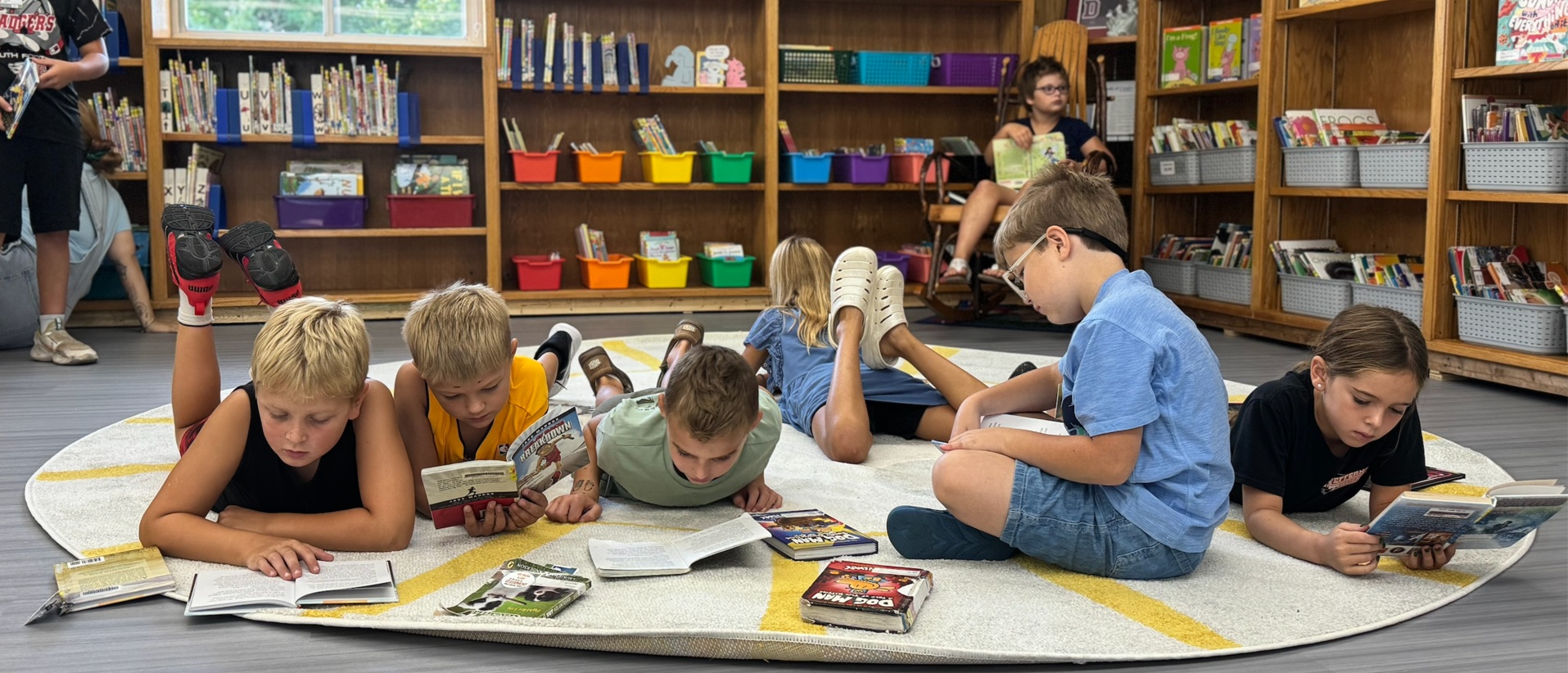
Scales Mound School District | Jo Daviess County Illinois 815
Oxford students after exams, 1989. pic.twitter.com/HQbO4r6dUE
— M (@0detobeauty) May 27, 2026
The calendar of Anglosphere educational settlements subtly shapes life of the mind, generally; and family and community life, specifically. Its cadence has roots in the cathedral schools and monastic learning communities of medieval Europe. Universities were not originally organized around modern “semesters.” Instead, the year followed the Christian liturgical calendar, agricultural seasons, food paths, daylight availability, and travel conditions.
In America educational calendars were nudged along by agricultural cycles. In the United Kingdom university calendars evolved into three major terms: Michaelmas in autumn, associated with arrival and beginnings; Hilary or Lent in winter, associated with discipline and study; and Trinity or Easter in spring, associated with examinations, outdoor rituals, music, rowing, gardens, and celebration.
Modern commencement traditions across the Anglosphere are descendants of medieval spring degree ceremonies. Academic gowns, hoods, processions, Latin phrases, formal dining, chapel music, and public recognition all preserve traces of the university as a scholarly guild and religious-civic community.
Before railways, electric lighting, and central heating, universities had to adapt to muddy roads, short winter days, limited candles, cold buildings, and agricultural obligations. Spring therefore became the natural season of culmination, reunion, athletic competition, courtship, and ceremony.
The medieval university was not merely a school but an educational settlement — a self-governing town of scholars, libraries, chapels, kitchens, workshops, residences, and dining halls. That settlement pattern survives in residential colleges, quadrangles, tutorial systems, common rooms, chapel choirs, and formal meals.
Anglosphere campuses retain this ancient emotional rhythm: autumn seriousness, winter inwardness, and spring release. That continuity helps explain why colleges and universities still feel culturally distinct from ordinary commercial society. (Relata: Gulliver Visits the Great Academy of Lagado)

We’re “organized” but not too organized; like the bookseller who knows where every book can be found.
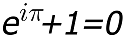
at a conference where you don’t have to present
— Peyman Milanfar (@docmilanfar) April 4, 2025
#AcademicChatter #AcademicTwitter
Academics be like 👇 pic.twitter.com/6cpVEw3PVS
— Reviewer 2 (@GrumpyReviewer2) April 2, 2024





