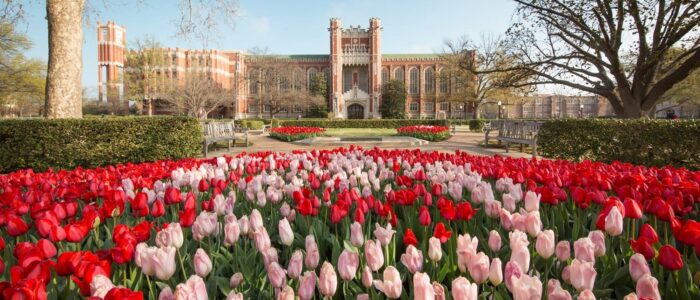
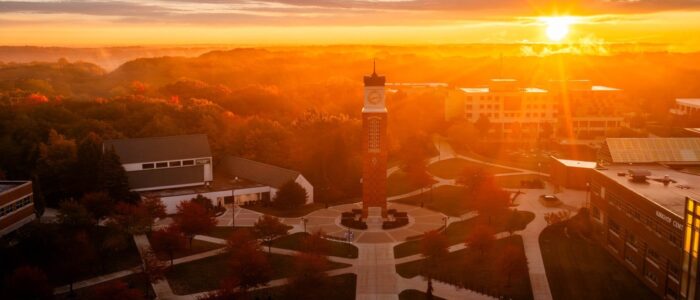
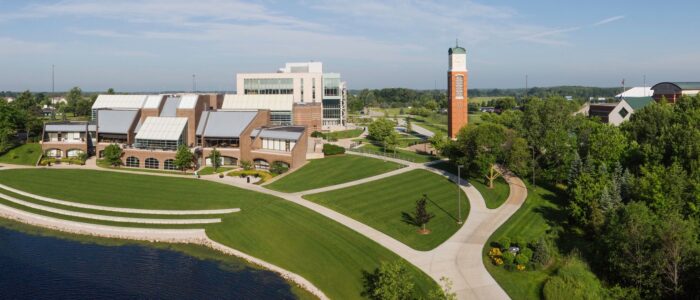
Situated near the heart of the settlement along the Arcadia Creek Watershed as a reminder that the postwar American campus was conceived as something more than classrooms, laboratories and residence halls. Planned during Western’s great expansion onto its West Campus, the chapel was made possible by the estate of alumnus William Kanley and completed in the early 1950s. It became a memorial to Western students lost in the Second World War.
Designed by Ralph Calder and Associates, Kanley belongs to Michigan’s mid-century modern tradition. Its restrained exterior, prominent tower and remarkable collection of 72 student-designed stained-glass windows give the building an unusually intimate relationship with the university community. Students did not merely occupy the chapel; they helped make it.
That relationship extended into the rhythm of campus life. Early Western yearbooks place weekly chapel services and Sunday evening meetings alongside concerts, lectures and theater as part of the university’s cultural life. Another remembers hymns sounding from Kanley’s bell tower across campus on quiet evenings.
This content is accessible to paid subscribers. To view it please enter your password below or send mike@standardsmichigan.com a request for subscription details.
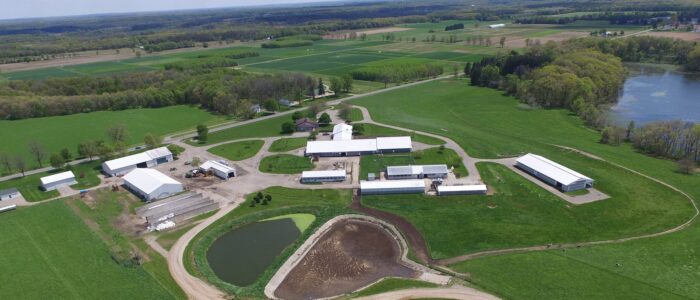
One characteristic of the “customer experience” of school children, dormitory residents, patients in university-affiliated hospitals and attendees of large athletic events is the quality of food. School districts and large research universities are responsible for hundreds of food service enterprises for communities that are sensitive to various points along the food supply chain.
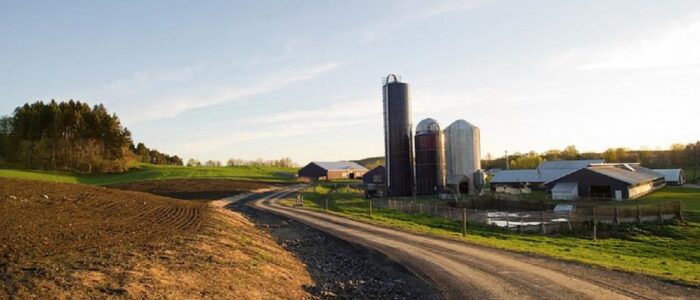
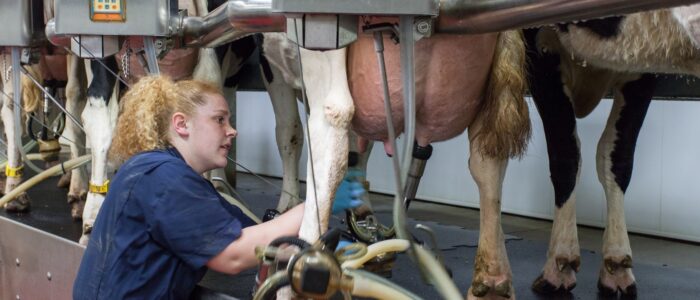
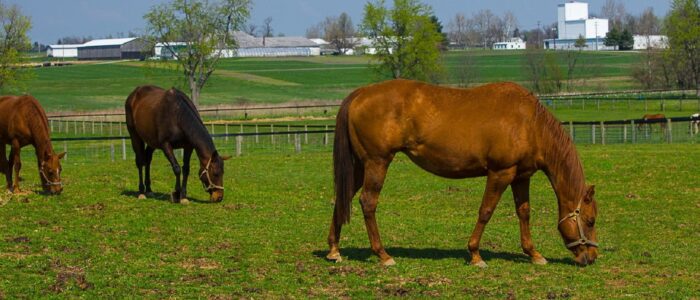
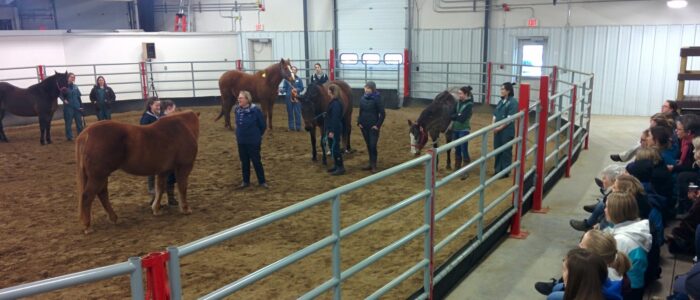
The American Society of Agricultural and Biological Engineers (ASABE) is one of the first names in standards setting for the technology and management of the major components of the global food supply chain. It has organized its ANSI-accredited standards setting enterprise into about 200 technical committees developing 260-odd consensus documents*. It throws off a fairly steady stream of public commenting opportunities; many of them relevant to agricultural equipment manufacturers (i.e, the Producer interest where the most money is) but enough of them relevant to consumers (i.e. the User interest where the least money is) and agricultural economics academic programs that we follow the growth of its best practice bibliography.
A few of the ASABE consensus documents that may be of interest to faculty and students in agricultural and environmental science studies are listed below:
Safety for Farmstead Equipment
Safety Color Code for Educational and Training Laboratories
Recommended Methods for Measurement and Testing of LED Products for Plant Growth and Development
Distributed Ledger Technology applications to the global food supply chain
The ASABE bibliography is dominated by product-related standards; a tendency we see in many business models of standards setting organizations because of the influence of global industrial conglomerates who can bury the cost of their participation into a sold product. Our primary interest lies in the movement of interoperability standards — much more difficult — as discussed in our ABOUT.
The home page for the ASABEs standards setting enterprise is linked below:
As of this posting we find no live consultation notices for interoperability standards relevant to educational settlements. Sometimes you can find them ‘more or less concurrently’ posted at the linked below:
We always encourage our colleagues to participate directly in the ASABE standards development process. Students are especially welcomed into the ASABE Community. Jean Walsh (walsh@asabe.org) and Scott Cederquist (cedarq@asabe.org) are listed as contacts.
Colleagues: Mike Anthony, Jack Janveja, Richard Robben
Meet Raley Kirk from San Saba, TX. Raising hair sheep and Spanish goats in the Texas Hill Country, Raley is proud to play a part in providing the food and fiber our country depends on every day.
For her, National Ag Week is about highlighting that meaningful work and ensuring… pic.twitter.com/9KKC4pzRgC
Located 15 minutes from Traverse City, this Laker alum and his family are celebrating their 10th season at Rove Winery this summer! 🍷🍇 Read about Creighton Gallagher ’06 and his journey to the vineyard here: https://t.co/lJ0eYlL7z7pic.twitter.com/iAXWXRuglO
Settled in the Village of Berrien Springs (Population 2043, including students) Andrews University is the flagship educational institution of the Seventh-day Adventist Church, and is made up of the Seventh-day Adventist Theological Seminary, College of Arts and Sciences, School of Business Administration, School of Education, School of Health Professions, and the School of Architecture, Art & Design.
The University is named after John Nevins Andrews (1829–1883), the biggest thinker in the 19th-century Seventh-day Adventist Church. He was also the first sponsored missionary that the Church sent overseas. J.N. Andrews’ example of careful thought and compassionate action in Christian life is something we have taken to heart. Our motto is “Seek Knowledge. Affirm Faith. Change the World.”
Andrews University is honored to be ranked as one of the top 15 Christian universities and the highest ranked Adventist university in the country in the 2024 Niche Best Colleges report. pic.twitter.com/FQb7czeHoL
Pres. JW Taylor greeted Julianna Magan, her parents, Andy & Cindy Magan, & sister, Clara, at Sutherland House on Aug. 19. Julianna, a transfer student, & Clara are great-great-great-granddaughters of Percy T. Magan, 1 of the 2 major founders of the Andrews Berrien Springs campus. pic.twitter.com/2wqcgUQBdl
💉✨ Choose your pathway to nursing success! Davenport’s BSN program offers flexible admission options, no waitlists, and three years of hands-on learning. Apply now! https://t.co/nJB6eNMhBs
The 1943 American bombing of the hydrogen plant at Rjukan Norway — so that the Germans could not make a heavy water hydrogen bomb — resembles the 2026 American bombing of Operation Epic Fury. Inspired by Norwegian family immigration to the shores of Lake Michigan we collect stories of those families fleeing the economic hardship of their homeland before the discovery of North Sea oil.
In the late 1960s, the discovery of massive North Sea oil reserves transformed Norway from a modest fishing, shipping, and hydroelectric economy into one of the world’s richest nations. Oil revenues funded an expansive welfare state and created the world’s largest sovereign wealth fund. This “outsized good fortune” should temper any sense of moral or cultural superiority some Norwegians express toward America. Striking oil is no guarantee of success — see Venezuela or Nigeria. Norway also benefited from American technology, open markets, and capital.
The United States further provided critical security: liberating Norway in WWII and leading NATO during the Cold War, allowing Norway to focus on welfare rather than heavy defense. No student debt! Arrogance ignores contingency. Norway’s success rests on oil rents, a small homogeneous population, high trust, and luck — not inherent superiority. America’s innovations and security role helped create the global order that enabled such fortunes in Norway specifically and Western Europe generally. Recall the American role in the destruction of the German heavy water refinement plants in November 1943 (The Heroes of Telemark) which bears an uncanny resemblance to the present USA Operation Epic Fury in Iran.
Gratitude and humility suit these discussions better than condescension.
This content is accessible to paid subscribers. To view it please enter your password below or send mike@standardsmichigan.com a request for subscription details.
This content is accessible to paid subscribers. To view it please enter your password below or send mike@standardsmichigan.com a request for subscription details.
This content is accessible to paid subscribers. To view it please enter your password below or send mike@standardsmichigan.com a request for subscription details.
New update alert! The 2022 update to the Trademark Assignment Dataset is now available online. Find 1.29 million trademark assignments, involving 2.28 million unique trademark properties issued by the USPTO between March 1952 and January 2023: https://t.co/njrDAbSpwBpic.twitter.com/GkAXrHoQ9T