Clambake: A History and Celebration of an American Tradition

Loading
loading...

Clambake: A History and Celebration of an American Tradition

July 1, 2026
mike@standardsmichigan.com
, ,

Yes — and there is serious academic treatment of the New England clambake, enough that it could support something richer than a food post.

The place I would begin is Katherine D. Neustadt’s Clambake: A History and Celebration of an American Tradition, published by the University of Massachusetts Press edition listing in 1992. It is essentially a scholarly ethnography/history of the clambake. Neustadt organizes the subject around its social, economic, political and regional history, then studies the long-running Allen’s Neck clambake in Massachusetts and finally treats the clambake as food, ritual and festival.

That last formulation is especially promising for Standards Michigan. Neustadt’s work treats the meal not simply as a recipe but as a community institution — something through which people express place, season, memory and belonging. An Indiana University scholarly review describes the book as an ethnography concerned with the “invention of tradition,” usable pasts, power and the relationship between observer and participant.

There is also an interesting historical complication. The familiar story says coastal Native Americans taught colonists the clambake. The scholarship is considerably more cautious. A University of Rhode Island Sea Grant environmental history, drawing on Neustadt, notes that archaeological and written evidence does not establish the familiar nineteenth-century version of that origin story. Neustadt consequently sees something more complicated: Native cultural inheritance intertwined with a tradition subsequently constructed and ritualized by white New Englanders. Historic New England reaches much the same conclusion: Indigenous peoples unquestionably harvested and cooked shellfish, but the genealogy of the recognizable New England beach clambake is not securely established.

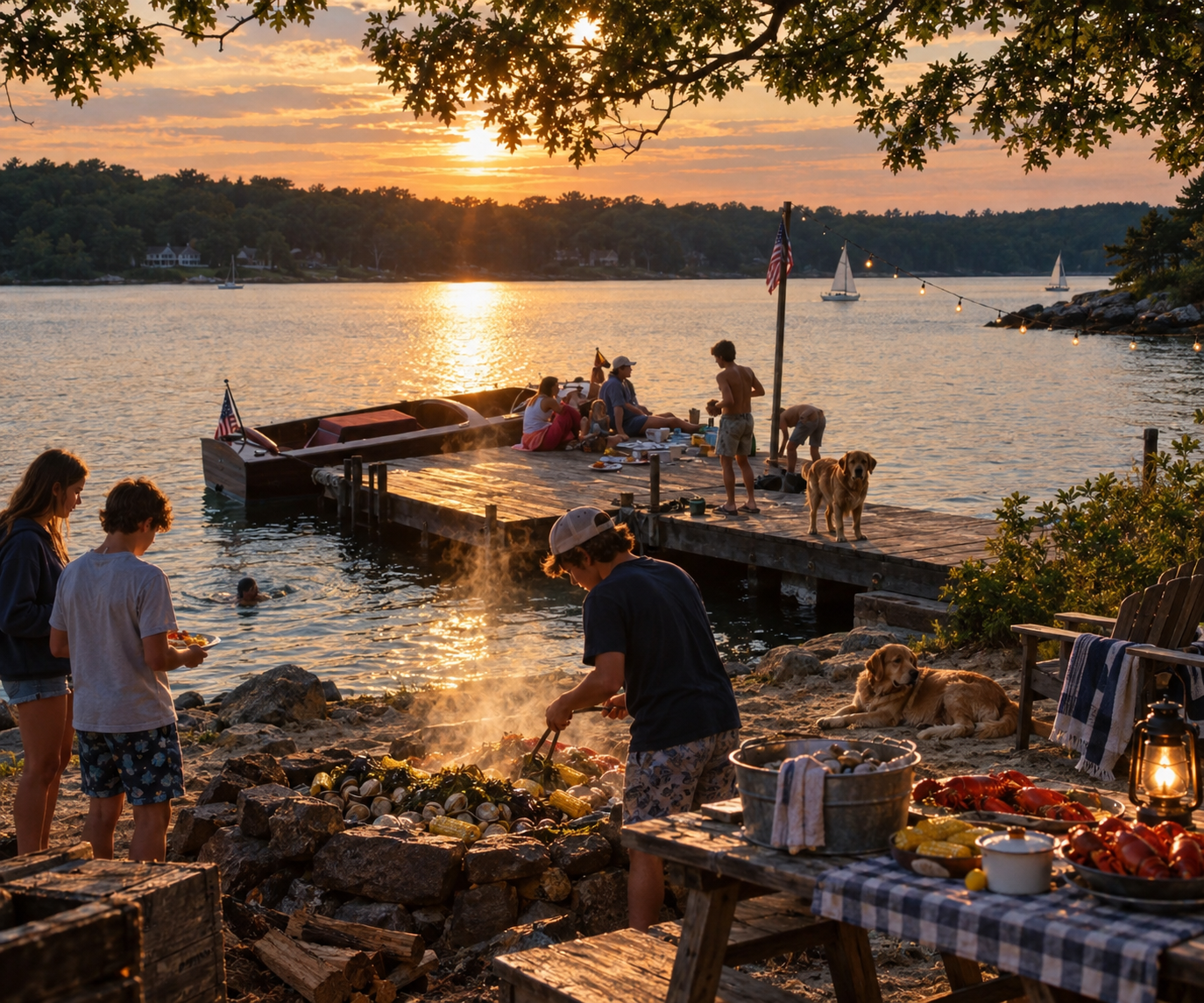
What really catches my attention for an August Sunday, however, is a scholarly archaeological treatment that quotes Neustadt describing clambaking as a seasonal rite marking the end of summer and as a means of transmitting traditional knowledge. The same research discusses the physical process itself — gathering stone, firewood and rockweed, heating the stones and orchestrating the bake — as part of the tradition rather than merely a cooking technique.

And there is a campus connection. Massachusetts Institute of Technology has actually used the New England clambake as part of institutional social life: its 2014 reunion program included a clambake on Kresge Oval for the 25th reunion class.

So I think you’ve stumbled onto an unusually good late-August Sunday subject. It gives us seafood and summer dining on the surface, but underneath it are season, landscape, fire, water, inherited practice, community assembly and the transmission of culture. In other words, rather more Standards Michigan material than the clams initially let on.


McGrath Clambakes and Catering

Yes. Harvard gives you a couple of good college-site examples, though one is stronger on the tradition itself and another on how the custom survives in university life.

The best historical/cultural reference I found is a Harvard Environmental Law Review article that explicitly describes the New England clambake as a longstanding regional custom with origins in the cooking practices of Indigenous coastal peoples, later adopted broadly into New England culture.

For a more accessible campus-life angle, Harvard’s Biophysics Graduate Program has an annual Year-End Clambake held around Commencement. The university describes it as a recurring celebration for graduating Ph.D. students, faculty and guests, featuring lobster and other traditional fare.

Harvard College Observatory has also hosted a summer staff and faculty clambake, with lobster, littleneck clams, New England clam chowder, mussels, corn and strawberry shortcake—a very recognizable New England summer menu.

For Standards Michigan, I think the Harvard Biophysics example is especially useful: it shows the clambake not merely as regional cuisine, but as a summer academic custom marking the end of the university year. That’s exactly the kind of ordinary cultural continuity you’ve been looking for in educational settlements.

Layout mode
Predefined Skins
Custom Colors
Choose your skin color
Patterns Background
Images Background
Standards Michigan
error: Content is protected !!
Skip to content