


Tag Archives: D5/3
- Home
- Posts tagged "D5/3" (Page 2)

loading..

Southern Ice Cream
University of Mississippi Financial Statement 2023: $1.207B

Demystifying the graduate school application process with our #nanoREU students @OxfordCreamery 🍦 pic.twitter.com/4HLda9lhSC
— Nikki Reinemann (@OleMiss_MBELab) July 15, 2024

US Department of Agriculture | § 58.2825 United States Standard for ice cream.
Southern ice cream often differs from ice cream in other regions of the U.S. in several ways, reflecting regional tastes, ingredients, and traditions:
- Flavors and Ingredients:
- Pecans and Pralines: Southern ice cream frequently incorporates pecans and pralines, which are popular in the region.
- Peaches: Georgia is known for its peaches, so peach-flavored ice cream is a Southern staple.
- Sweet Tea and Bourbon: These flavors are inspired by Southern beverages and can be found in ice creams.
- Buttermilk: Buttermilk ice cream has a tangy flavor and is a nod to traditional Southern cooking.
- Style and Texture:
- Custard Base: Southern ice cream often uses a custard base, which includes egg yolks, giving it a richer and creamier texture compared to the typical Philadelphia-style ice cream that uses a simpler cream and sugar base.
- Churned at Home: Traditional Southern ice cream is often made using hand-cranked ice cream makers, producing a different texture and incorporating more air, which can make it lighter and fluffier.
- Historical Influence:
- Cultural Heritage: The South’s diverse cultural heritage influences its ice cream, with recipes passed down through generations and reflecting African American, Native American, and European influences.
- Popular Brands and Shops:
- Regional Brands: Brands like Blue Bell, which originated in Texas, are particularly popular in the South and known for their classic Southern flavors.
- Local Shops: Small, local ice cream parlors in the South often offer unique, homemade flavors that highlight regional ingredients and traditions.
These differences highlight the South’s rich culinary traditions and how they extend even to sweet treats like ice cream.

University of Mississippi | Lafayette County



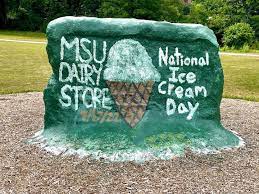
Ice Cream at the Rock
“The only emperor is the emperor of ice cream”
— Wallace Stevens
The invention of ice cream, as we know it today, is a product of historical evolution, and there isn’t a single individual credited with its creation. Various cultures and civilizations throughout history have contributed to the development of frozen treats resembling ice cream.
One of the earliest records of frozen desserts can be traced back to ancient China, where people enjoyed a frozen mixture of milk and rice around 200 BC. Similarly, ancient Persians and Arabs had a tradition of mixing fruit juices with snow or ice to create refreshing treats.
In Europe, frozen desserts gained popularity in the 17th and 18th centuries, and it was during this time that the more modern version of ice cream, made with sweetened milk or cream, began to take shape. During this period, ice cream became more widely accessible and enjoyed by the nobility and upper classes.
MSU Infrastructure Planning and Facilities
To produce ice cream on a commercial scale, several key pieces of infrastructure and equipment are necessary. The specific requirements may vary depending on the production capacity and the type of ice cream being produced, but the basic infrastructure typically includes:
- Manufacturing Facility: A dedicated space or building is needed to house all the production equipment and storage facilities. The facility should comply with local health and safety regulations and be designed to maintain the required temperature and hygiene standards.
- Mixing and Blending Equipment: Industrial-scale mixers and blending machines are used to mix ingredients like milk, cream, sugar, stabilizers, emulsifiers, and flavorings. These machines ensure that the mixture is homogenized and consistent.
- Pasteurization Equipment: To ensure product safety and extend shelf life, ice cream mix needs to be pasteurized. Pasteurization equipment heats the mixture to a specific temperature and then rapidly cools it to destroy harmful microorganisms.
- Homogenizers: Homogenizers help break down fat molecules in the ice cream mix to create a smoother and creamier texture.
- Aging Vats: The ice cream mix is aged at a controlled temperature for a specific period, which allows the ingredients to fully blend and improves the ice cream’s texture.
- Freezers: Continuous freezers or batch freezers are used to freeze the ice cream mix while incorporating air to create the desired overrun (the amount of air in the final product). Continuous freezers are more commonly used in large-scale production, while batch freezers are suitable for smaller batches.
- Hardening and Storage Room: Once the ice cream is frozen, it needs to be hardened at a lower temperature to achieve the desired texture. Storage rooms are used to store finished ice cream at the appropriate temperature until distribution.
- Packaging Equipment: Equipment for filling and packaging the ice cream into various containers, such as cartons, tubs, or cones.
- Quality Control and Laboratory Facilities: A dedicated area for quality control testing, where ice cream samples are analyzed for consistency, flavor, and other characteristics.
- Cleaning and Sanitation Systems: Proper cleaning and sanitation systems are essential to maintain hygiene and prevent contamination.
- Utilities: Adequate water supply, electrical power, and refrigeration capacity are critical for ice cream production.

Boosting Equality in Brewing
How Do You Measure the Percentage of Alcohol in Beer, Wine and Other Beverages?
Readings:
Pew Research Center: “Childlessness Up Among All Women; Down Among Women with Advanced Degrees”
Business Insider: More and more women just don’t want children: ‘Kids are expensive and sticky’
BBC: The adults celebrating child-free lives
How To Cope With The Loneliness Of Being Single: Being Single in the 21st Century
The Historical Role of Women in Higher Education

Root Beer Olympics

“Standard Root Beer” is typically made using a combination of ingredients that include water, sugar, sassafras root or extract, and various other flavoring agents. Here’s a general overview of the process:
- Sassafras Flavoring: In traditional root beer recipes, sassafras root or extract is a key ingredient. However, it’s important to note that sassafras contains safrole, a compound that has been deemed potentially carcinogenic. For this reason, commercial root beers often use a safrole-free sassafras flavoring.
- Sweetener: Sugar is commonly used to sweeten root beer, although some recipes may use alternatives like corn syrup or honey. The amount of sweetener can vary based on personal preference.
- Water: Root beer typically starts with plain water as its base. The water is heated to dissolve the sweetener and other ingredients.
- Flavorings: Besides sassafras flavoring, root beer can include a range of other flavorings to create its distinct taste. These may include wintergreen, vanilla, anise, licorice, molasses, or other herbs and spices. The exact combination of flavors varies among different root beer recipes.
- Carbonation: Carbonation gives root beer its characteristic fizz. This can be achieved by using carbonated water or by introducing carbon dioxide gas into the mixture. In commercial production, carbonation is typically added during the bottling process.
- Yeast Fermentation (optional): Some traditional homemade root beer recipes involve a fermentation step. Yeast is added to the root beer mixture, which consumes the sugar and produces carbon dioxide as a byproduct. This creates a natural carbonation in the beverage. However, this step can also increase the alcohol content, so it’s important to be mindful of the fermentation duration.
- Bottling and Aging: Once the root beer is prepared, it is typically poured into bottles or kegs and sealed. Some recipes may recommend allowing the root beer to age for a certain period to develop the desired flavors.
It’s worth noting that the commercial production of root beer may involve different processes, as well as the use of artificial flavors, stabilizers, and preservatives to ensure consistency and shelf life. The specific recipe and production methods may vary among manufacturers.


New Beaver Brewery
This content is accessible to paid subscribers. To view it please enter your password below or send mike@standardsmichigan.com a request for subscription details.
The Science of Beer Brewing
This content is accessible to paid subscribers. To view it please enter your password below or send mike@standardsmichigan.com a request for subscription details.

Robert De Niro | Cambridge Union
The Cambridge Union is the oldest debating society in the world, as well as the largest student society in Cambridge. It remains one of the highest-ranking competitive debating chambers worldwide, and hosts a range of speakers and topical debates each term.
Since 1815 the Union has been committed to the principles of free speech and of fair, open, and honest debate. Founded at a time when the university authorities attempted to restrict these freedoms, the Union remains the centre of controversial and serious debate within the University of Cambridge.
The Union has been discussing, debating, and shaping the issues that matter for the last two hundred years. Understanding how concepts work, challenging ideas, and having a frank discussion is the bedrock upon which our society is founded. It is the responsibility of the Union to ensure that these ideals are protected and nurtured for years to come.

Academic and Financial Planning and Analysis

New update alert! The 2022 update to the Trademark Assignment Dataset is now available online. Find 1.29 million trademark assignments, involving 2.28 million unique trademark properties issued by the USPTO between March 1952 and January 2023: https://t.co/njrDAbSpwB pic.twitter.com/GkAXrHoQ9T
— USPTO (@uspto) July 13, 2023
Welcome
Standards Michigan Group, LLC
2723 South State Street | Suite 150
Ann Arbor, MI 48104 USA
888-746-3670
DIRECTIONS
 |
 |
|
 |
 |
|
 |
 |
Layout mode
Predefined Skins
Custom Colors
Choose your skin color
Patterns Background
Images Background
error: Content is protected !!
Skip to content