




“Having visited my great grandmother, Omi, in Germany multiple times growing up, I’ve always had a special connection to German baked goods. While I have yet to find the perfect German pretzel in the U.S. or a recipe that yields a decent replica, I have discovered that stollen — a traditional German Christmas bread — is relatively easy to recreate in my own kitchen.” — Alison Tashima, Class of 2024
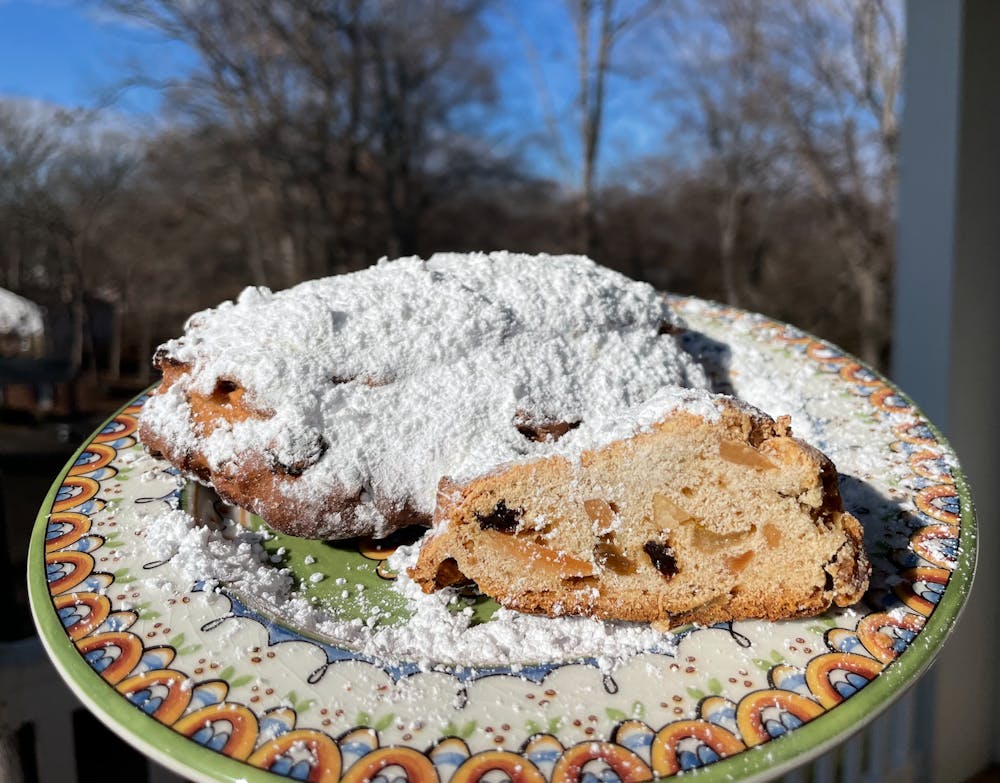
Click image for recipe

More:
Thomas Jefferson’s Masterpiece
Thomas Jefferson & the University of Virginia
University of Virginia Financial Report: 2023 Net Position $12.580B
University of Virginia Capital Construction & Renovations
The recent tragedy inspires a need to review relevant safety standards. Today, a very brief examination and discussion about whether there is an enforceable standard solution that already exists, or is there an affordable solution to remediate a gap. Just a very cursory review today during our Open Office Hour.
2025 Annual Security Report and Annual Fire Safety Report

This content is accessible to paid subscribers. To view it please enter your password below or send mike@standardsmichigan.com a request for subscription details.
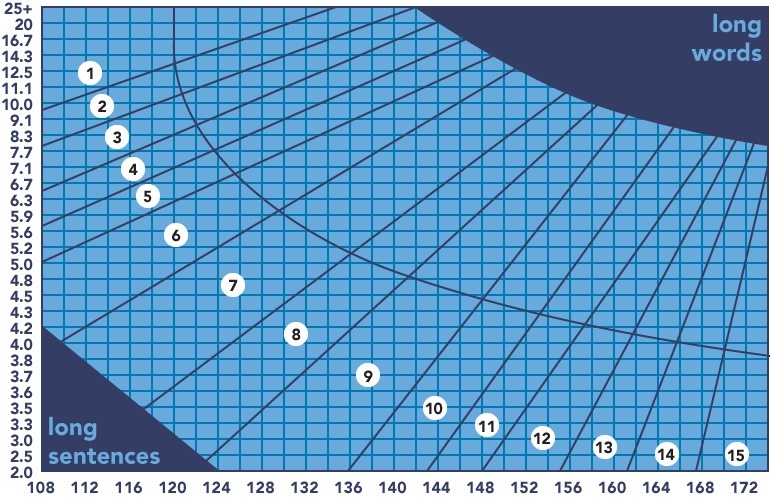
Fry readability formula
Abstract. Research problem: Readability equations are widely used to compute how well readers will be able to understand written materials. Those equations were usually developed for nontechnical materials, namely, textbooks for elementary, middle, and high schools. This study examines to what extent computerized readability predictions are consistent for highly technical material – selected Society of Automotive Engineers (SAE) and International Standards Organization (ISO) Recommended Practices and Standards relating to driver interfaces. Literature review: A review of original sources of readability equations revealed a lack of specific criteria in counting various punctuation and text elements, leading to inconsistent readability scores. Few studies on the reliability of readability equations have identified this problem, and even fewer have systematically investigated the extent of the problem and the reasons why it occurs. Research questions:
(1) Do the most commonly used equations give identical readability scores?
(2) How do the scores for each readability equation vary with readability tools?
(3) If there are differences between readability tools, why do they occur?
(4) How does the score vary with the length of passage examined?
Method: Passages of varying lengths from 12 selected SAE and ISO Recommended Practices and Standards were examined using five readability equations (Flesch-Kincaid Grade Level, Gunning Fog Index, SMOG Index, Coleman-Liau Index, and Automated Readability Index) implemented five ways (four online readability tools and Microsoft Word 2013 for Windows). In addition, short test passages of text were used to understand how different readability tools counted text elements, such as words and sentences. Results and conclusions: The mean readability scores of the passages from those 12 SAE and ISO Recommended Practices and Standards ranged from the 10th grade reading level to about 15th. The mean grade reading levels computed across the websites were: Flesch-Kincaid 12.8, Gunning Fog 15.1 SMOG 12.6, Coleman-Liau 13.7, and Automated Readability Index 12.3. Readability score estimates became more consistent as the length of the passage examined increased, with no noteworthy improvements beyond 900 words. Among the five readability tools, scores typically differed by two grade levels, but the scores should have been the same. These differences were due to how compound and hyphenated words, slashes, numbers, abbreviations and acronyms, and URLs were counted, as well other punctuation and text elements. These differences occurred because the sources for these equations often did not specify how to score various punctuation and text elements. Of the tools examined, the authors recommend Microsoft Word 2013 for Windows if the Flesch-Kincaid Grade Level is required.
ICYMI. The OED has recently been updated with:
new words, phrases and senses added
more than 1,000 entries revised
new audio files and pronunciation transcriptions from Northern England and North-Eastern England
and more!Learn more: https://t.co/JCLcZzTtEQ pic.twitter.com/FhdbPKxBVZ
— The OED (@OED) April 4, 2025
Virginia Woolf: pic.twitter.com/8IPw1Fmevk
— Dr. Maya C. Popa (@MayaCPopa) May 25, 2023
Lyrics, Augustus Toplady 1776 | Calvin University Hymnary Kent County Michigan
Today’s weather is ‘snow’ joke! ❄️ pic.twitter.com/JXxwEN6Vll
— Brown University (@BrownUniversity) December 20, 2024
Internet Archive: “Catcher in the Rye” 1951 , J.D. Salinger
Harold Bloom’s Catcher in the Rye Critical Readings
Selected quotes:
“I’m quite illiterate, but I read a lot.”
“It’s funny. All you have to do is say something nobody understands and they’ll do practically anything you want them to.”
“The mark of the immature man is that he wants to die nobly for a cause, while the mark of the mature man is that he wants to live humbly for one.”
“I like it when somebody gets excited about something. It’s nice.”
“If a girl looks swell when she meets you, who gives a damn if she’s late? Nobody.”
Related:
“For Esme, with Love and Squalor” 1950, J.D. Salinger
— Edward Elderman (@edwereddie) November 26, 2025
BSI Group: Consumer, Retail & Food Standards
Higher Education (Freedom of Speech) Act 2023
This British festive pastry has origins dating back to the 13th century when European Crusaders returned from the Middle East with recipes containing meats, fruits, and spices. These early pies, known as “mincemeat pies,” combined minced meat (usually mutton), suet, fruits, and spices such as cinnamon, cloves, and nutmeg, symbolizing the gifts of the Magi. In the 16th century, the pies were rectangular, representing Jesus’ crib.
Over time, the meat content reduced, and by the Victorian era, the recipe had evolved to primarily include dried fruits, suet, and spices, aligning with the modern version of the mince pie. Traditionally enjoyed during the Christmas season, mince pies are now small, round pastries filled with a mixture called mincemeat, which typically contains no meat but a blend of dried fruits, sugar, spices, and sometimes brandy or other spirits.
Good luck to all candidates doing their Oxford interviews over the next couple of weeks 🤞
📷 Instagram | Juncao_Oxford#ApplyingToOxford pic.twitter.com/sqj0LpKdgD
— University of Oxford (@UniofOxford) December 9, 2024
Last night, after a 3 year break, we were delighted to once again host our Festive Networking Drinks 🎄 in person, at the Oxford & Cambridge Club, London.
We had a great turn out with almost 60 fellows, students & alumni braving the cold to socialise & network with their peers. pic.twitter.com/WX7aVskMsi— Kellogg College, University of Oxford (@KelloggOx) December 14, 2022
New update alert! The 2022 update to the Trademark Assignment Dataset is now available online. Find 1.29 million trademark assignments, involving 2.28 million unique trademark properties issued by the USPTO between March 1952 and January 2023: https://t.co/njrDAbSpwB pic.twitter.com/GkAXrHoQ9T
— USPTO (@uspto) July 13, 2023
Standards Michigan Group, LLC
455 East Eisenhower Parkway, Suite 300
Ann Arbor, MI 48108 USA
888-748-3670
 |
 |
|
 |
 |
|
 |
 |