This content is accessible to paid subscribers. To view it please enter your password below or send mike@standardsmichigan.com a request for subscription details.
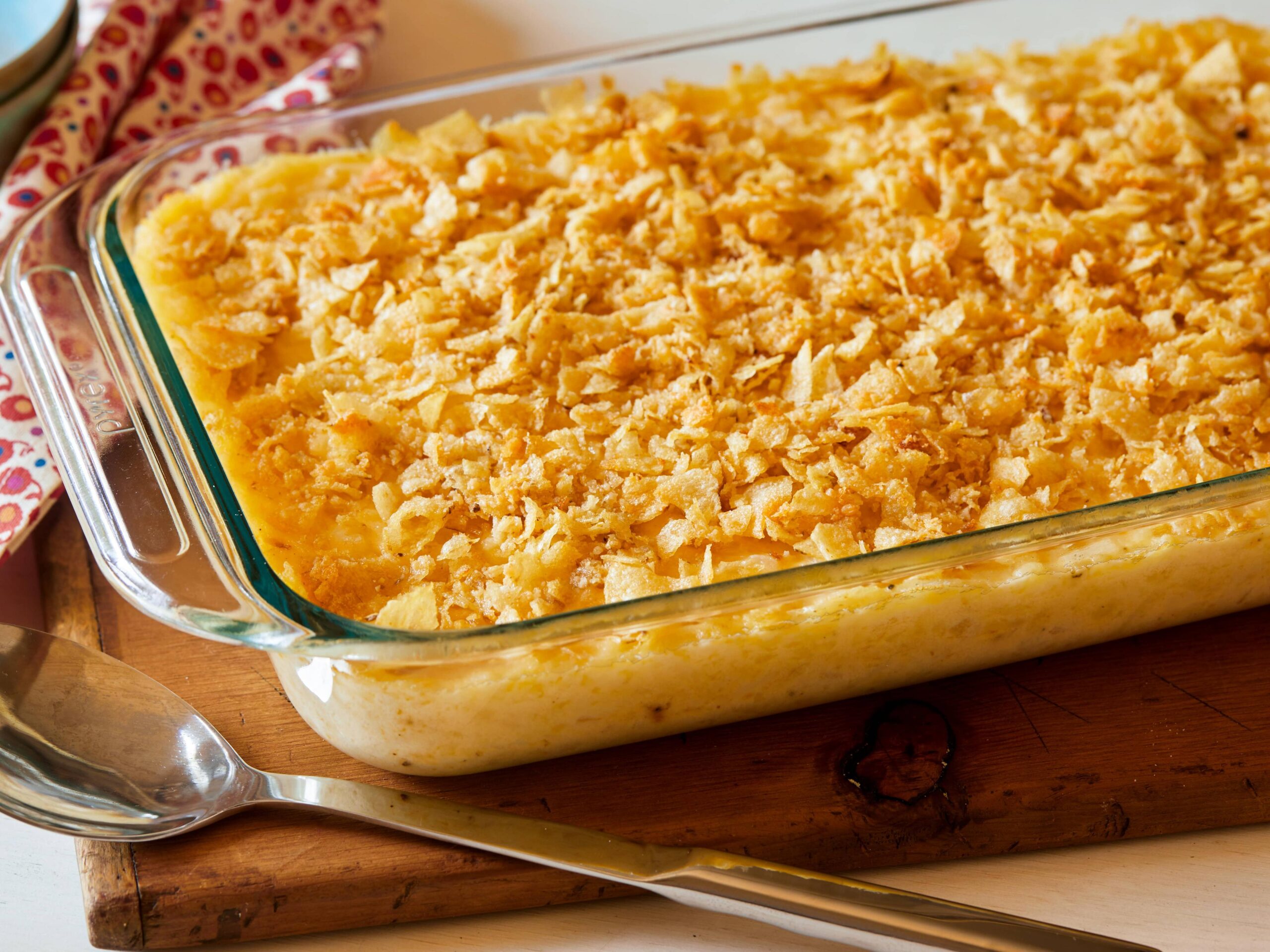
Funeral potatoes are a tradition in Utah, especially within the Latter-day Saints community. This food is typically served at gatherings following funerals, providing warmth and solace to grieving families.The dish is a casserole made with hash brown potatoes, sour cream, cream of chicken soup, cheese, and a topping, often cornflakes or crushed potato chips. Its origins date back to the mid-20th century, when practical, easily-prepared meals were essential for feeding groups quickly.The name “funeral potatoes” reflects their frequent appearance at post-funeral luncheons, but they are also enjoyed at other gatherings and holidays. The dish embodies the spirit of community and support, symbolizing the care and comfort shared among friends and family during difficult times.
This content is accessible to paid subscribers. To view it please enter your password below or send mike@standardsmichigan.com a request for subscription details.
This content is accessible to paid subscribers. To view it please enter your password below or send mike@standardsmichigan.com a request for subscription details.
Note in the transcript above that the four proposals submitted by Standards Michigan relate to healthcare facilities. Code Panel 15 receives proposals for healthcare and assembly occupancy wiring safety concepts.
Marcel Jambon for an 1895 Paris production of Giuseppe Verdi’s Otello.
The standard of care for electrical system safety in dramatic art facilities in the education, and other industries, is largely established in Articles 518 through Article 540 of the National Electrical Code (NEC). In some instances, dramatic art activity takes place in athletic arenas so we are mindful of parent standards for assembly occupancies generally; found in Chapter 3 of the International Building Code.
Free public access to the current 2023edition of the NEC is linked below:
Note the imperfect correlation between the NFPA and ICC occupancy definitions. This never happens by design but is sometimes necessary. Some risk aggregations have to be understood as terms of art; to be understood by seasoned experts in context. Also, keep in mind that the NEC is a wiring installation safety code.
Proposals for revisions to assembly-related installations in the for 2023 is linked below:
The so called “song and dance” sections of the NEC have been fairly “stable” in recent cycles. Changes to these articles in the NEC 2020 revision are incremental — i.e clarifications on grounding, wiring methods, cord wiring, illumination — and helpful for designers and inspectors. Nothing budget busting. Convergence of fire safety, mass notification, environmental air and visual experiences continues as once-independent technologies continue integration.
We collaborate with the IEEE Education & Healthcare Facilities Committee which meets 4 times monthly in Europe and the Americas. See our CALENDAR for the next online teleconferences; open to everyone.
Issue: [Various]
Category: Sport, Electrical, Telecommunications, Fire Protection, Arts & Entertainment Facilities, Lively Art
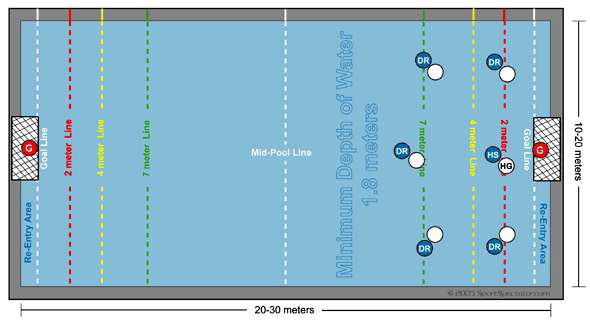
A standard water polo pool playing field has specific characteristics and dimensions regulated by the sport’s governing bodies, such as Fédération Internationale de Natation with regional variations informed by student athlete safety. There are about 750 high school girls and boys girls water polo programs in the US and about 70 collegiate teams. Here are the key features:
Pool Dimensions
Length: The playing area is typically 20 to 30 meters long.
Width: The playing area is 10 to 20 meters wide.
Depth: The minimum depth is 1.8 meters (about 6 feet) to ensure players cannot touch the bottom.
Goal Dimensions
Width: The goals are 3 meters wide.
Height: The goals are 0.9 meters high.
Markings and Zones
Midline: The center of the pool has a midline to divide the playing area into two halves.
5-Meter Line: There are lines marked at 5 meters from each goal line, used to indicate where penalty shots can be taken.
2-Meter Line: There are lines marked at 2 meters from each goal line, inside which attacking players cannot remain for more than a few seconds without the ball.
Goals and Nets
Goalposts and Crossbar: The goals are constructed with goalposts and a crossbar, usually made of metal or a similar sturdy material.
Nets: Attached to the goals to catch the ball.
Ball Specifications
Size: The ball has a circumference of 0.68 to 0.71 meters for men and 0.65 to 0.67 meters for women.
Weight: The ball weighs between 400 and 450 grams.
Additional Features
Team Benches: Located on the pool deck for players not in the water.
Shot Clocks: To keep track of the possession time, typically set to 30 seconds.
Scoreboards: To display the game score, time remaining, and other relevant information.
Water Temperature
Temperature: The water temperature is usually maintained between 25-28°C (77-82°F) to ensure player comfort.
This content is accessible to paid subscribers. To view it please enter your password below or send mike@standardsmichigan.com a request for subscription details.
New update alert! The 2022 update to the Trademark Assignment Dataset is now available online. Find 1.29 million trademark assignments, involving 2.28 million unique trademark properties issued by the USPTO between March 1952 and January 2023: https://t.co/njrDAbSpwBpic.twitter.com/GkAXrHoQ9T