
Category Archives: Security/Doors
- Home
- Archive by category "Security/Doors" (Page 8)


Emergency Communication Strategies for Buildings and Campuses.
This content is accessible to paid subscribers. To view it please enter your password below or send mike@standardsmichigan.com a request for subscription details.
Active Shooter & Hostile Event Response Program



We have been following the fast-tracked development of NFPA 3000 Standard for an Active Shooter/Hostile Event Response (ASHER) Program since its launch. We have contributed to it and we have catalyzed education industry trade associations to rally their membership to participate. Keep in mind that there are several other non-profit trade associations moving into this space; each of them assembling experts and preparing curricula to drive conformity, compliance and training revenue. Nothing necessarily wrong with this except that the active shooter risk aggregation is highly “siloed” and setting the standard of care is, well, highly-siloed.
Click on the link below to sample the ideas running through proposed revisions to the next edition:
NFPA 3000 Second Draft Ballot Final
Notice the wordsmithing, the internal coordination and administration, and the referencing to existing and new consensus products emerging in this space.
Similar to the condition in the energy sector in which the federal government has to effectively “clear the market” of redundancy and destructive competition among market participants (i.e. trade associations), we may find that some form of federal legislation may be required. As we explain in our post on the National Technology Transfer and Advancement Act that there lies a risk of damping normal, healthy “animal spirit” competition among trade associations.
All that said, NFPA consensus products are very familiar to the public safety culture in local and state governments so it is wise to keep pace; if not lead when necessary. Note that NFPA 3000 is a trademarked consensus product; tantamount to becoming a “code” that can be incorporated by reference into public safety laws at all levels of government.
Principal and Alternate Votes on the NFPA Technical Committee from educational institutions: Harvard School of Public Health, Auburn University, Missouri State University, University of Connecticut and Vanderbilt University. None of them are casting User-interest votes according to the NFPA Classification of Committee Members. In other words, no representative of an entity that is subject to the provisions of the standard or that voluntarily uses the standard — such as a student or a teacher — has a vote on this committee. They will depend upon the standard of care set by other interest categories. See our ABOUT to understand why this is.
The next several milestones in the NFPA 3000 development are listed below:
First Draft Meeting Minutes (from the November 6-9 face-to-face meetings in New Orleans)NFPA 3000_A2020_ACT_AAA_FDminutes__11_18
NFPA 3000_A2020_ACT_AAA_FDagenda_11_18First Draft Report Posting Date:March 11, 2019Public Comment Closing Date: June 5, 2019Second Draft Report Posting Date: January 22, 2020NITMAM Closing Date: February 19, 2020NITMAM Posting Date: April 1, 2020
Normally, NITMAMs are heard at the NFPA Annual Conference and Expo. It is likely that the NFPA Standards Council will release NFPA 3000 for use by regulating agencies in lieu of the meeting that would have taken place in June. (CLICK HERE for information about cancellation of the NFPA Annual Conference)
We keep NFPA 3000, along with other emergent school security standards, on the agenda with our Security, Risk and Pathway teleconference See our CALENDAR for the next online meeting; open to everyone.
Issue [18-15]
Category: Public Safety, Risk Management
Colleagues: Mike Anthony, Richard Robben
LEARN MORE:
U.S. Department of Homeland Security / Active Shooter: How to Respond

H.R. 3665 / School Violence Prevention and Mitigation Act of 2019
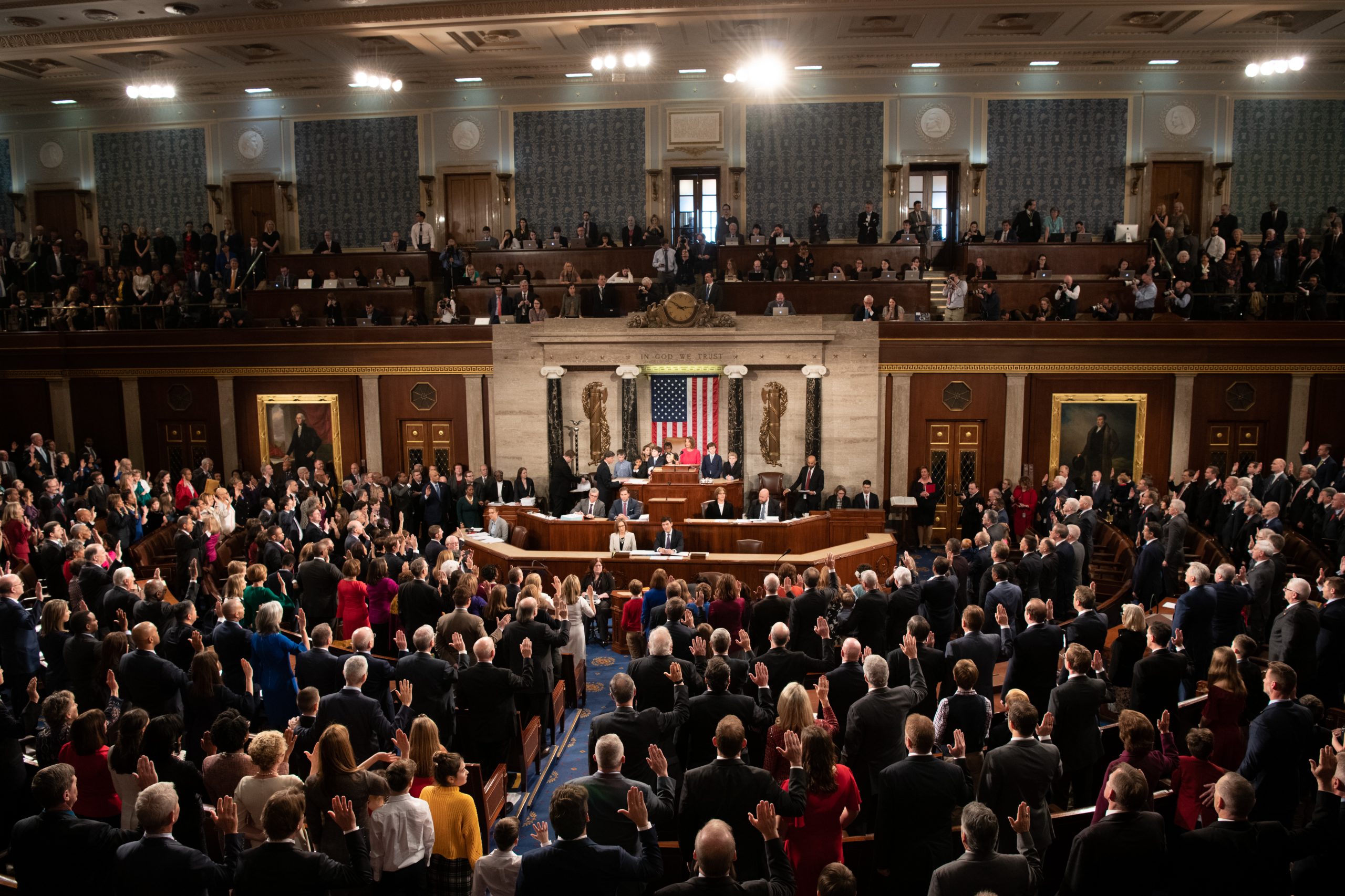
434 lawmakers, including 89 new freshman Members, were sworn in to the 116th Congress on January 3, 2019. Photo by Phi Nguyen.
A BILL: To establish a grant program to encourage schools to conduct independent facility security risk assessments and make hard security improvements, and for other purposes.

Workplace Violence Prevention & Intervention
_141202-F-PO994-001.jpg)
“Fine Art, War and Peace” 2014 / U.S. Air Force art by Staff Sgt. Jamal D. Sutter
Last year ASIS International announced a new revision cycle for its standard — Workplace Violence Prevention and Intervention. It is a revision and re-designation of an 2011 standard developed jointly with the Society of Human Resource Management.
From the project prospectus:
Scope: Standard provides an overview of policies, processes, and protocols that organizations can adopt to help prevent threatening behavior and violence affecting the workplace and better respond to and resolve security incidents. Standard describes the implementation of a Workplace Violence Prevention and Intervention Program, and protocols for effective incident management and resolution. Standard also includes an annex on Active Assailants which provides actionable information and guidance relative to prevention, intervention, and response to incidents involving an active assailant/active shooter. It describes security design considerations, security protocols and response strategies as well as the procedures for detecting, assessing, managing, and neutralizing immediately life-threatening behavior intended or perpetrated by an active assailant/active shooter, either acting alone or in a group.
Project Need: Workplace violence, in its many forms, presents one of the most challenging security and personnel safety problems that an organization can face. This standard provides information and practical methods that will enable an organization to develop an effective and informed approach to prevention, intervention and response, including incidents involving active assailants.
Stakeholders: Organizations of all sizes and types: Human resources, legal counsel, business owners, and executive level managers; occupational safety and health personnel; union leaders; employee assistance programs; law enforcement; clinicians and service providers in the mental health field; insurers and practitioners who specialize in threat management and violence prevention; public relations/corporate communications and risk management and crisis management professionals; professional security practitioners and consultants; risk and resilience management practitioners; the global business community; not-for-profit organizations and foundations; educational institutions; government agencies and organizations.
Revisions were completed and the 2020 edition is listed on the ASIS standards bibliography:
For the 2020 revision, the work is done. We have added this document to our tracking algorithm and maintain it on the standing agenda of our periodic Security and Risk teleconferences. See our CALENDAR for the next online meeting; open to everyone.
We encourage our colleagues responsible for workspace safety in education communities to participate in the ASIS standards development process by communicating directly with Alexandria Virginia, Aivelis Opicka, standards@asisonline.org, (703) 518-1517.
Issue: [18-151]
Category: Security, Risk, Human Resources
Colleagues: Mike Anthony, Richard Robben
S. 2530 / School Safety Clearinghouse Act

Photo by Architect of the Capitol | Left: The teacher and children in a “little red schoolhouse” represent an important part of American education in the 1800s.
Right: Students attend a land grant college, symbolic of the national commitment to higher learning.
S. 2530: School Safety Clearinghouse Act
To require the Secretary of Homeland Security to establish a School Safety Clearinghouse, and for other purposes.
5.4.20

Risk Management for Youth & School Trips

“The School Walk” 1872 / Albert Anker
The ISO Advisory Committee on Consumer Policy (COPOLCO) has submitted a proposal for new work item proposal for the development of an ISO standard on Managing risk for youth and school trips, with the following scope statement:
We envision a new ISO standard which will provide guidance for managing risk for youth (in particular, minors due to their particular vulnerabilities) and school trips for both domestic and international travel. The standard will gather best practices to address typical risks for this sector such as behavioral breaches and carelessness of students, weather-related problems, requirements for those with special needs (such as travelers with disabilities), technical elements such as mechanical failures of equipment, etc. The standard will benefit both the travelers themselves and the organizations that serve them by covering:
– Safety and security of groups of young people travelling (specifically but not limited to school groups);
– Risk management for organizations such as school boards, tourist attractions, tour operators, service providers, and recreational activities, etc. NOTE: This proposed standard will not include how to organize such trips and it will not be limited to adventure travel.
Anyone wishing to review the proposal can request a copy by contacting ANSI’s ISO Team (isot@ansi.org), with a submission of comments to Steve Cornish (scornish@ansi.org) by close of business on Friday, June 5, 2020
We maintain all ISO consensus products on the standing agenda of our Global standards teleconferences. See our CALENDAR for the next online meeting; open to everyone.
Issue: [20-144]
Category: Security, Global, Risk Management
Colleagues: Mike Anthony, Christine Fischer, Jack Janveja
Source: Managing Risk for Youth and School Trips: ANSI Seeks Feedback on New ISO Proposal
LEARN MORE:

Emergency Preparedness and Response Standards Development Priorities
This content is accessible to paid subscribers. To view it please enter your password below or send mike@standardsmichigan.com a request for subscription details.

Cybersecurity Training for Public Safety Personnel
This content is accessible to paid subscribers. To view it please enter your password below or send mike@standardsmichigan.com a request for subscription details.
Telecommunicator Emergency Response Taskforce Deployment
This content is accessible to paid subscribers. To view it please enter your password below or send mike@standardsmichigan.com a request for subscription details.
New update alert! The 2022 update to the Trademark Assignment Dataset is now available online. Find 1.29 million trademark assignments, involving 2.28 million unique trademark properties issued by the USPTO between March 1952 and January 2023: https://t.co/njrDAbSpwB pic.twitter.com/GkAXrHoQ9T
— USPTO (@uspto) July 13, 2023
Standards Michigan Group, LLC
2723 South State Street | Suite 150
Ann Arbor, MI 48104 USA
888-746-3670
DIRECTIONS
 |
 |
|
 |
 |
|
 |
 |