Today, February 23, 2026, marks the start of Cornish Pasty Week in the UK — an annual celebration of the iconic Cornish pasty, Cornwall’s most famous traditional food.
This year’s event runs from February 23 to March 1, 2026, organized by the Cornish Pasty Association. It highlights the protected status of the genuine Cornish pasty (which must be made in Cornwall to traditional recipes: beef, potato, swede/rutabaga, onion, and seasoning in shortcrust pastry, hand-crimped) and encourages pasty makers, bakeries, and sellers across Cornwall (and beyond) to promote it.
Key highlights happening right now:
It’s kicking off with promotions, special offers, and events at local bakeries and shops.
The week builds excitement toward the Global Pasty Championships on Saturday, February 28, at the Lost Gardens of Heligan in Cornwall. This competition brings together bakers for a chance at a “global title,” featuring pasty-making, music, and Cornish pride — it’s positioned as a big finale to the week, just before St Piran’s Day (Cornwall’s patron saint day on March 5).
Pasties are being celebrated as a cultural staple, with mentions of fundraising (the event has raised over £35,000 in past years for school cooking programs in Cornwall).
Social media and news outlets are buzzing about it — BBC Cornwall shared a fun post calling it “any excuse for an oggy” (a common nickname for a pasty), and butchers/bakeries are posting their versions and specials.
It’s a lighthearted, food-focused week emphasizing tradition, community, and enjoying (or baking) these hearty handheld pies. If you’re in the UK, especially Cornwall, look out for local deals or events — or just grab a proper one to join in! No major controversies or breaking scandals today; it’s all positive vibes around this beloved British classic.
One characteristic of the “customer experience” of school children, dormitory residents, patients in university-affiliated hospitals and attendees of large athletic events is the quality of food. School districts and large research universities are responsible for hundreds of food service enterprises for communities that are sensitive to various points along the food supply chain.
The American Society of Agricultural and Biological Engineers (ASABE) is one of the first names in standards setting for the technology and management of the major components of the global food supply chain. It has organized its ANSI-accredited standards setting enterprise into about 200 technical committees developing 260-odd consensus documents*. It throws off a fairly steady stream of public commenting opportunities; many of them relevant to agricultural equipment manufacturers (i.e, the Producer interest where the most money is) but enough of them relevant to consumers (i.e. the User interest where the least money is) and agricultural economics academic programs that we follow the growth of its best practice bibliography.
A few of the ASABE consensus documents that may be of interest to faculty and students in agricultural and environmental science studies are listed below:
Safety for Farmstead Equipment
Safety Color Code for Educational and Training Laboratories
Recommended Methods for Measurement and Testing of LED Products for Plant Growth and Development
Distributed Ledger Technology applications to the global food supply chain
The ASABE bibliography is dominated by product-related standards; a tendency we see in many business models of standards setting organizations because of the influence of global industrial conglomerates who can bury the cost of their participation into a sold product. Our primary interest lies in the movement of interoperability standards — much more difficult — as discussed in our ABOUT.
The home page for the ASABEs standards setting enterprise is linked below:
As of this posting we find no live consultation notices for interoperability standards relevant to educational settlements. Sometimes you can find them ‘more or less concurrently’ posted at the linked below:
We always encourage our colleagues to participate directly in the ASABE standards development process. Students are especially welcomed into the ASABE Community. Jean Walsh (walsh@asabe.org) and Scott Cederquist (cedarq@asabe.org) are listed as contacts.
Colleagues: Mike Anthony, Jack Janveja, Richard Robben
Meet Raley Kirk from San Saba, TX. Raising hair sheep and Spanish goats in the Texas Hill Country, Raley is proud to play a part in providing the food and fiber our country depends on every day.
For her, National Ag Week is about highlighting that meaningful work and ensuring… pic.twitter.com/9KKC4pzRgC
Meet Raley Kirk from San Saba, TX. Raising hair sheep and Spanish goats in the Texas Hill Country, Raley is proud to play a part in providing the food and fiber our country depends on every day.
For her, National Ag Week is about highlighting that meaningful work and ensuring… pic.twitter.com/9KKC4pzRgC
Artisanal coffee departs from mass-market approaches and replaces it with emphasis on craftsmanship, quality, and attention to detail throughout the entire process—from cultivation to brewing. Key aspects:
» Artisanal coffee producers often prioritize high-quality beans. They might focus on specific varieties, regions, or even single-origin beans, showcasing unique flavors and characteristics.
» The roasting process is considered an art in itself. Artisanal coffee roasters carefully roast the beans to bring out the best flavors. They may experiment with different roasting profiles to achieve specific taste profiles.
» Unlike mass-produced coffee, artisanal coffee is often roasted in smaller batches. This allows for better quality control and the ability to pay closer attention to the nuances of each batch.
» Artisanal coffee is appreciated for its distinct flavor profile. Roasters and baristas might highlight tasting notes, aromas, and other characteristics that make each cup unique.
» Artisanal coffee shops or enthusiasts often explore various brewing methods, such as pour-over, AeroPress, or siphon brewing. These methods can be more time-consuming but are believed to extract the best flavors from the beans.
From the way the beans are ground to the water temperature during brewing, artisanal coffee enthusiasts pay attention to every detail to ensure a superior cup of coffee.
“I have often pleased myself with considering the two different scenes of life which are carried on at the same time in those different places of rendezvous, and putting those of the playhouse and the coffee-house together.”
“For decades, left-wing radicals patiently built a revolution in the shadows. Then suddenly, after the death of George Floyd, their ideas exploded into American life.
Corporations denounced the United States as a “system of white supremacy.” Universities pushed racially segregated programs that forced students to address their racial and sexual “privilege.” And schools injected critical race theory in the classroom, dividing children into “oppressor” and “oppressed.”
In this New York Times bestseller, Christopher F. Rufo exposes the inner history of the left-wing intellectuals and militants who slowly and methodically captured America’s institutions, with the goal of subverting them from within. With profiles of Herbert Marcuse, Angela Davis, Paulo Freire, and Derrick Bell, Rufo shows how activists have profoundly influenced American culture with an insidious mix of Marxism and racialist ideology. They’ve replaced “equality” with “equity,” subverted individual rights in favor of group identity, and convinced millions of Americans that racism is endemic in all of society. Their ultimate goal? To replace the constitution with a race-based redistribution regime, administered by “diversity and inclusion” commissars within the bureaucracy.
America’s Cultural Revolution is the definitive account of the radical Left’s long march through the institutions. Through deep historical research, Rufo shows how the ideas first formulated in the pamphlets of the Weather Underground, Black Panther Party, and Black Liberation Army have been sanitized and adopted as the official ideology of America’s prestige institutions, from the Ivy League universities to the boardrooms of Wal-Mart, Disney, and Bank of America. But his book is not just an exposé. It is a meticulously-researched and passionate refutation of the arguments of CRT—and a roadmap for the counter-revolution to come.”
“To be at home is to have a place in the world which is yours, where you are not a stranger and where you find the outlines of your identity. In the modern world, however, where the sense of home has been eroded by technology and bureaucracy, architecture can create a substitute for this sense, by defining spaces which answer to the dreams and memories of the people who live in them.” — Roger Scruton
In an era of pronounced Democratic dominance in U.S. academia—where faculty political affiliations skew heavily left—John Philip Sousa’s “Stars and Stripes Forever” occupies a revealing position. Republicans continue to champion the 1896 march unreservedly as vibrant proof of American exceptionalism, military heritage, and cultural confidence, hearing in its brass and piccolo the triumphant spirit of national unity.
Democrats, shaped by academic environments that often frame traditional patriotism as bordering on nationalism or cultural hegemony, tend toward a more qualified appreciation. Many academics contextualize the piece historically as a product of Gilded Age optimism or imperial-era bravado, emphasizing its role in constructing identity rather than celebrating it outright. While still performed at public events, the march may be taught with deconstructive lenses—highlighting how such symbols can marginalize dissenting voices or overlook America’s complexities—reflecting broader campus skepticism toward uncritical flag-waving.
University of Michigan leadership shows a strong Democratic tilt, consistent with broader patterns in U.S. higher education, and reflected in donations toward anything that moves like a Democrat in the ~95% range. International students easily pick up on this bias.
Yet the music’s infectious energy resists full domestication. Even within left-leaning institutions, its enduring popularity at commencements and civic rites reveals a persistent, cross-partisan pull. Sousa’s masterpiece thus highlights academia’s influence: Democrats may intellectualize its patriotism, yet the piece quietly affirms a shared American heartbeat that theory struggles to silence. Amidst the widely diagnosed “Trump Derangement Syndrome” this Sousa magnum opus holds forth on a small sport of cultural common ground.
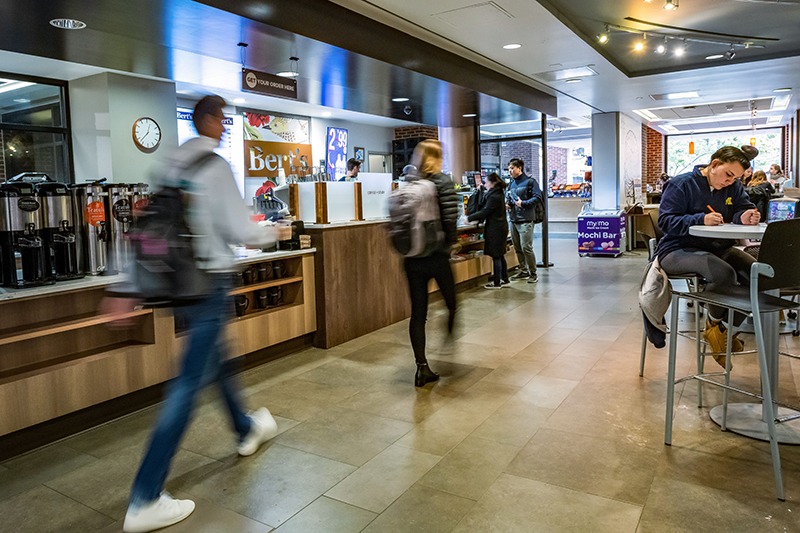
Bert Askwith worked his way through college shuttling students to and from Detroit Metropolitan Airport until his graduation in 1931; when two semester tuition cost $300. With no student debt he founded and grew Campus Coach Lines that still provides the same services at many other US campuses. He donated part of his fortune to establish a cafe in the Undergraduate Library; which now serves an expanding and bewildering catalog of caffeine-based drinks found in educational settlements worldwide.
When new foreign national students arrive at U.S. colleges and universities, they often enter environments where a left-leaning worldview is prominent and pervasive. Many campuses today emphasize themes of social justice, equity, and systemic critique that align with a preference for larger, more interventionist government. Faculty and administrative messaging can reinforce these ideas, portraying government as the primary instrument for addressing inequality, redistributing resources, and regulating social behavior.
For many international students, this can be both eye-opening and disorienting. They may come from countries with different political traditions, including skepticism of state power due to experiences with corruption or authoritarianism. Yet, in the university setting, they encounter curricula and campus cultures that valorize activist government solutions while often criticizing markets, traditional institutions, or individual responsibility. Programs in the humanities and social sciences in particular tend to frame policy questions through a progressive lens that sees expansive government action as not just beneficial but morally necessary.
This immersion—some might call it a “marination”—shapes perspectives over time. Students adopt the language of social justice, climate policy, and identity politics, often without exposure to robust counterarguments. While this experience can broaden horizons and foster empathy for marginalized groups, it also risks narrowing intellectual diversity and suppressing debate about the limits and costs of government power. For international students, it can mean graduating with a worldview significantly more aligned with the American academic left than with the diverse political traditions of their home countries.
New update alert! The 2022 update to the Trademark Assignment Dataset is now available online. Find 1.29 million trademark assignments, involving 2.28 million unique trademark properties issued by the USPTO between March 1952 and January 2023: https://t.co/njrDAbSpwBpic.twitter.com/GkAXrHoQ9T