
Nikola Tesla, with his equipment / Credit: Wellcome Library, London

We collaborate closely with the IEEE Education & Healthcare Facilities Committee which meets 4 times monthly in European and American time zones. Risk managers, electrical safety inspectors, facility managers and others are welcomed to click into those teleconferences also. We expect that concepts and recommendations this paper will find their way into future revisions of US and international electrical safety codes and standards. There is nothing stopping education facility managers from applying the findings immediately.
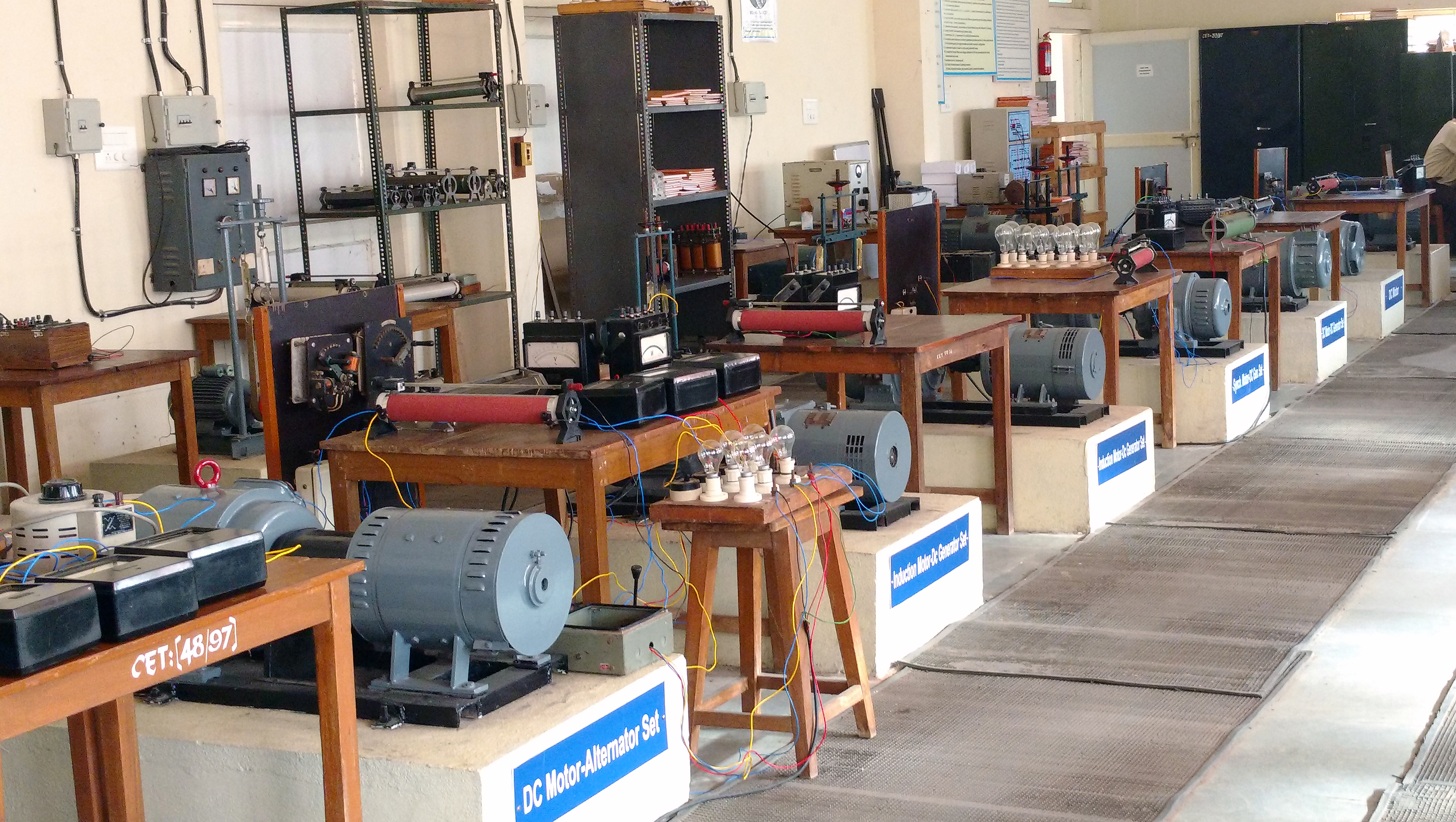
College of Engineering and Technology, Bhubaneswar India
Electrical Safety of Academic Laboratories | 2019-PSEC-0204
Presented at the 55th IEEE Industrial Applications Society I&CPS Technical Conference | Calgary, Alberta Canada | May 6-9, 2019
Ω
Rodolfo Araneo, University of Rome “La Sapienza” | rodolfo.araneo@ieee.org
Payman Dehghanian, George Washington University | payman@gwu.edu
Massimo Mitolo, Irvine Valley College | mitolo@ieee.org
Abstract. Academic laboratories should be a safe environment in which one can teach, learn, and conduct research. Sharing a common principle, the prevention of potential accidents and imminent injuries is a fundamental goal of laboratory environments. In addition, academic laboratories are attributed the exceptional responsibility to instill in students the culture of the safety, the basis of risk assessment, and of the exemplification of the prudent practice around energized objects. Undergraduate laboratory assignments may normally be framed based upon the repetition of established experiments and procedures, whereas, academic research laboratories may involve new methodologies and/or apparatus, for which the hazards may not be completely known to the faculty and student researchers. Yet, the academic laboratory should be an environment free of electrical hazards for both routine experiments and research endeavors, and faculty should offer practical inputs and safety-driven insights to academic administration to achieve such a paramount objective. In this paper, the authors discuss the challenges to the electrical safety in modern academic laboratories, where users may be exposed to harmful touch voltages.
I. INTRODUCTION
A. Electricity and Human Vulnerabilities
B. Electrical Hazards in Academic Laboratories
II. ELECTRICAL SEPARATION
III. SAFETY IN ACADEMIC LABORATORIES WITH VARIABLE FREQUENCY DRIVES
IV. ELECTRICAL SAFETY IN ACADEMIC LIGHTING LABORATORIES
V. ACADEMIC RESEARCH LABORATORIES
A. Basic Rules of Engagement
B. Unidirectional Impulse Currents
VI. HAZARDS IN LABORATORIES DUE TO ELECTROMAGNETIC FIELD EXPOSURE
VII. WARNING SIGNS AND PSYCHOLOGICAL PERCEPTION OF DANGER
VIII. CONCLUSION
Safety is the most important practice in an academic laboratory as “safety and productivity are on the same team”. Electrical measurement and electrically-powered equipment of various brands and models are common in both teaching and research laboratories, highlighting the need to maintaining them continuously in an electrically-safe status. Annual reports on the occurrence of electrical hazards (i.e. shocks and injuries) in academic laboratory environments primarily discover the (i) lack of knowledge on using the electrical equipment, (ii) careless use of the energized electric facilities, and (iii) faulty electrical equipment or cords. The above does call for the establishment of safety-driven codes, instructions, and trainings for the academic personnel working with or near such devices for teaching, learning, experiments, and research. This paper provided background information on the concept of electrical safety in the academic laboratories, presented the safety challenges of modern academic laboratories, and offered solutions on how enhance the lab environment and research personnel safety awareness to avoid and control electrical hazards.
Issue: [19-129]
Category: Electrical, Facility Asset Management, Fire Safety, International
Colleagues: Mike Anthony, Rodolfo Araneo, Payman Dehghanian, Jim Harvey, Massimo Mitolo, Joe Tedesco
Related IEEE Research:
Strengthening and Upgrading of Laboratory Safety Management Based on Computer Risk Identification
Critical Study on the feasiblity of Smart Laboratory Coats
Clean Environment Tools Design For Smart Campus Laboratory Through a Global Pandemic
Design of Laboratory Fire Safety Monitoring System