
Category Archives: @IntlCodeCouncil

Loading
loading...

Interior Finishes: Ceilings

International Building Code Chapter 23: Wood

“Office in a Small City” 1953 Edward Hopper

Chapter 8 of the International Building Code contains the performance requirements for controlling fire growth and smoke propagation within buildings by restricting interior finish and decorative materials.  A great deal of interior square footage presents fire hazard; even bulletin boards and decorations; as a simple web search will reveal.  We are respectful of the competing requirements of safety and ambience and try to assist in a reconciliation of these two objectives.

Free access to the current edition of the relevant section is linked below:

CHAPTER 8: Interior Finishes

The public input period of the Group A Codes — which includes the International Fire Code; which contains parent requirements for this chapter — closed in July 2nd.  Search on the word “interior”, or “school” or “classroom “in the document linked below for a sample of the ideas in play.

Update to the 2024 Group A – Consolidated Monograph Updates 3/18/2024

2021 REPORT OF THE COMMITTEE ACTION HEARINGS ON THE 2021 EDITIONS OF THE GROUP A INTERNATIONAL CODES

Development of Group A proceeds in the calendar linked below:

Current Code Development Cycle 2024-2026

Most of the ICC bibliography lies at the foundation of the safety and sustainability agenda of education communities everywhere so we follow development continuously; setting priorities according to our resources.  We keep the issues in this chapter on the standing agenda of our Interiors colloquium.  See our CALENDAR for the next online meeting; open to everyone.

Elevators and Conveying Systems

Latest 2024 / 2025 / 2026 Code Development: Group B Documents

Partial selection of topics:

ADM39-25 IFC: 105.6.26 (New) | p 224

G52-25 403.6.1 Fire service access elevator | p 556

SECTION 3003 EMERGENCY OPERATIONS | p 557

TABLE 403.6.1 AMBULANCE STRETCHER-SIZED ELEVATOR CAR

Add new standards EN 8, EN 77 (Seismic condition design) and ISO 8002 | p 758

SECTION 3006 ELEVATOR LOBBIES AND HOISTWAY OPENING PROTECTION | p 762

3002.3 Emergency signs | p 765

3002.4 Elevator car to accommodate ambulance stretcher. | p 774

(To be continued)

Variations in Backup Power Requirements for Elevators

Group B Proposed Changes 2024 Editions Complete Monograph (2630 Pages)

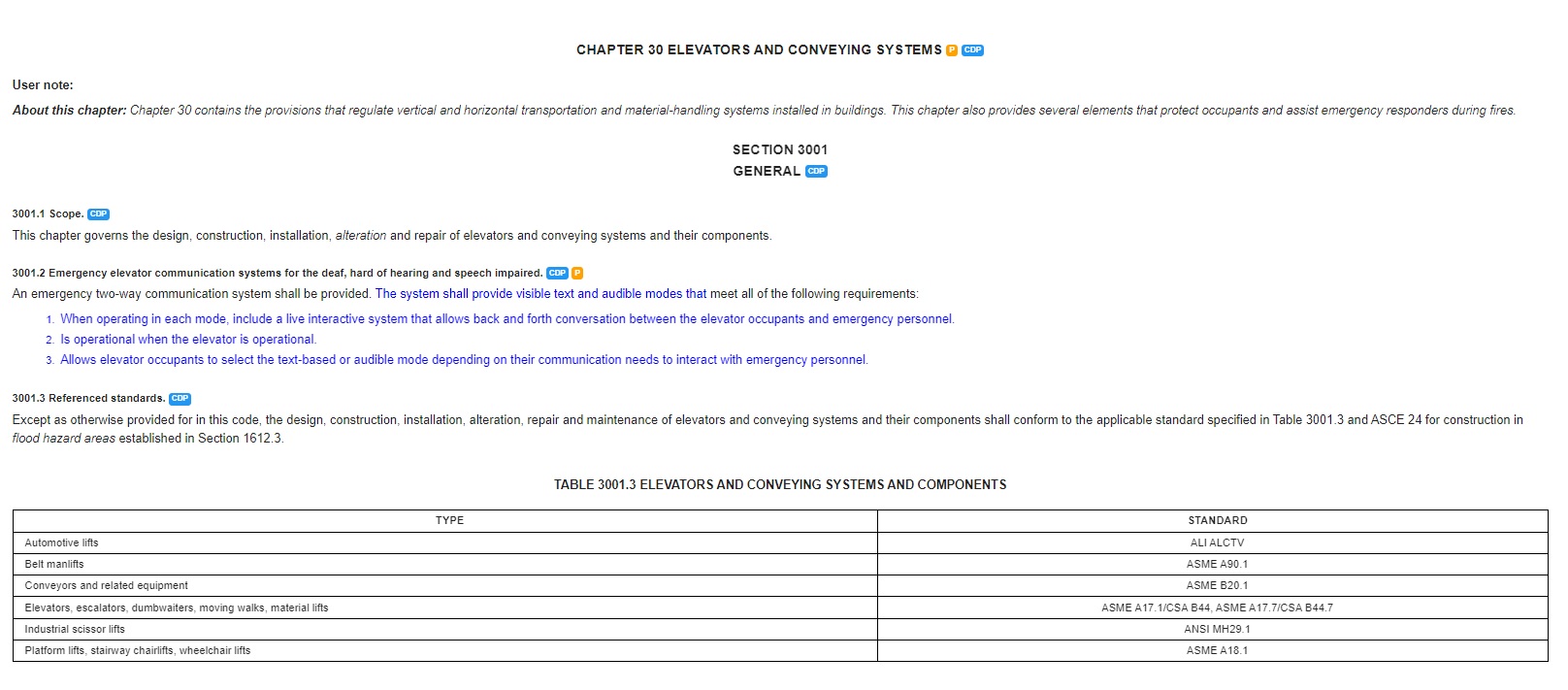
The International Code Council bibliography of elevator safety practice incorporates titles published by American Society of Mechanical Engineers, the National Fire Protection Association and the Institute of Electrical and Electronic Engineers.  The relevant section of the International Building Code is therefore relatively short and linked below.

2021 International Building Code: Chapter 30 Elevators and Conveying Systems

The 2021 IBC is the current edition but committees are now forming to developed the 2024 revision according to the schedule in the link below:

2024/2025/2026 ICC CODE DEVELOPMENT SCHEDULE

2024 GROUP A PROPOSED CHANGES TO THE I-CODES

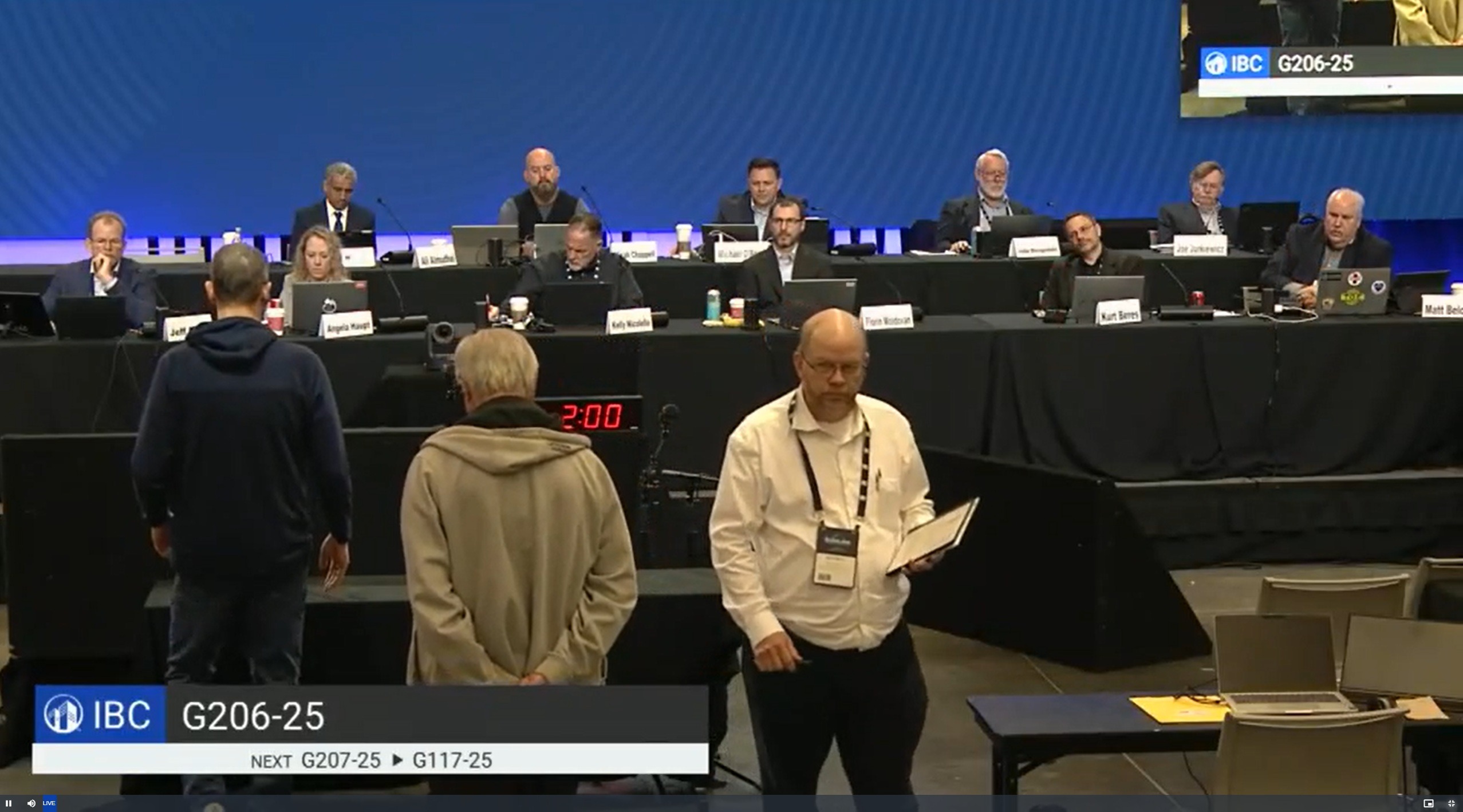
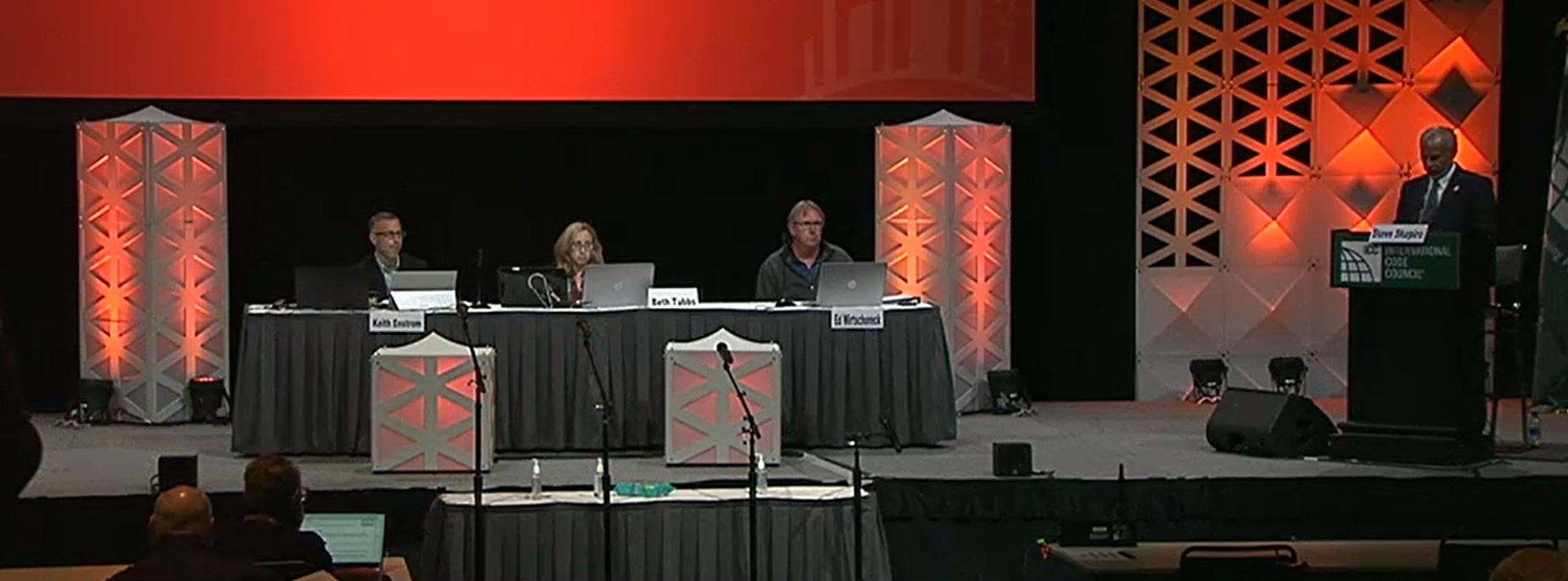
Comments on changes to the Group A tranche of titles will be heard in Long Beach California, October 23-31st. 

IBC Electrical (Outdoor Lighting)

Means of Egress

International Mechanical Code

Off-Site Construction

The latest version of the ICC/MBI Standard 1200 is the 2020 edition, specifically the ICC/MBI 1200-2020: Standard for Off-Site Construction: Planning, Design, Fabrication and Assembly. This standard, developed by the International Code Council (ICC) in collaboration with the Modular Building Institute (MBI), addresses the planning, design, fabrication, and assembly of off-site construction projects. It is part of a series of standards aimed at ensuring safety and compliance in off-site construction processes.

READ ONLY 2021 Edition


More

ICC Off-Site and Modular Construction Standards Committee

Higher Education Laboratories

2024 GROUP A PROPOSED CHANGES TO THE I-CODES: Complete Monograph (2658 pages)

Note the following changes in the transcript above:

Section 702 (Rated Construction), FS44-24 Installer Qualifications (typical marketmaking), Section 3801 (Materials exceeding the Maximum Allowable Quantity), F59-24 (Battery Containment Areas), F81-24 (Health Care Facility Plugs), F112-24 (Lithium Ion Battery Labs), F197-24 (Market making, laboratory oven protection study), F235-24 (Hazardous Materials Classifications & quantity limits).


Safety and sustainability concepts for research and healthcare delivery cut across many disciplines and standards suites and provides significant revenue for most research universities.  The International Code Council provides free access to current editions of its catalog of titles incorporated by reference into public safety law.  CLICK HERE for an interactive edition of Chapter 38 of the 2021 International Fire Code.

During today’s colloquium we will examine consultations for the next edition in the link below:

2021 International Fire Code Chapter 38 Higher Education Laboratories

We encourage our colleagues to participate directly in the ICC Code Development process.   The next revision of the International Fire Code will be undertaken accordingly to next ICC Code Development schedule; the timetable linked below:

2024/2025/2026 ICC CODE DEVELOPMENT SCHEDULE

We encourage directly employed front-line staff of a school district, college or university that does not operate in a conformance/compliance capacity — for example, a facility manager of an academic unit — to join a committee.  Not the Fire Marshall.  Not the Occupational Safety Inspector.  Persons with job titles listed below:

  • Fire Safety System Designer
  • Fire Alarm Technician (Shop Foreman)
  • Building Commissioner
  • Electrical, Mechanical Engineer
  • Occupational Safety Engineer

These subject matter experts generally have a user-interest point of view.

Contact Kimberly Paarlberg (kpaarlberg@iccsafe.org) for information about how to do so.


Related:

 2021 International Mechanical Code

2021 International Plumbing Code

2021 International Energy Conservation Code

Issue 16-69

Category: Fire Safety, Facility Asset Management

Colleagues: Joe DeRosier, Josh Elvove, Mark Schaufele

Archive / Higher Education Laboratories

Meeting Point

Danse de recherche sur le cancer

Morning Shower (And All That)

Complete Monograph: 2024 GROUP A PROPOSED CHANGES TO THE I-CODES

Annual Conference Home Page

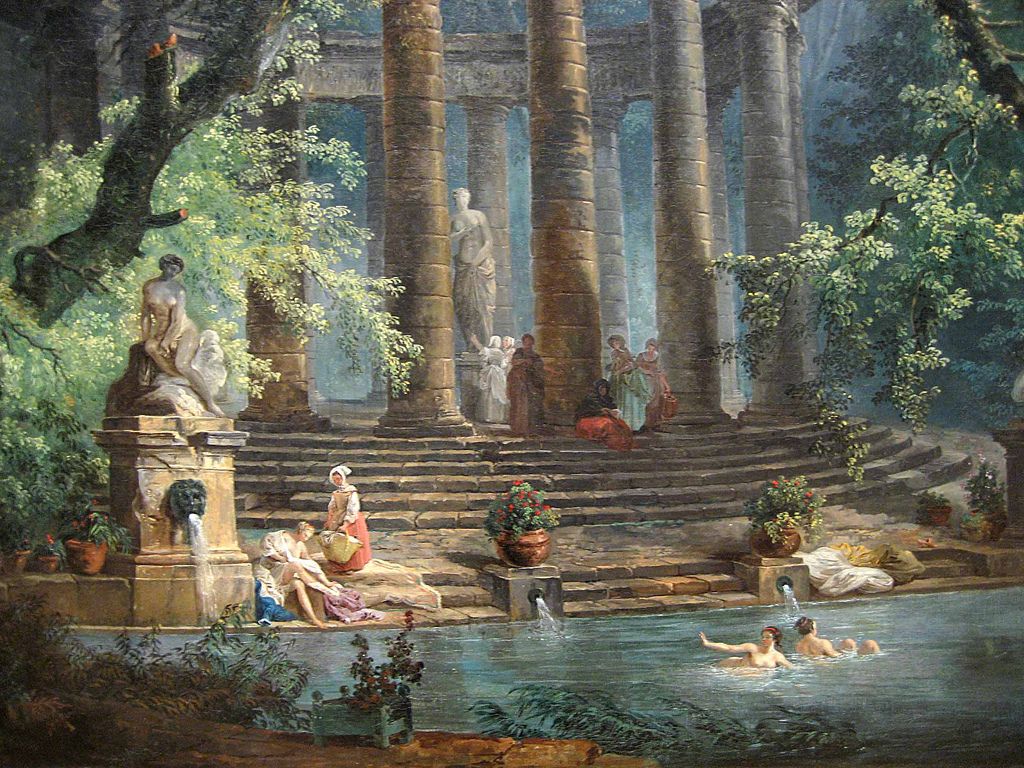
“The Bathing Pool” | Hubert Robert (1733–1808)

CLICK IMAGE to access complete text

Design Considerations for Hot Water Plumbing

Baseline Standards for Student Housing

2024/2025/2026 ICC CODE DEVELOPMENT SCHEDULE

Indoor plumbing has a long history, but it became widely available in the 19th and early 20th centuries. In the United States, for example, the first indoor plumbing system was installed in the Governor’s Palace in Williamsburg, Virginia in the early 18th century. However, it was not until the mid-19th century that indoor plumbing became more common in middle-class homes.

One important milestone was the development of cast iron pipes in the 19th century, which made it easier to transport water and waste throughout a building. The introduction of the flush toilet in the mid-19th century also played a significant role in making indoor plumbing more practical and sanitary.

By the early 20th century, indoor plumbing had become a standard feature in most middle-class homes in the United States and other developed countries. However, it was still not widely available in rural areas and poorer urban neighborhoods until much later.

International Plumbing Code

Form v. Function | Function v. Form

Stairway Design & Construction

This content is accessible to paid subscribers. To view it please enter your password below or send mike@standardsmichigan.com a request for subscription details.

International Plumbing Code

The International Plumbing Code (IPC) is developed to harmonize with the full span of ICC’s family of building codes.  The IPC sets minimum regulations for plumbing systems and components to protect life, health and safety of building occupants and the public. The IPC is available for adoption by jurisdictions ranging from states to towns, and is currently adopted on the state or local level in 35 states in the U.S, the District of Columbia, Guam, and Puerto Rico.

CLICK HERE for the 2021 Public Access Edition 

SOURCE: CLICK ON IMAGE | Contact ICC for most recent IPC adoption map


The IPC is developed in the ICC Group A Code development framework and concluded its revision cycle in late 2021 under the circumstances of the pandemic.  The 2023 International Plumbing Code revision cycle will not begin until early 2023 but it is never too soon to understand the issues from previous revision cycles to enlighten approaches to the forthcoming Group A revision cycle.   The complete monograph of the Group A Codes is linked below, with comments on IPC proposals starting on Page 1417 of this 1613 page document:

2021 IPC | Group A Public Comment Monograph

Because transgender issues are on the agenda of many facility managers we direct you to Page 1424 of the rather large document linked above.

As always, we persist in encouraging education industry facility managers (especially those with operations and maintenance data) to participate in the ICC code development process.  You may do so by CLICKING HERE.

Real asset managers for school districts, colleges, universities and technical schools in the Las Vegas region should take advantage of the opportunity to observe the ICC code-development process during the upcoming ICC Annual Conference in Las Vegas, October 20-23 during which time the Group B c Public Comment Hearings will take place.  Even though the IPC has moved farther along the ICC code development process it is still enlightening to observe how it work.   The Group B Hearings are usually webcast — and we will signal the link to the webcast when it becomes available — but the experience of seeing how building codes are determined is enlightening when you can watch it live and on site.

Issue: [16-133]

Category: Plumbing, Water, Mechanical

Colleagues: Eric Albert, Richard Robben, Larry Spielvogel

#StandardsNewMexico


LEARN MORE:

Neutral Public Bathroom Design

International Building Code § 303.4: Places of Religious Worship

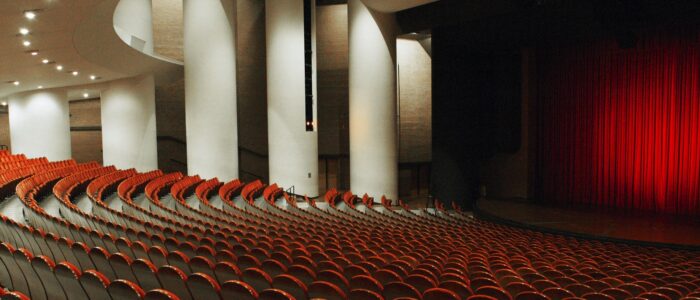
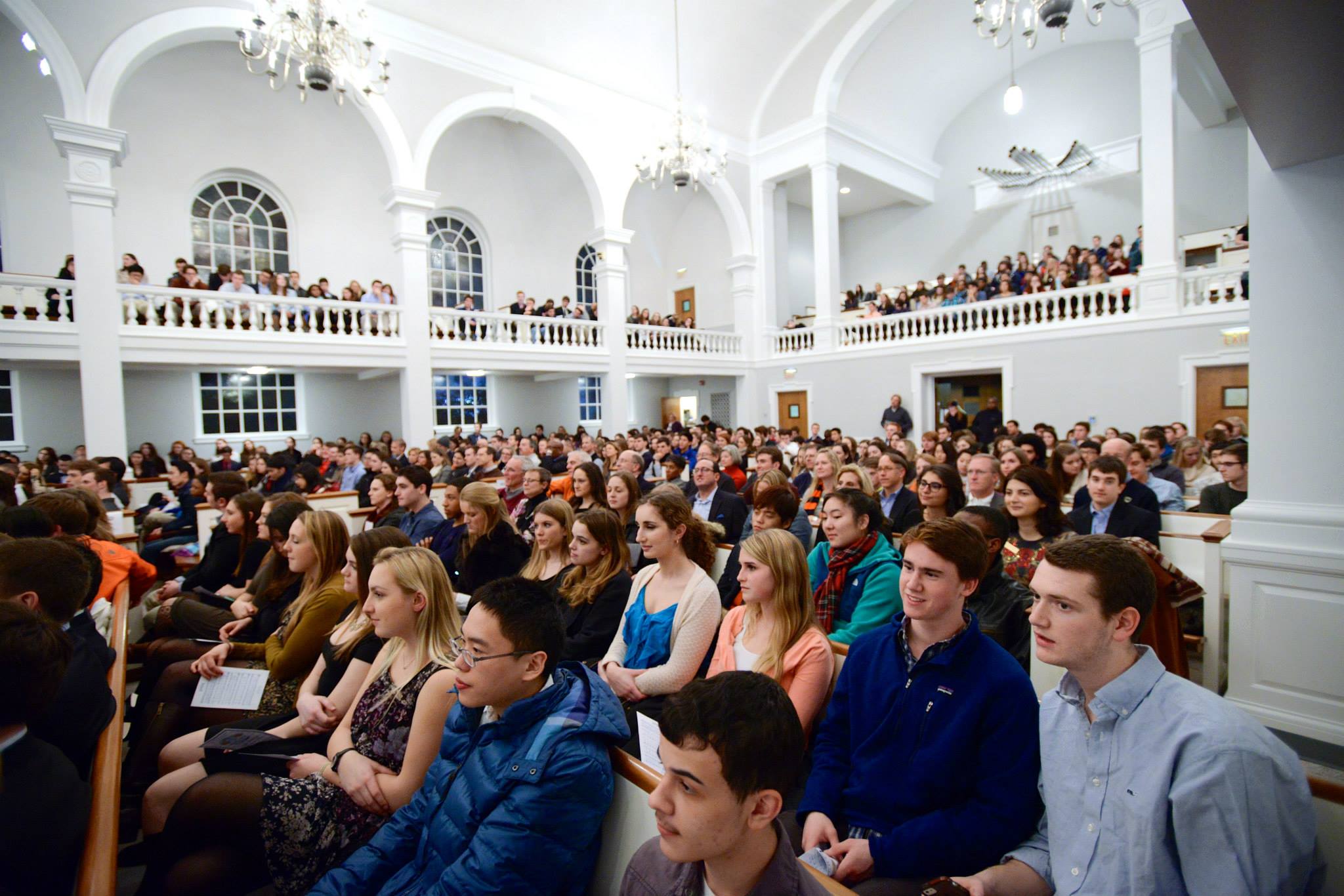
Occupancy classification is a first principle in all International Code Council consensus products.   Chapels and churches associated with educational institutions are grouped with all other “Places of Religious Worship” in Section 303.4 Assembly Group A-3.  You may find the text of this section in the current 2024 edition in the link below:

2024 International Building Code | Section 303 | Assembly Group A

For the next few weeks we will sort through issues appearing in the transcript below:

2025 Group B Committee Action Agenda (2630 Pages)

Recent incidents in the tragic city of Minneapolis inspire revisiting the standards of care listed below:

Targeted Violence and Active Shooters: Incidents like mass shootings have increased, with 54% of attacks on U.S. houses of worship involving armed assaults, often motivated by religious or racial hatred (67% of cases). Comprehensive emergency plans and training are critical.

Vandalism and Arson: These are common, with over 400 attacks on U.S. churches since 2020, including property damage and desecration. Surveillance cameras and regular security audits can deter such acts.

Theft: Donation boxes, religious artifacts, and personal belongings are frequent targets. Access control and monitoring valuables reduce risks.

Cybersecurity Threats: Houses of worship are vulnerable to hacking, ransomware, and data breaches, especially as they rely on digital platforms. Implementing cybersecurity best practices is essential.

Internal Threats: Risks from disgruntled employees or volunteers, including theft or fraud, necessitate thorough background checks and clear protocols for handling sensitive information.

Proactive measures like risk assessments, security teams, and collaboration with law enforcement can mitigate these threats while maintaining a welcoming environment


Related:

Why is the State of Minnesota such a hot mess?


Electric Vehicle Charging

GROUP A MODEL BUILDING CODES: Comments on Committee Actions will be received until July 8th

International Building Code Chapter 4, Section 406.2.7

Edison electric vehicle | National Park Service, US Department of the Interior


Free public access to the 2021 edition of the International Energy Conservation Code (IECC) is linked below:

2021 International Energy Conservation Code


Electric vehicle charging stations are addressed in the 2024 International Energy Conservation Code (IECC) within two specific appendices:

Appendix RE: This appendix provides detailed requirements for electric vehicle charging infrastructure, focusing on both residential and commercial buildings. It includes definitions and infrastructure standards to ensure that new constructions are equipped to support electric vehicle charging​

Appendix CG: This appendix offers guidance on electric vehicle power transfer and charging infrastructure, emphasizing the integration of EV-ready requirements into building designs. It outlines the necessary provisions for installing and managing EV charging stations, ensuring compliance with energy conservation standards​

.These appendices are part of the broader efforts to incorporate EV infrastructure into building codes, promoting energy efficiency and supporting the transition to electric vehicles.

Recharging infrastructure at at Google’s Mountain View (California) campus | Pretty ugly, eh?

“Gas” 1940 Edward Hopper

This standard will be updated within a reconfigured code development cycle linked below:

2024/2025/2026 ICC CODE DEVELOPMENT SCHEDULE

Keep in mind that many electric vehicle safety and sustainability concepts will track in other titles in the ICC catalog.   It is enlightening to see other energy related proposals tracking in the most recent Group A code revision cycle

The following proposals discussed during the Group A Hearings ended earlier this month are noteworthy:

IBC § 202 (NEW) | G66-21 |  Electrical mobility definitions

IBC § 1107.2, et al | E124-21 & E125-21 & E126-21 |  Electrical vehicle charging stations for R-2 occupancies.

From the Group B revision cycle — COMPLETE MONOGRAPH:

R309.6 Electric vehicle charging stations and systems. Where provided, electric vehicle charging systems shall be installed in accordance with NFPA 70. Electric vehicle charging system equipment shall be listed and labeled in accordance with UL 2202. Electric vehicle supply equipment shall be listed and labeled in accordance with UL 2594.

IBC 406.2.7 Electric vehicle charging stations and systems. Where provided, electric vehicle charging systems shall be installed in accordance with NFPA 70. Electric vehicle charging system equipment shall be listed and labeled in accordance with UL 2202. Electric vehicle supply equipment shall be listed and labeled in accordance with UL 2594. Accessibility to electric vehicle charging stations shall be provided in accordance with Section 1108.

TABLE R328.5 MAXIMUM AGGREGATE RATINGS OF ESS (Energy Storage Systems) – PDF Page 1476

Incumbents are socking in EV concepts all across the ICC catalog.  We refer them to experts in the Industrial Applications Society IEEE E&H Committee.


One of the more spirited debates in recent revision cycles is the following:

Who shall pay for electrical vehicle charging infrastructure?   

The underlying assumption is that the electrification of the global transportation grid has a net benefit.   We remain mute on that question; the question of net gain.

Of course, many proposals pointed the finger at the stakeholder with the deepest pockets.  Accordingly, new commercial building owners will be required to install charging stations for new buildings.   During 2018 and 2019 we tracked the action in the workspace below so that we could collaborate with the IEEE Education & Healthcare Facilities Committee:

2021 Electric Vehicle Infrastructure

Given that most higher education facilities are classified as commercial, the cost of charging stations will be conveyed into the new building construction budget unless the unit takes an exception.   Generally speaking, most colleges and universities like to display their electric vehicle credentials, even if the use of such charging stations remains sparse.

Cornell University

Issue: [11-40]

Category: Electrical, #SmartCampus

Colleagues: Mike Anthony, Jim Harvey

* The education industry has significant square footage this is classified as residential; particularly on the periphery of large research campuses.


LEARN MORE:

ICC 2021/2022 Code Development Cycle

The Top 5 Energy Efficiency Proposals for the 2021 IECC

Archive / IECC Electric Vehicle Charging


Layout mode
Predefined Skins
Custom Colors
Choose your skin color
Patterns Background
Images Background
Standards Michigan
error: Content is protected !!
Skip to content