
Category Archives: @IntlCodeCouncil

Loading
loading...

Commercial Kitchens

2026 PUBLIC COMMENT AGENDA | Complete Monograph 2087 Pages

2025 GROUP B PROPOSED CHANGES TO THE I-CODES: Complete Monograph (2630 pages)

Quick View of Results

36 kitchen related proposals were reviewed during our precious sesssion

2024 GROUP A PROPOSED CHANGES TO THE I-CODES: Complete Monograph (2658 pages)

Commercial kitchens offer several benefits, such as efficient food preparation and large-scale production, allowing businesses to meet high demand. They provide professional-grade equipment and ample space, enabling chefs to explore culinary creativity. Commercial kitchens also promote hygiene and food safety standards, with dedicated cleaning protocols and inspections. However, hazards can arise from the high-temperature cooking equipment, sharp tools, and potentially hazardous substances. There is also a risk of burns, slips, and falls, emphasizing the importance of proper training and safety measures. Adequate ventilation and fire safety systems are vital to prevent accidents and maintain a healthy working environment.

The International Code Council is re-configuring its code development process in nearly every dimension. While that situation stabilizes let us review the back-and-forth on this topic during the previous revision cycle (linked below):

2021 International Building Code Section 306 Factory Group F Moderate Hazard

2021 International Fire Code Section 606 Commercial Cooking Equipment and Systems

The International Code Council has recently re-configured its code development calendar:

2024/2025/2026 ICC CODE DEVELOPMENT SCHEDULE

Public hearings on the proposed changes happen in Orlando, April 7-16.

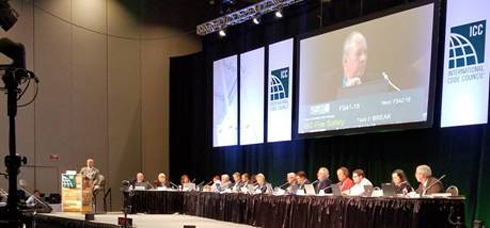
This is a summary of the actions taken on the 2024 Comments on Proposed Changes to the ICC International Codes at the October 23-28, 2024 Committee Action Hearings #2 held at the Long Beach Convention Center, Long Beach, California.  Balloting of local building code officials is now underway.

Commercial kitchen electrical power wiring requirements are covered extensively in Article 210 through Article 215 of the National Electrical Code.  Standards action in this domain is referred to IEEE Education & Healthcare Facility Committee.

ASHRAE International: Calculating Airflow Rates, Cooking Loads in Commercial Kitchens

Related

International Mechanical Code: Chapter 10 Boilers, Water Heaters and Pressure Vessels

AGA Response to The Atlantic Article about Natural Gas Cooking

Thomas Edison State University: Undergraduate Certificate in Gas Distribution

International Fire Code

K-TAG Matrix for Healthcare Facilities

CMS 2786R | MOMS.GOV

University of Iowa

Technical committees of the International Code Council synchronize best practice discovery processes with the Centers for Medicare & Medicaid Services using this matrix, linked here without comment. For more information contact Kimberly Paarlberg (kpaarlberg@iccsafe.org).

ICC KTAGS Group B Existing Hospitals

Life Safety Code

Healthcare Facilities Code


LEARN MORE:

Ensuring compliance with Life Safety and Health Care Facilities codes

Storm Shelters

Current Code Development Cycle: 2024–2026

Happening Now: Groups A&B Public Comment Hearings


March 12, 2026


2024 GROUP A PROPOSED CHANGES TO THE I-CODES

Latest News and Documents

“Landscape between Storms” 1841 Auguste Renoir


When is it ever NOT storm season somewhere in the United States; with several hundred schools, colleges and universities in the path of them? Hurricanes also spawn tornadoes. This title sets the standard of care for safety, resilience and recovery when education community structures are used for shelter and recovery.  The most recently published edition of the joint work results of the International Code Council and the ASCE Structural Engineering Institute SEI-7 is linked below:

2020 ICC/NSSA 500 Standard for the Design and Construction of Storm Shelters.

Given the historic tornados in the American Midwest this weekend, its relevance is plain.  From the project prospectus:

The objective of this Standard is to provide technical design and performance criteria that will facilitate and promote the design, construction, and installation of safe, reliable, and economical storm shelters to protect the public. It is intended that this Standard be used by design professionals; storm shelter designers, manufacturers, and constructors; building officials; and emergency management personnel and government officials to ensure that storm shelters provide a consistently high level of protection to the sheltered public.

This project runs roughly in tandem with the ASCE Structural Engineering Institute SEI-17 which has recently updated its content management system and presented challenges to anyone who attempts to find the content where it used to be before the website overhaul.    In the intervening time, we direct stakeholders to the link to actual text (above) and remind education facility managers and their architectural/engineering consultants that the ICC Code Development process is open to everyone.

The ICC receives public response to proposed changes to titles in its catalog at the link below:

Standards Public Forms

2024/2025/2026 ICC CODE DEVELOPMENT SCHEDULE

You are encouraged to communicate with Kimberly Paarlberg (kpaarlberg@iccsafe.org) for detailed, up to the moment information.  When the content is curated by ICC staff it is made available at the link below:

ICC cdpACCESS

We maintain this title on the agenda of our periodic Disaster colloquia which approach this title from the point of view of education community facility managers who collaborate with structual engineers, architects and emergency management functionaries..   See our CALENDAR for the next online meeting, open to everyone.

Readings:

FEMA: Highlights of ICC 500-2020

ICC 500-2020 Standard and Commentary: ICC/NSSA Design and Construction of Storm Shelters

IEEE: City Geospatial Dashboard: IoT and Big Data Analytics for Geospatial Solutions Provider in Disaster Management


Happening Now: Groups A&B Public Comment Hearings

2024 / 2025 / 2026 Code Development | Calendar

CLICK HERE TO ACCESS WEBCAST

The hearings officially run from April 19–24 (or up to April 28 in some references), with daily sessions typically from morning into the evening.  This is part of the 2024–2026 code development cycle for the 2027 editions of the International Codes (I-Codes). Stakeholders discuss and testify on public comments submitted for proposed changes to building, residential, mechanical, plumbing, fire, energy, and related codes.  It is the first combined Public Comment Hearing under ICC’s updated process.

Complete Monograph for this week’s hearings


Archive


The International Code Council (ICC) Group B Committee Action Hearings — soon to take place in Albuquerque New Mexico, April 28 through May 8 —  signals the beginning of a new (every three year) revision cycle for its Group B suite of consensus products detailed in the link below:

ICC Group B Code Development Schedule

The Group B suite now under consideration is listed below: .

  • International Energy Conservation Code
  • International Building Code – Structural Only
  • International Existing Building Code
  • International Green Construction Code
  • International Residential Code

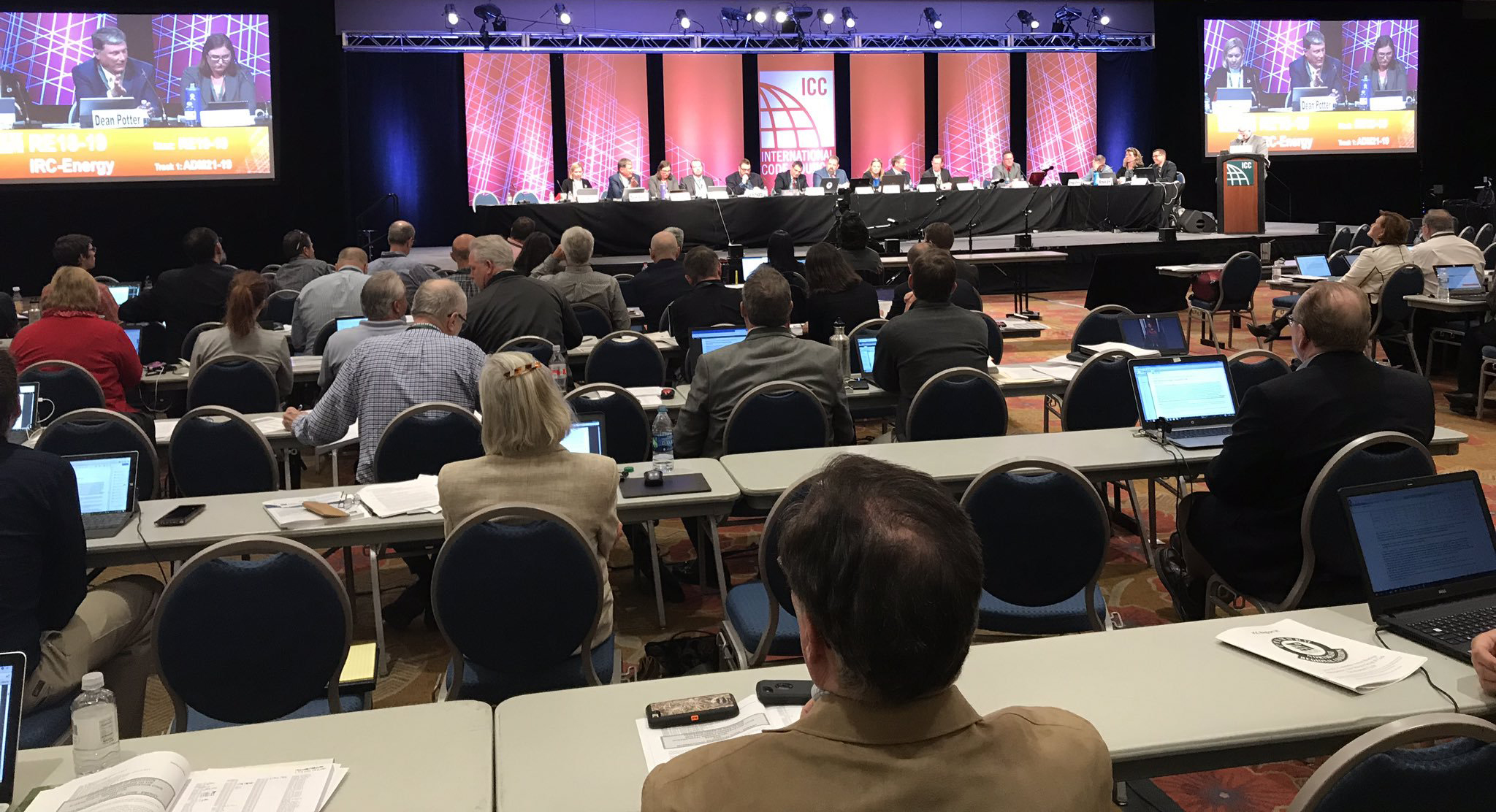
We have covered noteworthy concepts  in all of the foregoing codes and standards in previous posts and during our daily and monthly coverage of commenting opportunities the ICC makes available to its stakeholders.  Today we are simply providing a link to the webcast of the hearings that will take place for the better part of 10 days for about 10 hours per day.   The webcasts proceed on two tracks and may be accessing by clicking on the image below:

USE TRACK 2

The agenda of the hearings generally proceeds according to the core document for this phase of the Group B consensus product development; linked below:

2019 GROUP B PROPOSED CHANGES TO THE I-CODES ALBUQUERQUE COMMITTEE ACTION HEARINGS

We encourage education industry facility managers (especially those with operations and maintenance data) to participate in the ICC code development process.   The business models of education industry trade associations as “opinion aggregators” is limited by many factors so we encourage direct participation by workpoint experts involved with individual school districts, colleges, universities, university-affiliated healthcare systems and trade schools.

“Efeito de Sol” | Lucílio de Albuquerque (1877-1939)

Issue: [19-Various]

Category: Architectural, Facility Asset Management

Colleagues: Mike Anthony, Jack Janveja, Richard Robben

#StandardsNewMexico #StandardsVirginia #StandardsMaryland


LEARN MORE:


Healthcare Occupancies

DECEMBER 2025 ICC COMMITTEE ON HEALTHCARE Minutes


2025 REPORT OF THE COMMITTEE ACTION HEARINGS


Safety and sustainability for any facility, not just university-affiliated healthcare facilities, usually begin with an understanding of who, and how, shall occupy the built environment.  University settings, with mixed-use occupancy arising spontaneously and temporarily, often present challenges and they are generally well managed.

First principles regarding occupancy classifications for healthcare facilities appear in Section 308 of the International Building Code, Institutional Group I; linked below:

2021 International Building Code Section 308 Institutional Group I

There are thousands of healthcare code compliance functionaries and instructors; most of them supported by trade associations and most of them authoritative.   Hewing to our market discipline to track only the concepts that will affect university-affiliated healthcare enterprises only.  There are a few noteworthy differences between corporate healthcare businesses and university affiliated healthcare enterprises (usually combined with teaching and research activity) that we identify on this collaboration platform.

We collaborate closely with the IEEE Education & Healthcare Facilities Committee which takes a far more global view of the healthcare industry.  That committee meets online 4 times monthly in European and American time zones.

Finally, we encourage our colleagues to participate directly in the ICC Code Development process.  Contact Kimberly Paarlberg (kpaarlberg@iccsafe.org) for more information about its healthcare committees and how to participate in the ICC code development process generally.  Tranches of ICC titles are developed according to the schedule below:

2024/2025/2026 ICC CODE DEVELOPMENT SCHEDULE

LIVE: I-Code Group B Public Comment Hearings


Issue: [18-166]

Category: Architectural, Healthcare Facilities, Facility Asset Management

Colleagues: Mike Anthony, Jim Harvey, Richard Robben


More

The ICC Code Development Process

K-TAG Matrix for Healthcare Facilities

American Society of Healthcare Engineers

One & Two Family Dwellings

Some colleges and universities in the USA (e.g. Stanford, Duke, University of Chicago, University of Michigan) own one- and two-family dwellings (detached single-family homes or duplexes), though this is not common for most institutions and typically occurs on a limited scale rather than as large portfolios. 
These and others sometimes acquire residential parcels for income, tax advantages, or long-term asset management.  Acquiring adjacent residential properties controls development, reduces conflicts (e.g., student overcrowding in single-family areas), or creates future land banks for Town-Gown solutions.
§

§

Risk aggregations distinguishing single-family (IRC) from multi-family (IBC) requirements include:

Occupant load and life safety: Multi-family buildings have more residents per structure, raising the potential for higher casualties in fires or emergencies → stricter egress rules (e.g., often requiring multiple exits/stairways beyond three stories, wider corridors, and more robust exit access).

Fire spread and compartmentation: Shared walls/floors in apartments increase vertical/horizontal fire propagation risk → enhanced fire-resistance ratings for separations (e.g., between units, corridors), fire-rated assemblies, and often mandatory sprinklers using NFPA 13R (higher capacity for simultaneous head activation) versus IRC’s NFPA 13D (lower capacity, no fire department connection required for single-family).

Egress and evacuation complexity: In multi-family settings, unknown layouts, longer travel distances, and more people amplify evacuation challenges → performance-based requirements for means of egress, smoke control, and sometimes additional features like fire alarms or standpipes.

Structural and hazard exposure: Greater building size/height in multi-family increases exposure to wind, seismic, or progressive collapse risks → more engineered design (performance-based) versus IRC’s prescriptive tables for simpler single-family loads.

Sprinkler and suppression differences: IRC allows simpler, lower-flow domestic-style systems for one-/two-family; IBC mandates systems scaled for higher fire loads in R-2 occupancies.

These distinctions reflect the principle that risk scales with density and shared elements—single-family homes pose primarily individual/household-level threats, while multi-family structures aggregate risks across many unrelated occupants, justifying the IBC’s more comprehensive, often stricter provisions for safety.


Detached site condominiums (also called detached condos or site condos) offer a practical solution to the U.S. housing affordability crisis for young families by providing standalone, single-family-style homes at significantly lower costs than traditional detached single-family residences.

These properties look and feel like conventional homes—fully detached with no shared walls, private yards, and often garages—but are legally structured as condominiums. Owners typically own the interior structure (and sometimes the land beneath it, depending on the setup), while sharing common areas, landscaping, and amenities through an HOA.

This model reduces purchase prices substantially: median condo prices (including detached variants) hover around $340,000–$357,000 nationally, compared to $410,000–$420,000+ for detached single-family homes. Builders achieve this by clustering units more densely, lowering per-unit land and development costs, and enabling entry-level homeownership in desirable areas where land is expensive.

For young families, this means easier access to homeownership with lower down payments, more predictable maintenance (HOA handles exteriors and common elements), and family-friendly features like space for kids and pets—without the full financial burden of a traditional house. It bridges the gap between unaffordable single-family homes and denser options like apartments or townhomes, helping families build equity and stability sooner amid rising prices and shortages.

International Fire Code

2024 International Fire Code | Free Access

Crosswalk: NFPA Fire Code and ICC International Fire Code

2024 GROUP A PROPOSED CHANGES TO THE I-CODES based on Committee Action Hearings October 2024

2024 GROUP A PROPOSED CHANGES TO THE I-CODES

2024/2025/2026 ICC CODE DEVELOPMENT SCHEDULE

ICC BCAC | Comments to be presented at October Hearings

Noteworthy Proposals:

IFC 1010.27 Locking arrangements, PDF page 252

IFC 1020.2 Corridor Fire Resistance Ratings. PDF page 356

IFC 915 More Carbon Monoxide Detection Systems, PDF page 1156

IBC 917 Mass notification for Group E occupancies, PDF page 1176

IFC 5701 More Process Hazard Analysis, PDF page 1571

The transcript (Complete Monograph) of Committee Actions should be available by September 5th.

Committee Action Hearings on Proposed Changes: October 23-31 Long Beach, California

“A Square with Imaginary Buildings” | Hendrik van Steenwijck (1614)

LIVE: I-Code Group B Public Comment Hearings

Higher Education Laboratories

“Waking Effectiveness of Alarms for Adults Who Are Hard of Hearing” 2007  Victoria University, Australia

Health Facilities: Navigating IBC and NFPA differences


Posted February 14, 2023

Free access to the latest edition of the IFC is linked below:

2021 International Fire Code

Following the ICC Group A revision cycle public consultation on the 2024 International Fire Code will begin.  The ICC will announce the development schedule sometime in 2022.

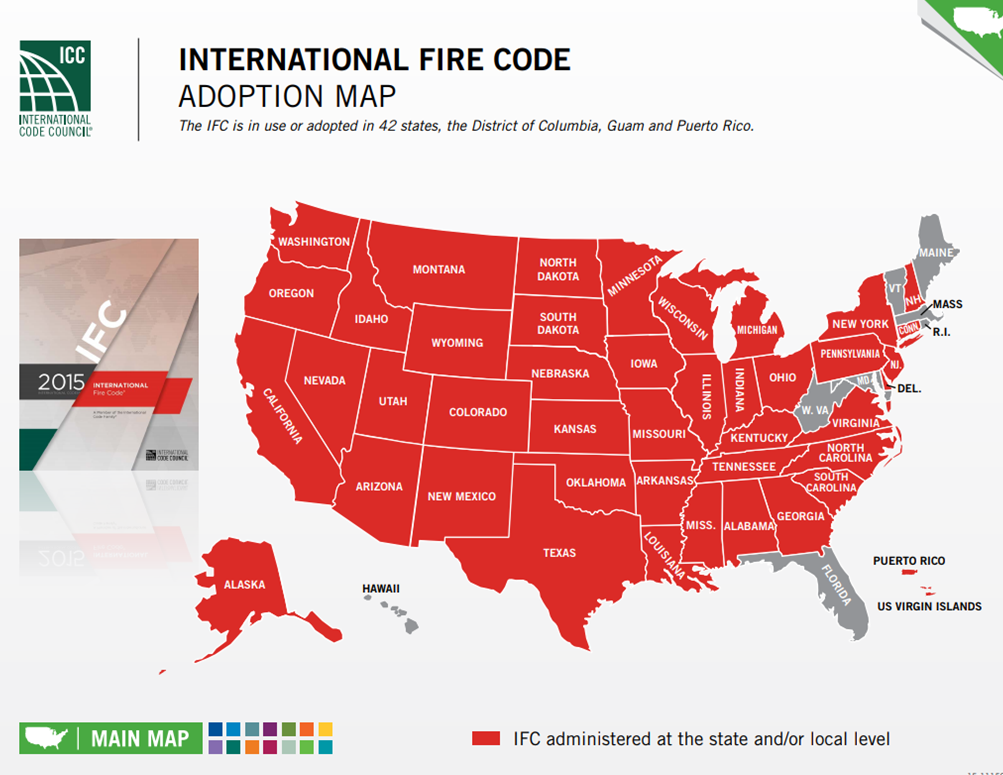
We limit our resources simply tracking the proposals that run through Group E (Educational) and Group I (Institutional) occupancies in the Group A suite with closer attention to the state they are adopted whole cloth or with local exceptions.  In many cases, IFC adoption by state and local authorities is delayed by one or more previous code revisions.  This delay in adoption may be necessary in order for jurisdictions to evaluate the impact of changes upon the region under their authority.

Public safety budgets historically support the local and state fire marshal and his or her staff.   The revenue stream of many trade associations originates from membership, conference attendance, training and certification enterprises that service the public sector stakeholder.   Manufacturer sponsorship of trade association conferences is noteworthy.

Unless there is an idea, or proposed regulation that has run off the rails (either in terms of rigor or cost increase) — we place fire safety in the middle of our ranking of priorities.  With gathering pace, we find many fires safety goals being met with electrotechnologies where we place our highest priority.

Click on image for more information. The map is updated by expert agencies frequently so we recommend a web search for an update.

Significant code changes rarely happen within a 3-year cycle so it is wise to follow ideas as they travel through the agendas of technical committees through several cycles as administered by the Fire Code Action Committee.

The ICC posts the transcripts of public proposals, technical committee responses to public proposals, public response to the technical committee response and the final balloting in a fair and reasonable fashion as can be seen in the transcripts linked below:

2021 International Fire Code Proposed Changes

2021 International Fire Code Public Comment Agenda 

A search on the terms “classroom” or “school” in any of the documents above offers granular insight into the trend of current thinking.   We find fire extinguishers placement a perennial concern across several standards suites.   You will note the careful consideration of proposals for use of the mass notification systems, now integrated into fire alarm systems and their deployment in active shooter situations.

The transcripts reveal detailed understanding and subtlety.

“The Country School” | Winslow Homer

There are many issues affecting the safety and sustainability of the education facility industry.  We add value to the industry because of our cross-cutting perspective on the hundreds of “silos”created by the competition (and sometimes cooperation) among accredited, consortia and open-source standards developers.  We have the door open every day at 11 AM Eastern time to enlighten understanding of them all.  We also host a breakout teleconference every month to drill into the specifics of standards action on fire safety for the real assets of school districts, colleges and universities.  See our CALENDAR for the next online meeting.

Finally, we persist in encouraging education industry facility managers (especially those with operations and maintenance data) to participate in the ICC code development process.  You may do so by CLICKING HERE.

The ICC Group B Code Meetings will be hosted soon and open to the public:   

International Code Council 2022 Group B Public Comment Agenda (September 14-21 Kentucky International Convention Center)

The Group B tranche is largely focused on energy, structural, residential and existing building concepts but all of the titles cross-reference the IFC in some way so it is wise to follow how the concepts re-arrange and cross-reference themselves with each cycle.


Issue: [16-169]

Category: Architectural, Facility Asset Management, Space Planning

Colleagues: Mike Anthony,  Casey Grant, Joshua Evolve, Marcelo Hirschler


More

2021/2022 ICC CODE DEVELOPMENT SCHEDULE

FINAL ACTION RESULTS ON THE 2018 PROPOSED CHANGES TO THE INTERNATIONAL CODES – GROUP A

2018 GROUP A PROPOSED CHANGES TO THE I-CODES COLUMBUS COMMITTEE ACTION HEARINGS

2018 GROUP A PUBLIC COMMENT AGENDA | INTERNATIONAL BUILDING CODE

2018 GROUP A PUBLIC COMMENT AGENDA | INTERNATIONAL FIRE CODE

2018 REPORT OF THE COMMITTEE ACTION HEARINGS ON THE 2018 EDITIONS OF THE GROUP A INTERNATIONAL CODES


International Building Code Definitions: Chapter 2

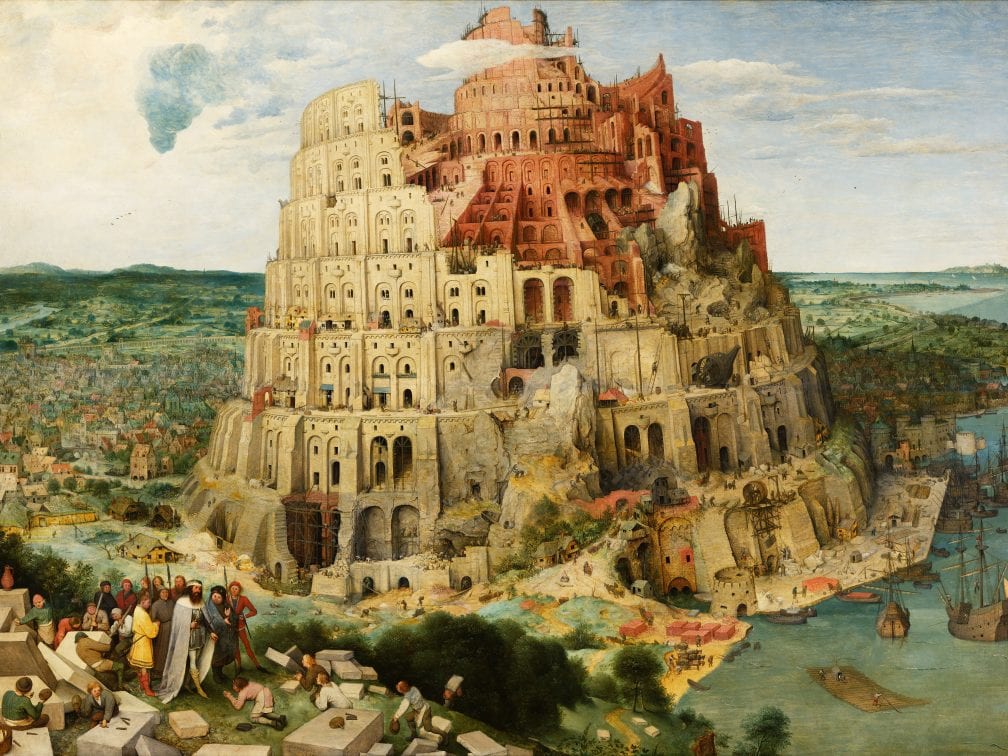
“The Tower of Babel” 1563 | Pieter Bruegel the Elder

Widely accepted definitions (sometimes “terms of art”) are critical in building codes because they ensure clarity, consistency, and precision in communication among architects, engineers, contractors, and regulators.  Ambiguity or misinterpretation of terms like “load-bearing capacity,” “fire resistance,”  “egress” or “grounding and bonding”  could lead to design flaws, construction errors, or inadequate safety measures, risking lives and property.
“Standardized” definitions — by nature unstable — create a shared language that transcends local practices or jargon, enabling uniform application and enforcement across jurisdictions.  Today at the usual hour we explore the nature and the status of the operational language that supports our raison d’être of making educational settlements safer, simpler, lower-cost and longer-lasting.  


2021 IBC Chapter 2: Definitions

2024/2025/2026 ICC CODE DEVELOPMENT SCHEDULE

Group B Documents

Complete Monograph (2650 pages) | Note our proposal on Page 754

Entertainment Occupancies

2025 GROUP B PROPOSED CHANGES TO THE I-CODES | Complete Monograph 2630 Pages

N.B.

G73-25 Section 410: Stages, Platforms and Technical Production Areas (Page 591-…) Submitted by the American Society of Theater Consultants

G77-25: Emergency ventilation  (Pages 601-…)

G27-25: Type A and B stage definition (Page 490)

G78-25: Technical Production areas (Page 602)

American Society of Theater Consultants | Oberlin College

2024 GROUP A PROPOSED CHANGES TO THE I-CODES | Complete Monograph 2658 Pages

2024/2025/2026 ICC CODE DEVELOPMENT SCHEDULE

“View from the Ancient Theater in Taormina to Mount Etna” c. 1880 Carl Wuttke

Safety and sustainability for any facility begins with an understanding of who shall occupy it.  University settings, with mixed-use phenomenon arising spontaneously and temporarily, present challenges and no less so in  square-footage identified as performing arts facilities.  Education communities present the largest installed base of mixed use and performing arts facilities.  A distinction is made between supervised occupants that are in secondary schools (generally under age 18) and unsupervised occupants that are in university facilities (generally above age 18).

First principles regarding occupancy classifications for performing arts facilities appear in Section 303 of the International Building Code Assembly Group A-1.  The public edition of the 2021 IBC is linked below:

2024 IBC Chapter 3: Occupancy Classification and Use


Each of the International Code Council code development groups A, B and C; fetch back to these classifications.   You can sample the safety concepts in play with an examination of the document linked below:

2019 GROUP B PROPOSED CHANGES TO THE GROUP B I-CODES

2019 GROUP B PUBLIC COMMENT AGENDA

Each of the foregoing documents are lengthy so we recommend using search terms such as “school”, “college”, ‘”university”, “auditorium”, “theater”, “children”, “student” to hasten your cut through it.

We find continuation of lowering of the lighting power densities as noteworthy.  Technical committees assembled and managed by the International Code Council, the American Society of Heating & Refrigeration Engineers and the Illumination Engineering Society are leaders in developing consensus products that drive the LED illumination transformation.


The revision schedule for the next tranche of ICC titles that are built upon the foundation of the IBC is linked below:

2024/2025/2026 ICC CODE DEVELOPMENT SCHEDULE

We encourage experts in education communities — facility managers, research and teaching staff, architectural and engineering students — to participate directly in the ICC Code Development process at the link below:

https://www.iccsafe.org/cdpaccess/

We reserve a place on the agenda of our standing Lively 200 colloquia on this topic.  See our CALENDAR for the next online meeting; open to everyone.

 

Issue: [18-166]

Category: Architectural, Healthcare Facilities, Facility Asset Management

Colleagues: Mike Anthony, Jim Harvey, Richard Robben


The International Code Council (ICC) develops its codes and standards through a consensus-driven process. The ICC Code Development Process follows these major stages:

Code Change Proposal Submission

Stakeholders (e.g., government officials, industry professionals, and the public) submit proposals to modify existing codes or introduce new provisions.

Committee Action Hearing (CAH)

Expert committees review and evaluate submitted proposals.
Public testimony is allowed, and committees vote on whether to approve, disapprove, or modify the proposals.

Public Comment Period

After the CAH, the public can submit comments or suggest modifications to the committee’s decisions.
These comments help refine the proposed changes before final voting.

Public Comment Hearing (PCH)

ICC members discuss and vote on public comments.
This step ensures that all voices are heard and debated before finalizing changes.

Online Governmental Consensus Vote (OGCV)

Governmental members vote on the final code changes electronically.
Only governmental voting members (e.g., code officials) participate in this stage to ensure the process remains unbiased.

Publication of New Code Edition

Approved code changes are incorporated into the next edition of the ICC codes.
The ICC updates its codes every three years (e.g., 2021, 2024, 2027 editions).

This structured process ensures that ICC codes remain comprehensive, up-to-date, and responsive to industry needs while maintaining safety and functionality.

Layout mode
Predefined Skins
Custom Colors
Choose your skin color
Patterns Background
Images Background
Standards Michigan
error: Content is protected !!
Skip to content