


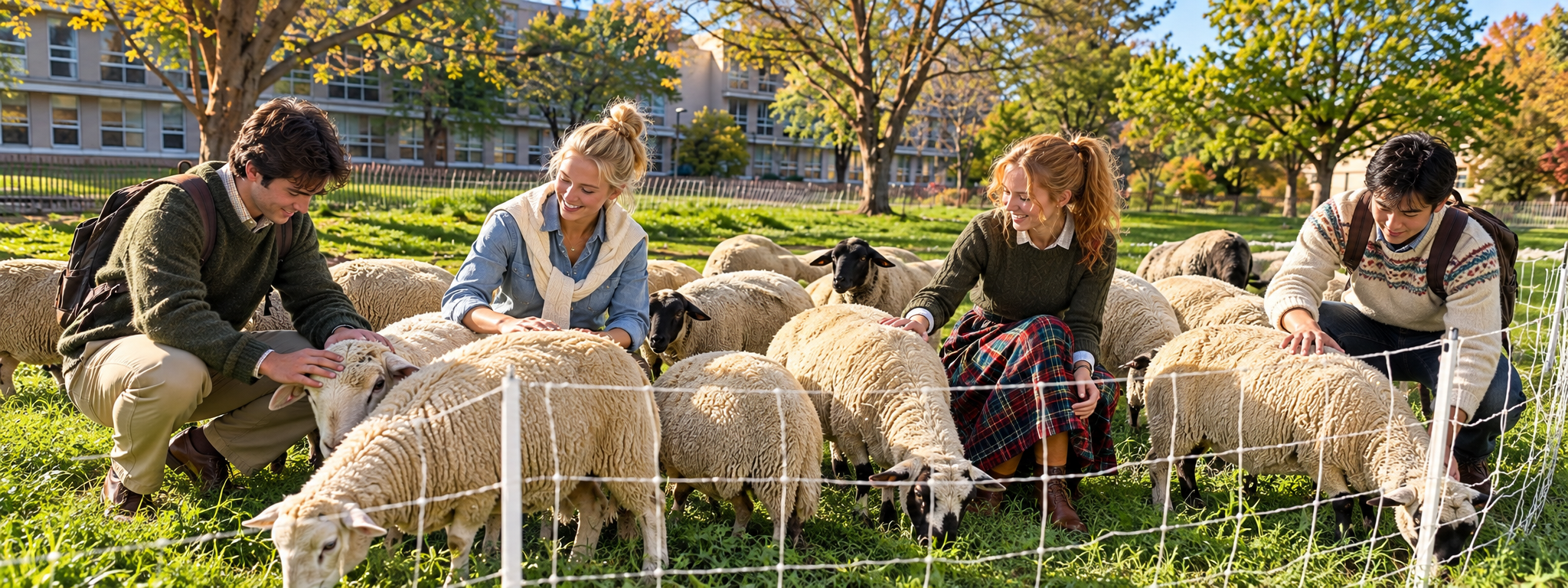
University of California Davis Sheep Mowers

https://youtu.be/hWFsFzdK6Ow “Os justi” is a sacred choral motet composed by the Austrian composer Anton Bruckner. The piece is based on a Latin text from the Book of Wisdom, which reads “Os justi meditabitur sapientiam, et lingua ejus loquetur judicium,” meaning “The mouth of the righteous speaks wisdom, and his tongue talks of judgment.” Bruckner composed the piece in 1879 for the choir of the St. Florian Monastery, where he served as the organist. “Os justi” is characterized by its rich, sonorous harmonies and its use of subtle rhythmic and melodic variations to create a sense of organic development throughout the piece. The motet is often regarded as one of Bruckner’s finest choral works, and it has been praised for its deep spirituality and expressive power. The piece is typically performed by a mixed choir a cappella, although some arrangements exist for accompanied versions. “Os justi” has become a popular selection for choral performances and recordings, and it is considered a cornerstone of the sacred choral repertoire. University endowments are comprised of money or other financial assets that are donated to academic institutions. Charitable donations are the primary source of funds for endowments. Endowment funds support the teaching, research, and public service missions of colleges and universities. In the case of endowment funds for academic institutions, the income generated is intended to finance a portion of the operating or capital requirements of the institution. Today we will pick through few reports where safety and sustainability claims are listed and described. https://standardsmichigan.com/schenkingen/ Lightning flash density – 12 hourly averages over the year (NASA OTD/LIS) This shows that lightning is much more frequent in summer than in winter, and from noon to midnight compared to midnight to noon. https://youtu.be/zisnPchVYKs https://standardsmichigan.com/rain-2/ TC 64 Electrical installations and protection against electric shock https://site.ieee.org/icps-ehe/ Today we explain our collaboration with other like-minded units in education communities in the US and other nations. In most cases we conform to participation requirements set by ANSI US Technical Advisory Groups but we also have liaison with other universities in the European Union who conform to the participation requirements of their own national standards bodies. Use the login credentials at the upper right of our home page. Because a great deal of content is copyright protected by the ISO, IEC and the ITU, please contact bella@standardsmichigan.com for an advance agenda. https://standardsmichigan.com/standing-agenda-international-standards/ Periodic scan of redlines of mechanical technology best practice titles open for public comment. Use the login credentials at the upper right of our homepage. For an advance agenda send bella@standardsmichigan.com an email. https://standardsmichigan.com/mechanical-engineering-monthly/ This is a simply delightful sketch animation of a ballet dancer. I was trying to get some different effects and style effects than usual. (Prompt in following tweets.) — Jason Baldridge (@jasonbaldridge) January 17, 2025 “Actors from the Commedia dell’Arte on a Wagon in a Town Square” 1640 Jan Miel A walk through the status of best practice literature that sets the standard of care for safety and sustainability in the education facilities built for the performance arts. Readings: The Seven Lively Arts (1924) Glibert Seldes (Oxford Academic review) https://twitter.com/RoyalBalletSch/status/1651974785490878464?s=20 https://youtu.be/3XU1wNYBnOk “Adiemus” is a song composed by Welsh composer Karl Jenkins, which was first featured on his album “Adiemus: Songs of Sanctuary” in 1995. The song is performed by a vocal ensemble and features a unique blend of world music influences, including African and Latin American rhythms, along with classical choral arrangements. The lyrics of “Adiemus” are not based on any specific language or culture. Instead, the vocalists perform with syllables and sounds that create a non-lexical vocable language, which is intended to be universal and accessible to people from all cultures and backgrounds. The overall message of the song is one of unity and harmony, with a focus on the power of music to bring people together. The composer has described the piece as a celebration of the human voice and the beauty of the human spirit, and it has been embraced by audiences around the world for its uplifting and inspiring qualities. https://standardsmichigan.com/nederland/
"Os justi" Rodolfus Foundation


Schenkingen
Rain & Lightning


IEC TC 64 Meetings
Hello World!

Mechanical 400

Lively 200
#Veo2 pic.twitter.com/fyznNWl3Mt
"Adiemus" Marianum High School

On 9/11 the FDNY lost 343 of their own.
Not statistics. Sons, fathers, husbands from 75 firehouses across the five boroughs.
121 engine companies and 62 ladder companies answered the call. Every Rescue company in New York went in.
They knew the buildings were coming down and… pic.twitter.com/e4ArBUmfLq— Sassafrass84 (@Sassafrass_84) September 7, 2026

Scales Mound School District | Jo Daviess County Illinois 815
Oxford students after exams, 1989. pic.twitter.com/HQbO4r6dUE
— M (@0detobeauty) May 27, 2026
The calendar of Anglosphere educational settlements subtly shapes life of the mind, generally; and family and community life, specifically. Its cadence has roots in the cathedral schools and monastic learning communities of medieval Europe. Universities were not originally organized around modern “semesters.” Instead, the year followed the Christian liturgical calendar, agricultural seasons, food paths, daylight availability, and travel conditions.
In America educational calendars were nudged along by agricultural cycles. In the United Kingdom university calendars evolved into three major terms: Michaelmas in autumn, associated with arrival and beginnings; Hilary or Lent in winter, associated with discipline and study; and Trinity or Easter in spring, associated with examinations, outdoor rituals, music, rowing, gardens, and celebration.
Modern commencement traditions across the Anglosphere are descendants of medieval spring degree ceremonies. Academic gowns, hoods, processions, Latin phrases, formal dining, chapel music, and public recognition all preserve traces of the university as a scholarly guild and religious-civic community.
Before railways, electric lighting, and central heating, universities had to adapt to muddy roads, short winter days, limited candles, cold buildings, and agricultural obligations. Spring therefore became the natural season of culmination, reunion, athletic competition, courtship, and ceremony.
The medieval university was not merely a school but an educational settlement — a self-governing town of scholars, libraries, chapels, kitchens, workshops, residences, and dining halls. That settlement pattern survives in residential colleges, quadrangles, tutorial systems, common rooms, chapel choirs, and formal meals.
Anglosphere campuses retain this ancient emotional rhythm: autumn seriousness, winter inwardness, and spring release. That continuity helps explain why colleges and universities still feel culturally distinct from ordinary commercial society. (Relata: Gulliver Visits the Great Academy of Lagado)

We’re “organized” but not too organized; like the bookseller who knows where every book can be found.
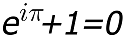
at a conference where you don’t have to present
— Peyman Milanfar (@docmilanfar) April 4, 2025
#AcademicChatter #AcademicTwitter
Academics be like 👇 pic.twitter.com/6cpVEw3PVS
— Reviewer 2 (@GrumpyReviewer2) April 2, 2024






