The Society of College and University Planning was founded in 1965 at the University of Michigan in Ann Arbor during an informal gathering of campus planners frustrated with the lack of professional exchange in their emerging field. Rapid postwar enrollment growth and massive campus expansion projects had created urgent needs for long-range physical planning, yet few institutions had dedicated planners or shared knowledge.
A small group, led by University of Michigan planners George J. Bruha and Frederick W Mayer met in Ann Arbor to discuss common challenges facing other State of Michigan settlements; joined by Stanford, Ohio State and the University of Illinois. They decided to create a formal organization to foster collaboration, research, and professional development. In 1966, with Michigan’s support, SCUP was officially established as a nonprofit with its first office on the Ann Arbor campus. Its founding principle—integrated planning linking academics, finances, and facilities—remains central today.
Early operations benefited from administrative support (aegis) provided by the University of Michigan, including office space and resources in Ann Arbor. This arrangement persisted until a financial crisis in the late 1970s (1976–1980), during which SCUP relocated to New York.
The decoupling—marking full operational and administrative independence from the University of Michigan—occurred in 1980, when SCUP returned to Ann Arbor as a self-sustaining nonprofit headquartered at a separate location –1330 Eisenhower Place — less than a mile walk from Standards Michigan‘s front door at 455 East Eisenhower.
* Of the 220 ANSI Accredited Standards Developers, the State of Michigan ranks 3rd in the ranking of U.S. states with the most ANSI-accredited standards developers (ASDs) headquartered there; behind the Regulatory Hegemons of California and ChicagoLand and excluding the expected cluster foxtrot of non-profits domiciled in the Washington-New York Deep State Megalopolis. Much of Michigan’s presence in the private consensus standards space originates from its industrial ascendency through most of the 1900’s.
MSU’s Extension’s Beef Production program supports Michigan’s beef industry through research, education, and outreach to enhance producer profitability, sustainability, and quality of life. It focuses on key areas like nutrition, genetics, grazing management, health, reproduction, and economics. Notable efforts include advancing grass-fed beef systems, feedlot management, and beef x dairy crossbreeding.
Conducted at facilities such as the Lake City and Upper Peninsula Research Farms, the program offers workshops, resources (e.g., pricing tools, disease prevention guides), and youth education via 4-H market beef projects and family recipes.
Our Master Gardeners are wrapping up a great educational tour of Alberta and British Columbia, Canada. They participated in learning opportunities at Canadian National Parks, agricultural sites, and gardens, and gained a better understanding of Indigenous and Asian cultures. pic.twitter.com/47jcrlYJfv
This content is accessible to paid subscribers. To view it please enter your password below or send mike@standardsmichigan.com a request for subscription details.
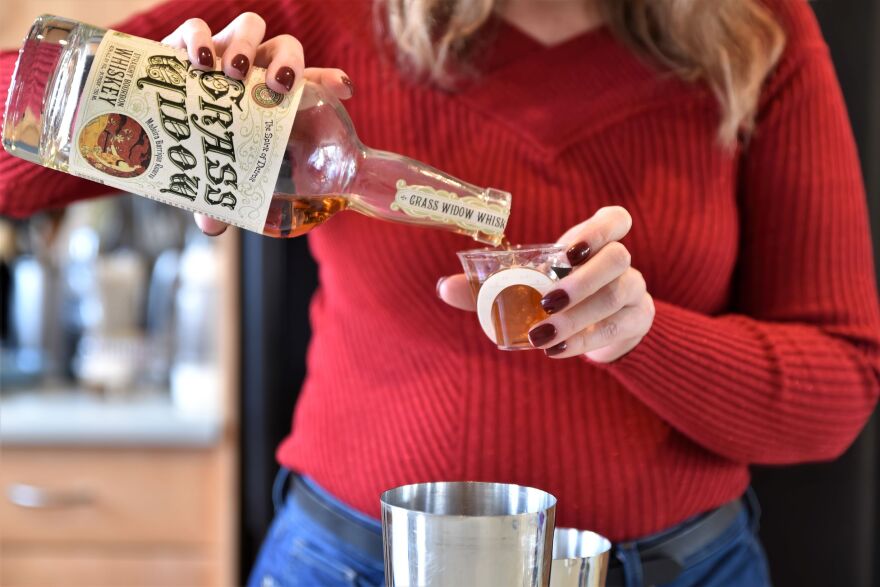
Historians’ best guess as to the origin of eggnog dates back to the English Middle Ages, where a warm, milky ale called ‘posset’, was consumed. Posset was often consumed with eggs and figs; eggs, figs, dairy, and sherry were products that only the wealthy could afford to enjoy at the time. Eggnog was thought to have arrived in the U.S. prior to the revolutionary war. Whereas most of the eggnog consumed in Britain was by the upper class (with sherry), as eggnog advanced throughout the U.S. like a milky river of frothy delight, it was generally consumed with rum or bourbon.
Because the agricultural-based colonies were flush with chickens and cows, the consumption of eggnog was not limited to crusty upper class Brits, but rather a drink that most people throughout the American colonies could enjoy. In fact, food historian, Emelyn Rude (2015), author of “How Eggnog (Almost) Changed the World”, explains that consumption of eggnog was a popular holiday pastime of many, even including West Point cadets, such as Edgar Allen Poe and Jefferson Davis.
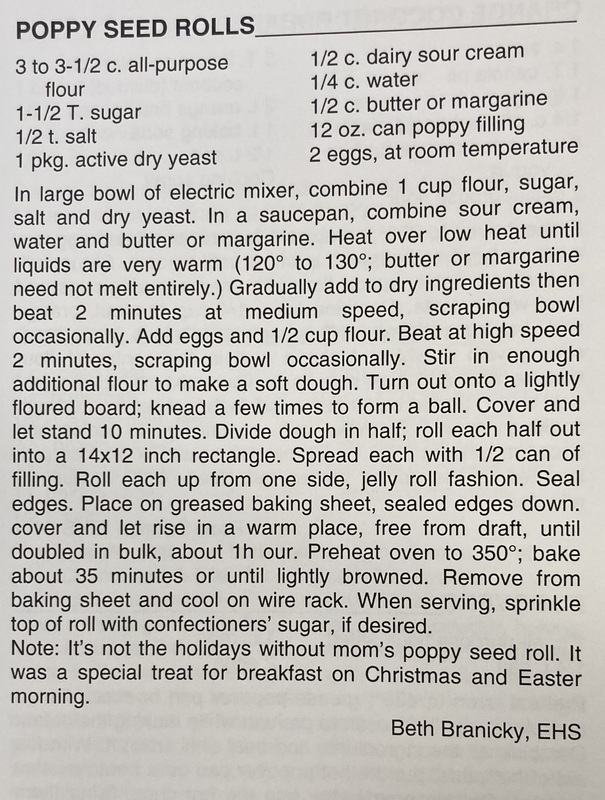
Makowiec is a poppy seed roll evolving from East European baking tradition that is commonly served during the Christmas season. It is a sweet pastry filled with a mixture of ground poppy seeds, honey, nuts, and sometimes raisins. The roll is often braided or shaped into a log and can be dusted with powdered sugar.
‘Makowiec’ (poppy seed cake), photo: Zbigniew Lewczak/Getty Images
This is his RVW’s first completed symphony and one of the earliest major choral symphonies in English music. Setting poetry from Walt Whitman’s Leaves of Grass, it explores the sea as both a literal and spiritual metaphor for exploration and human destiny. Premiered at the Leeds Festival, it signaled Vaughan Williams’s move toward a distinctly English symphonic voice, blending expansive orchestration with modal harmonies and visionary choral writing. The work’s significance lies in its ambition: it established him as a leading British composer and opened a new path for English symphonic and choral expression.
Williams College is a private liberal arts college located in Williamstown, Massachusetts, USA. Founded in 1793, it is one of the oldest institutions of higher education in the United States. The college was established through a bequest of Colonel Ephraim Williams Jr., a war hero who died in the Battle of Lake George during the French and Indian War. In his will, Colonel Williams left funds for the establishment of a free school on the condition that it be located in Williamstown.
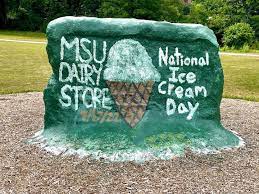
The invention of ice cream, as we know it today, is a product of historical evolution, and there isn’t a single individual credited with its creation. Various cultures and civilizations throughout history have contributed to the development of frozen treats resembling ice cream.
One of the earliest records of frozen desserts can be traced back to ancient China, where people enjoyed a frozen mixture of milk and rice around 200 BC. Similarly, ancient Persians and Arabs had a tradition of mixing fruit juices with snow or ice to create refreshing treats.
In Europe, frozen desserts gained popularity in the 17th and 18th centuries, and it was during this time that the more modern version of ice cream, made with sweetened milk or cream, began to take shape. During this period, ice cream became more widely accessible and enjoyed by the nobility and upper classes.
To produce ice cream on a commercial scale, several key pieces of infrastructure and equipment are necessary. The specific requirements may vary depending on the production capacity and the type of ice cream being produced, but the basic infrastructure typically includes:
Manufacturing Facility: A dedicated space or building is needed to house all the production equipment and storage facilities. The facility should comply with local health and safety regulations and be designed to maintain the required temperature and hygiene standards.
Mixing and Blending Equipment: Industrial-scale mixers and blending machines are used to mix ingredients like milk, cream, sugar, stabilizers, emulsifiers, and flavorings. These machines ensure that the mixture is homogenized and consistent.
Pasteurization Equipment: To ensure product safety and extend shelf life, ice cream mix needs to be pasteurized. Pasteurization equipment heats the mixture to a specific temperature and then rapidly cools it to destroy harmful microorganisms.
Homogenizers: Homogenizers help break down fat molecules in the ice cream mix to create a smoother and creamier texture.
Aging Vats: The ice cream mix is aged at a controlled temperature for a specific period, which allows the ingredients to fully blend and improves the ice cream’s texture.
Freezers: Continuous freezers or batch freezers are used to freeze the ice cream mix while incorporating air to create the desired overrun (the amount of air in the final product). Continuous freezers are more commonly used in large-scale production, while batch freezers are suitable for smaller batches.
Hardening and Storage Room: Once the ice cream is frozen, it needs to be hardened at a lower temperature to achieve the desired texture. Storage rooms are used to store finished ice cream at the appropriate temperature until distribution.
Packaging Equipment: Equipment for filling and packaging the ice cream into various containers, such as cartons, tubs, or cones.
Quality Control and Laboratory Facilities: A dedicated area for quality control testing, where ice cream samples are analyzed for consistency, flavor, and other characteristics.
Cleaning and Sanitation Systems: Proper cleaning and sanitation systems are essential to maintain hygiene and prevent contamination.
Utilities: Adequate water supply, electrical power, and refrigeration capacity are critical for ice cream production.
New update alert! The 2022 update to the Trademark Assignment Dataset is now available online. Find 1.29 million trademark assignments, involving 2.28 million unique trademark properties issued by the USPTO between March 1952 and January 2023: https://t.co/njrDAbSpwBpic.twitter.com/GkAXrHoQ9T