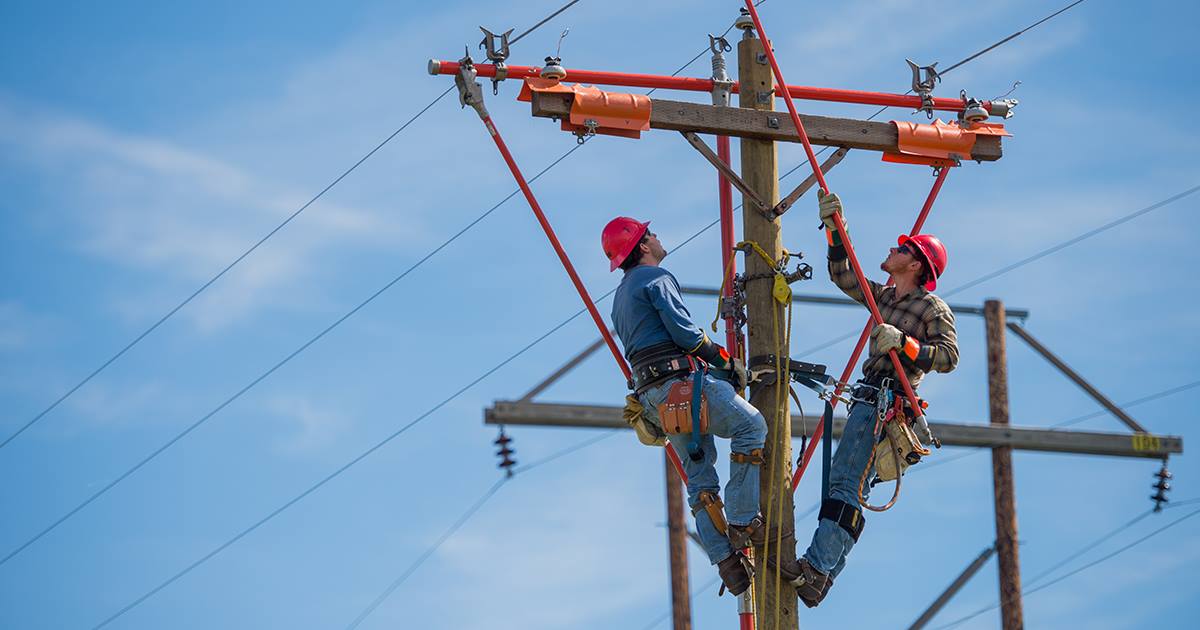
Abstract: This guide identifies the mechanisms and an analytic approach for developing consistent rules, agreements, and/or methodologies for the evaluation and inter-entity cooperation managing pole attachments on utility infrastructure that can contain both electric supply as well as communications wireline and wireless facilities.
The common safety codes and accepted good industry practices for joint use are referenced, including items such as clearances and strength/loading requirements, appropriate work rules during installation, maintenance and restoration, and general guidelines. The considerations within this guide can be used to help perform a detailed assessment of attachment installations where communications antennas and related wireline and wireless equipment are to be co-located on joint use structures.
Scope: This guide provides recommendations for the development of consistent guides, agreements, and/or methodologies for the evaluation and inter-company cooperation on managing pole attachments on Electric Utility infrastructure.
Purpose: The Joint Use Guide documents consistent approaches, methodologies and rules for the sharing and co-location of equipment with electric Transmission & Distribution (T&D) facilities for communications such as antennae and/or cable. With the emergence of new communications networks and emerging technologies which depend on widely distributed communications {e.g. 5G and Internet of Things ( IoT)}, the needs of vertical real-estate for use in communications is expected to dramatically increase in the coming years. While electric T&D facilities provide an excellent platform to help meet these needs, there are significant safety and reliability issues associated with their use.
This title sets the standard of care for construction, operation and maintenance of power and telecommunication infrastructure on the supply side of the point of common coupling. It is the first title to contemplate when weather disasters happen; with most public utilities bound to its best practice assertions by statute. Pre-print of Change Proposals for changes to appear in 2028 Edition will be available by 1 July 2025; with 24 March 2026 as the close date for comments on proposed changes.
The standard of care for electrical safety at high and low voltage is set by both the NEC and the NESC. There are gaps, however (or, at best “gray areas”) — the result of two technical cultures: utility power culture and building fire safety culture. There is also tradition. Local system conditions and local adaptation of regulations vary. Where there is a gap; the more rigorous requirement should govern safety of the public and workers.
The 2023 National Electrical Safety Code (NESC)– an IEEE title often mistaken for NFPA’s National Electrical Code (NEC) — was released for public use about six months ago; its normal 5-year revision cycle interrupted by the circumstances of the pandemic. Compared with the copy cost of the NEC, the NESC is pricey, though appropriate for its target market — the electric utility industry. Because the 2023 revision has not been effectively “field tested” almost all of the available support literature is, effectively, “sell sheets” for pay-for seminars and written by authors presenting themselves as experts for the battalions of litigators supporting the US utility industry. Without the ability to sell the NESC to prospective “insiders” the NESC would not likely be commercial prospect for IEEE. As the lawsuits and violations and conformance interests make their mark in the fullness of time; we shall see the 2023 NESC “at work”.
Change Proposals are now being accepted from the public for revisions to the 2023 Edition of the National Electrical Safety Code® #NESC through 15 May 2024.
The new code goes into effect 1 February 2023, but is now available for access on IEEE Xplore! Produced exclusively by IEEE, the National Electrical Safety Code (NESC) specifies best practices for the safety of electric supply and communication utility systems at both public and private utilities. The bibliography is expanding rapidly:
The IEEE NESC technical committee has released a “fast track” review of proposed changes to fault-managed power system best practice:
CP5605 Provides a definition of new Fault Managed Power System (FMPS) circuits used for the powering of
communications equipment clearly defines what constitutes a FMPS circuit for the purposes of application of the NESC
Rules of 224 and 344 https://ieee-sa.imeetcentral.com/p/eAAAAAAASPXtAAAAADhMnPs
CP5606 Provides new definitions of Communication Lines to help ensure that Fault Managed Power Systems (FMPS)
circuits used for the exclusive powering of communications equipment are clearly identified as communications lines
and makes an explicit connection to Rule 224B where the applicable rules for such powering circuits are found. https://ieee-sa.imeetcentral.com/p/eAAAAAAASPXpAAAAAFfvWIs
CP5607 The addition of this exception permits cables containing Fault Managed Power System (FMPS) circuits used for
the exclusive powering of communications equipment to be installed without a shield. https://ieee-sa.imeetcentral.com/p/eAAAAAAASPXuAAAAAEEt3p4
CP5608 The addition of this exception permits cables containing Fault Managed Power System (FMPS) circuits used for
the exclusive powering of communications equipment to be installed without a shield. https://ieee-sa.imeetcentral.com/p/eAAAAAAASPXvAAAAAGrzyeI
We refer them to the IEEE Education & Healthcare Facilities Committee for further action, if any.
August 5, 2022
We collaborate closely with the IEEE Education & Healthcare Facilities Committee (IEEE E&H) to negotiate the standard of care for power security on the #SmartCampus since many campus power systems are larger than publicly regulated utilities. Even when they are smaller, the guidance in building the premise wiring system — whether the premise is within a building, outside the building (in which the entire geography of the campus footprint is the premise), is inspired by IEEE Standards Association administrated technical committees.
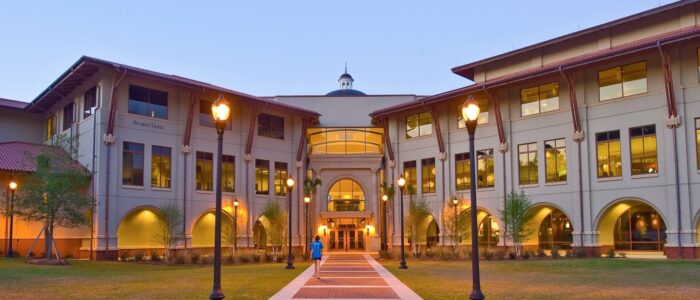
Northeast Community College | Norfolk, Nebraska
Today we begin a list of noteworthy changes to be understood in the next few Power colloquia. See our CALENDAR for the next online meeting.
New rules 190 through 195 cover photovoltaic generating stations. Rule 116c adds an exception for short lengths of insulated power cables and short-circuit protection if the situation involves fewer than 1,000 volts.
Rule 320B has been revised to clarify separations that apply to communications and supply in different conduit systems.
Table 410-4 is based on the latest arc flash testing on live-front transformers.
Rule 092A adds an exception allowing protection, control, and safety battery systems to not be grounded.
Rules 234 B1, C1, D1 were revised to better present vertical and horizontal wind clearances, and to coordinate requirements with the new Table 234-7.
Rule 120A was revised to provide correction factors for clearances on higher elevations.
Table 253-1 has been revised to reduce the load factor for fiber-reinforced polymer components under wire tension—including dead ends—for Grade C construction.
Rule 410A now requires a specific radio-frequency safety program for employees who might be exposed.
In the Clearances section, as well as in the specification of the Grade of Construction in Table 242-1, the Code further clarifies the use of non-hazardous fiber optic cables as telecom providers continue to expand their networks.
Revisions in the Strength & Loading sections include modified Rule 250C, which addresses extreme wind loading for overhead lines. Two wind maps are now provided instead of the previous single one. A map for Grade B, the highest grade of construction, with a Mean Recurrence Interval (MRI) of 100 years (corresponding to a one percent annual probability of occurrence) is provided in place of the previous 50–90-year MRI map. For Grade C construction, a separate 50-year MRI (two percent annual probability of occurrence) map is now provided. In the previous Code, a factor was applied to the 50–90-year MRI map for application to Grade C.
Changes were also made to the method of determining the corresponding wind loads, consistent with the latest engineering practices as an example of a Code revision focused on public safety, the ground end of all anchor guys adjacent to regularly traveled pedestrian thoroughfares, such as sidewalks, and similar places where people can be found must include a substantial and conspicuous marker to help prevent accidents. The previous Code did not require the marking of every such anchor guy.
Significant revisions were made in Section 14 covering batteries. Previous editions of the code were based on lead-acid technology and batteries only used for backup power. The 2023 Code incorporates the new battery technologies and addresses energy storage and backup power.
A new Section 19 of the code covers photovoltaic generating stations, with sections addressing general codes, location, grounding configurations, vegetation management, DC overcurrent protection, and DC conductors. These new rules accommodate large-scale solar power projects.
In the Clearances section, all rules for wireless antenna structures have been consolidated in the equipment section (Rule 238 and 239), which makes the Code more user-friendly.
A new subcommittee was created focusing on generating stations, with the original subcommittee continuing to address substations.
A working group is investigating Fault Managed Power Systems (FMPS) cables as the technology may be used for 5G networks. The team is looking at possible impacts, including clearances and work rules.
Several proposals recommending improvements to the 2017 National Electrical Safety Code (NESC) were submitted to the IEEE subcommittees drafting the 2022 revision of the NESC. Some of the proposals deal with coordination with the National Electrical Code — which is now in its 2023 revision cycle. Keep in mind that that NESC is revised every 5 years at the moment; the NEC is revised every 3 years.
The original University of Michigan standards advocacy enterprise has been active in writing the NESC since the 2012 edition and set up a workspace for use by electrical professionals in the education industry. We will be using this workspace as the 2022 NESC continues along its developmental path:
The NESC is a standing item on the 4-times monthly teleconferences of the IEEE Education & Healthcare Facilities committee. The next online meeting is shown on the top menu of the IEEE E&H website:
We have a copy of the first draft of the 2023 NESC and welcome anyone to join us for an online examination during any of Power & ICT teleconferences. See our CALENDAR for the next online meeting.
Business unit leaders, facility managers and electrical engineers working in the education facilities industry may be interested in the campus power system reliability database. Forced outages on large research campuses, for example, can have enterprise interruption cost of $100,000 to $1,000,000 per minute. The campus power system forced outage database discriminates between forced outages attributed to public utility interruptions and forced outages attributed to the university-owned power system. The E&H committee will convey some of the discipline applied by the IEEE 1366 technical committee into its study of campus power systems and, ultimately, setting a benchmark for the standard of care for large university power systems.
* The IEEE changed the nominal date of the next edition; likely owed to pandemic-related slowdown typical for most standards developing organizations.
Issue: [16-67]
Contact: Mike Anthony, Robert G. Arno, Lorne Clark, Nehad El-Sharif, Jim Harvey, Kane Howard, Joe Weber, Guiseppe Parise, Jim Murphy
Category: Electrical, Energy Conservation & Management, Occupational Safety
The 2023 National Electrical Safety Code (#NESC) will be published this August. Stay tuned for new resources from #IEEE coming soon! Read about the upcoming changes here:https://t.co/VLXCNaf74S
— IEEE Educational Activities (@IEEEeducation) June 8, 2022
University of Michigan – Bell Telephone Laboratories – Massachusetts Institute of Technology
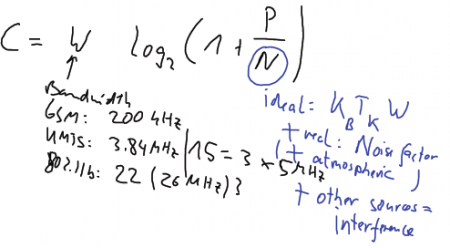
Abstract. A method is developed for representing any communication system geometrically. Messages and the corresponding signals are points in two “function spaces,” and the modulation process is a mapping of one space into the other. Using this representation, a number of results in communication theory are deduced concerning expansion and compression of bandwidth and the threshold effect. Formulas are found for the maximum rate of transmission of binary digits over a system when the signal is perturbed by various types of noise. Some of the properties of “ideal” systems which transmit at this maxmum rate are discussed. The equivalent number of binary digits per second for certain information sources is calculated.
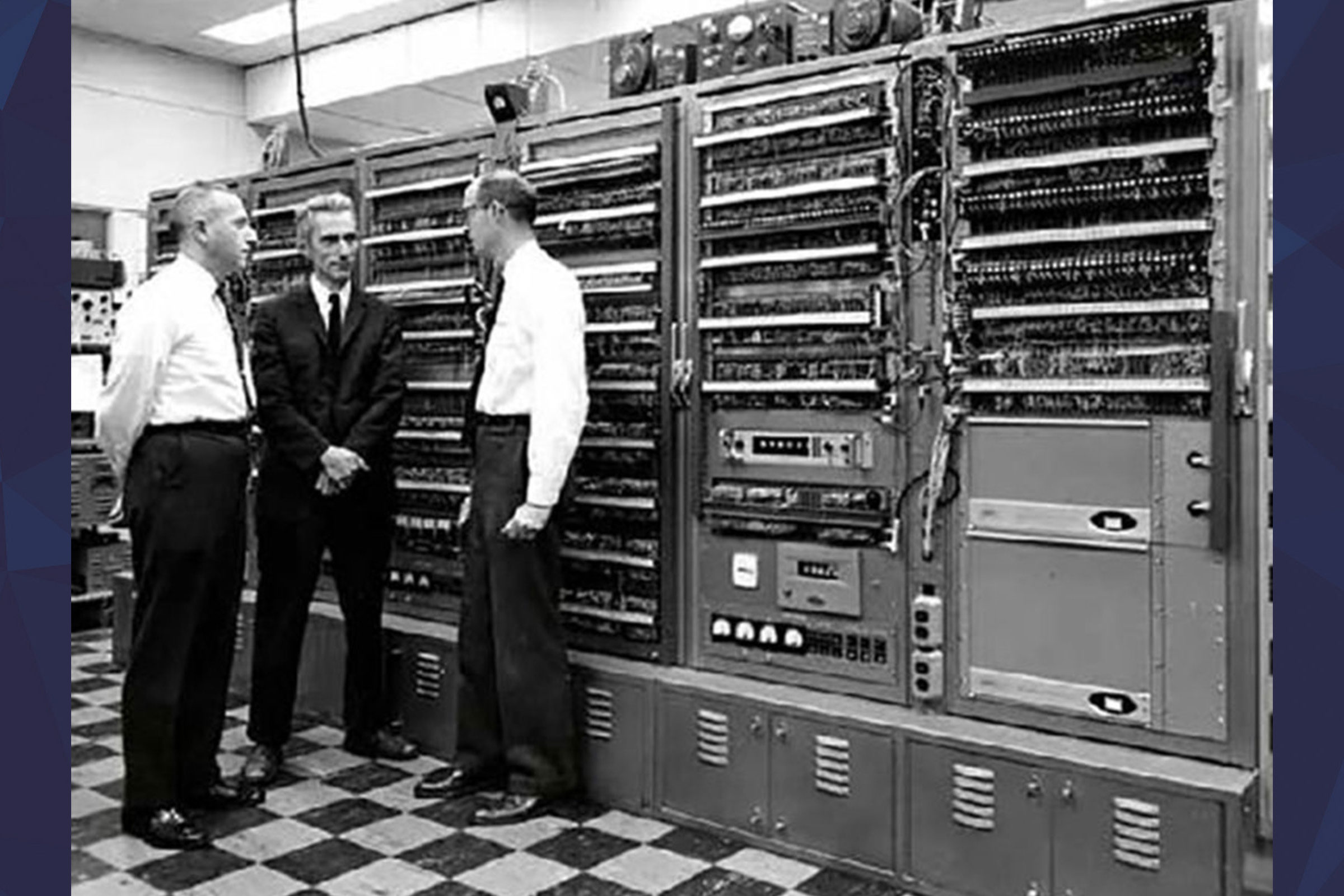
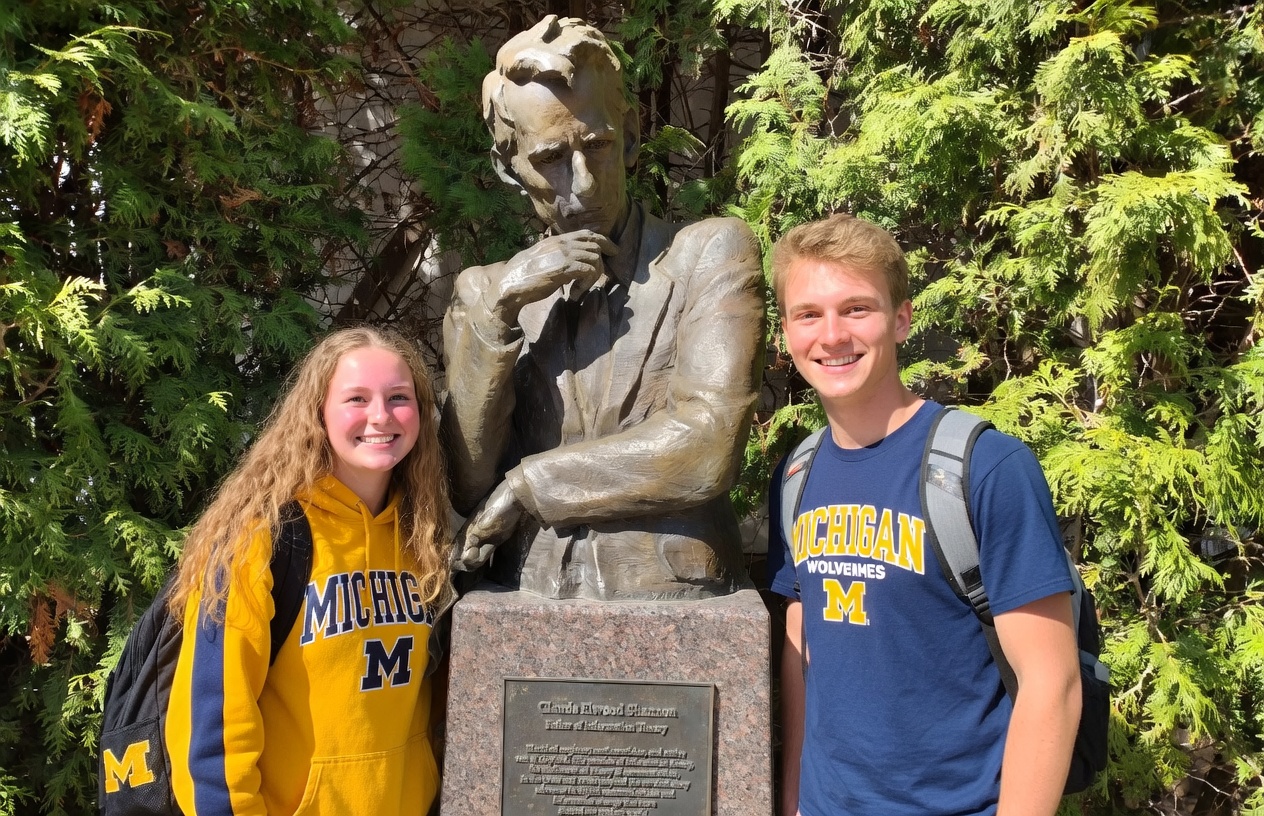
Claude Shannon (30 April 1916 in Petoskey, Michigan, USA – 24 Feb 2001 in Medford, Massachusetts, USA) founded the subject of information theory and he proposed a linear schematic model of a communications system. His Master’s thesis was on A Symbolic Analysis of Relay and… pic.twitter.com/d8q8og02oA
Today at 16:00 UTC we review best practice for engineering and installing the point of common coupling between an electrical service provider its and an purchasing — under the purview of NEC CMP-10.
Use the login credentials at the upper right of our home page.
The relevant passages of the National Electrical Code are found in Article 230 and Article 495. We calibrate our attention with the documents linked below. These are only representative guidelines:
We are in the process of preparing new (original, and sometimes recycled) proposals for the 2026 National Electrical Code, with the work of Code Panel 10 of particular relevance to today’s topic:
First Draft Meetings: January 15-26, 2024 in Charleston, South Carolina
Electrical meter billing standards are generally regulated at the state or local level, with guidelines provided by public utility commissions or similar regulatory bodies. These tariff sheets are among the oldest in the world. There are some common standards for billing and metering practices, including:
Meter Types: There are various types of meters used to measure electricity consumption, including analog (mechanical) meters, digital meters, and smart meters. Smart meters are becoming more common and allow for more accurate and real-time billing.
Billing Methodology:
Residential Rates: Most residential customers are billed based on kilowatt-hours (kWh) of electricity used, which is the standard unit of energy.
Demand Charges: Some commercial and industrial customers are also subject to demand charges, which are based on the peak demand (the highest amount of power drawn at any one point during the billing period).
Time-of-Use Rates: Some utilities offer time-of-use (TOU) pricing, where electricity costs vary depending on the time of day or season. For example, electricity may be cheaper during off-peak hours and more expensive during peak hours.
Meter Reading and Billing Cycle:
Monthly Billing: Typically, customers receive a bill once a month, based on the reading of the electricity meter.
Estimation: If a meter reading is not available, some utilities may estimate usage based on historical patterns or average usage.
Smart Meter Readings: With smart meters, some utilities can provide daily or even hourly usage data, leading to more precise billing.
Meter Standards: The standards for electrical meters, including their accuracy and certification, are set by national organizations like the National Institute of Standards and Technology (NIST) and the American National Standards Institute (ANSI). Meters must meet these standards to ensure they are accurate and reliable.
Utility Commission Regulations: Each state has a utility commission (such as the California Public Utilities Commission, the Texas Public Utility Commission, etc.) that regulates the rates and billing practices of electricity providers. These commissions ensure that rates are fair and that utilities follow proper procedures for meter readings, billing cycles, and customer service
Large University “Utilities”. Large colleges and universities that generate and distribute some or all of their electric power consumption have developed practices to distribute the cost of electricity supply to buildings. We will cover comparative utility billing practices in a dedicated colloquium sometime in 2025.
“…LIGHT + DESIGN was developed to introduce architects, lighting designers, design engineers, interior designers, and other lighting professionals to the principles of quality lighting design. These principles; related to visual performance, energy, and economics; and aesthetics; can be applied to a wide range of interior and exterior spaces to aid designers in providing high-quality lighting to their projects.
Stakeholders: Architects, interior designers, lighting practitioners, building owners/operators, engineers, the general public, luminaire manufacturers. This standard focuses on design principles and defines key technical terms and includes technical background to aid understanding for the designer as well as the client about the quality of the lighted environment. Quality lighting enhances our ability to see and interpret the world around us, supporting our sense of well-being, and improving our capability to communicate with each other….”
Illumination technologies run about 30 percent of the energy load in a building and require significant human resources at the workpoint — facility managers, shop foremen, front-line operations and maintenance personnel, design engineers and sustainability specialists. The IES has one of the easier platforms for user-interest participation:
Because the number of electrotechnology standards run in the thousands and are in continual motion* we need an estimate of user-interest in any title before we formally request a redline because the cost of obtaining one in time to make meaningful contributions will run into hundreds of US dollars; apart from the cost of obtaining a current copy.
We maintain the IES catalog on the standing agendas of our Electrical, Illumination and Energy colloquia. Additionally, we collaborate with experts active in the IEEE Education & Healthcare Facilities Committee which meets online 4 times monthly in European and American time zones; all colloquia online and open to everyone. Use the login credentials at the upper right of our home page to join us.
Today we break down the literature for building, maintaining and supporting the computing infrastructure of education settlements. We use the term “infotech” gingerly to explain action for a broad span of technologies that encompass enterprise servers and software, wireless and wired networks, campus phone networks, and desktop computers that provide administrative services and career tech video production. The private sector has moved at light speed to respond to the circumstances of the pandemic; so have vertical incumbents evolving their business models to seek conformance revenue. Starting 2023 we break down the topic accordingly:
Infotech 200: Wired and wireless infrastructure for education and administration related to teaching sciences and supporting fine and lively arts
Infotech 400: Physical system middleware for research facilities; data center location, power supply, cooling systems, fire suppression, security, monitoring and management.
The literature radiates continually by consortia, open-source, or ad hoc standards-setting domains rather than the private standards system administered by global and standards setting bodies; to wit:
The ICT domain is huge, replacing physical libraries. The foregoing is a highly curated sample.
We continue to include teaching and learning media standards on our colloquia however it is likely that will break up this topic into at least two related colloquia as 2022 proceeds; with primary focus on the design, construction and maintenance of the physical ICT infrastructure. Much depends upon the interest of our clients, colleagues and other stakeholders. We collaborate closely with the IEEE Education and Healthcare Electrotechnology Committee.
Use the login credentials at the upper right of our home page.
The American Society of Heating, Refrigerating, and Air Conditioning Engineers (ASHRAE) is an ANSI-accredited continuous-maintenance standards developer (a major contributor to what we call a regulatory product development “stream”). Continuous maintenance means that changes to its consensus products can change in as little as 30 days so it is wise to keep pace.
Among the leading titles in its catalog is ASHRAE 90.1 Energy Standard for Sites and Buildings Except Low-Rise Residential Buildings. Standard 90.1 has been a benchmark for commercial building energy codes in the United States and a key basis for codes and standards around the world for more than 35 years. Free access to ASHRAE 90.1 version is available at the link below:
Redlines are released at a fairly brisk pace — with 30 to 45 day consultation periods. A related title — ASHRAE 189.1 Standard for the Design of High Performance Green Buildings — first published in 2009 and far more prescriptive in its scope heavily references parent title 90.1 so we usually them as a pair because 189.1 makes a market for green building conformance enterprises. Note the “extreme prescriptiveness” (our term of art) in 189.1 which has the practical effect of legislating engineering judgement, in our view.
Education estate managers, energy conservation workgroups, sustainability officers, electric shop foreman, electricians and front-line maintenance professionals who change lighting fixtures, maintain environmental air systems are encouraged to participate directly in the ASHRAE consensus standard development process.
We also maintain ASHRAE best practice titles as standing items on our Mechanical, Water, Energy and Illumination colloquia. See our CALENDAR for the next online meeting; open to everyone.
Issue: [Various]
Category: Mechanical, Electrical, Energy Conservation, Facility Asset Management, US Department of Energy, #SmartCampus
Colleagues: Mike Anthony, Larry Spielvogel, Richard Robben
* Many standards-developing organizations aim to broaden their influence by entering the product standard and certification domain. Although our primary focus is on interoperability standards (within a system of interoperable products), we also consider market dynamics when product performance specifications are incorporated by reference into public law.
To paraphrase Marc Andreessen: “Building standards are eating the world and ASHRAE is eating building standards” (– Mike Anthony, University of Michigan). Just when you thought ASHRAE’s claim to energy regulation could not get any larger, it has recently appropriated everything *between* buildings in its scope — that means all above-ground pathway lighting, steam, hot water communication cabling tunnels, water pumps, fire protections systems; among others.
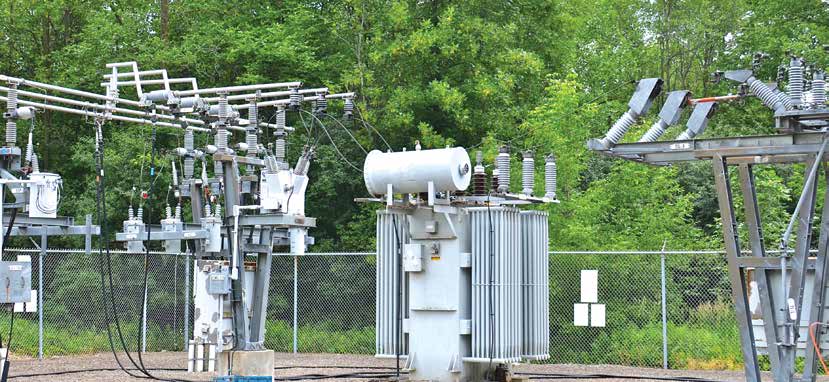
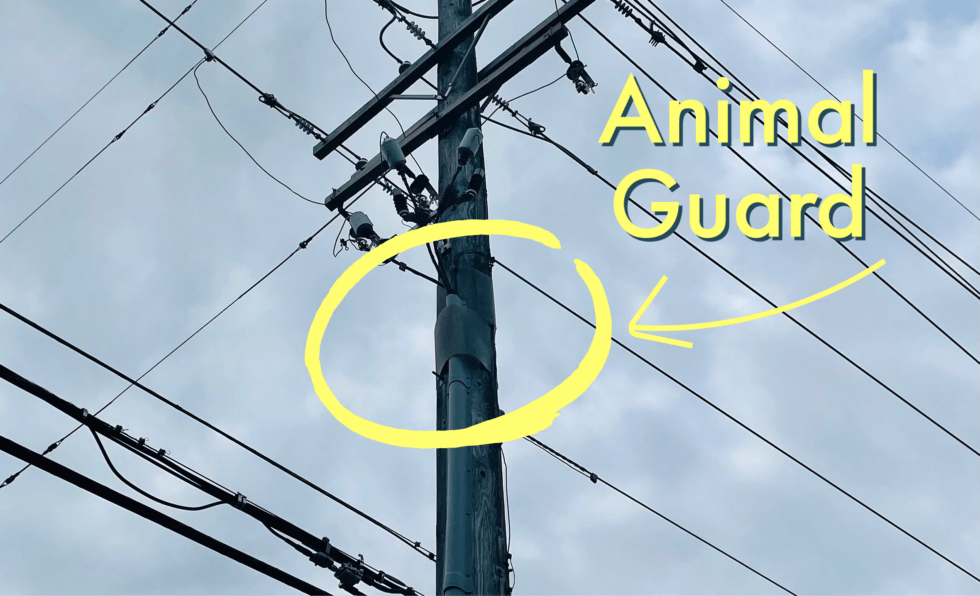
Abstract: Documented in this guide are methods and designs to mitigate interruptions, equipment damage, and personnel safety issues resulting from animal intrusions into electric power supply substations, thereby improving reliability and safety, and minimizing the associated revenue loss.
Scope: This guide documents methods and designs to mitigate interruptions, equipment damage, and personnel safety issues resulting from animal intrusions into electric power supply substations, thereby improving reliability and safety, and minimizing the associated revenue loss.
Purpose: Intrusion by animals into electric power supply substations has been a problem experienced by most of the electric utility industry. The costs associated with outages caused by animals continue to escalate. Although animal problems differ in nature geographically, the damage to equipment, interruption of or loss of service to customers, and safety problems encountered by operating personnel result in similar general concerns. This guide identifies various animals, the problems they cause, and mitigation methods. Further, it recommends criteria for applying mitigation methods, documents survey-reported effectiveness of various methods, and recommends factors for evaluating effectiveness of methods once they are applied.
“The Jack Pine” | Tom Thomson (1916) | National Gallery of Canada
Originally posted January 2014
In these clips — selected from Canadian Parliamentary debate in 2013 — we observe three points of view about Incorporation by reference(IBR); a legislative drafting technique that is the act of including a second document within a main document by referencing the second document.
This technique makes an entire second (or referenced) document a part of the main document. The consensus documents in which we advocate #TotalCostofOwnership concepts are incorporated by reference into legislation dealing with safety and sustainability at all levels of government. This practice — which many consider a public-private partnership — is a more effective way of driving best practices for technology, and the management of technology, into regulated industries.
Parent legislation — such as the Higher Education Act of 1965, the Clean Air Act and the Energy Policy Act – almost always require intermediary bureaucracies to administer the specifics required to accomplish the broad goals of the legislation. With the gathering pace of governments everywhere expanding their influence over larger parts of the technologies at the foundation of national economies; business and technology standards are needed to secure that influence. These standards require competency in the application of political, technical and financial concepts; competencies that can only be afforded by incumbent interests who build the cost of their advocacy into the price of the product or service they sell to our industry. Arguably, the expansion of government is a reflection of the success of incumbents in business and technical standards; particularly in the compliance and conformity industries.
About two years ago, the US debate on incorporation by reference has been taken to a new level with the recent statement released by the American Bar Association (ABA):
The incorporation by reference policy dilemma has profound implications for how we safely and economically design, operate and maintain our “cities-within-cities” in a sustainable manner but, admittedly, the results are only visible in hindsight over a time horizon that often exceed the tenure of a typical college or university president.
A recent development — supporting the claims of ANSI and its accredited standards developers — is noteworthy:
The National Institute for Standards and Technology (NIST) manages a website — Standards.GOV — that is a single access point for consensus standards incorporated by reference into the Code of Federal Regulations: Standards Incorporated by Reference Database. Note that this database does not include specific reference to safety and sustainability codes which are developed by standards setting organizations (such as NFPA, ICC, IEEE, ASHRAE and others) and usually incorporated by reference into individual state public safety and technology legislation.
LEARN MORE:
We applaud the Federal Government’s commitment to fund free access to the National Building Codes that are developed by the @NRC_CNRC. As a not-for-profit developer of standards that contribute to the health, safety and well-being of Canadians, CSA Group…https://t.co/QqhdkDvb7spic.twitter.com/1KRDvxDTaC
New update alert! The 2022 update to the Trademark Assignment Dataset is now available online. Find 1.29 million trademark assignments, involving 2.28 million unique trademark properties issued by the USPTO between March 1952 and January 2023: https://t.co/njrDAbSpwBpic.twitter.com/GkAXrHoQ9T





_-_Benjamin_Franklin_Drawing_Electricity_from_the_Sky_-_Google_Art_Project.jpg)