



Readings / Self-Reliance
- Home Page 147

loading...

International Building Code § 303.4: Places of Religious Worship
Occupancy classification is a first principle in all International Code Council consensus products. Chapels and churches associated with educational institutions are grouped with all other “Places of Religious Worship” in Section 303.4 Assembly Group A-3. You may find the text of this section in the current 2024 edition in the link below:
2024 International Building Code | Section 303 | Assembly Group A
For the next few weeks we will sort through issues appearing in the transcript below:
2025 Group B Committee Action Agenda (2630 Pages)
Recent incidents in the tragic city of Minneapolis inspire revisiting the standards of care listed below:
Targeted Violence and Active Shooters: Incidents like mass shootings have increased, with 54% of attacks on U.S. houses of worship involving armed assaults, often motivated by religious or racial hatred (67% of cases). Comprehensive emergency plans and training are critical.
Vandalism and Arson: These are common, with over 400 attacks on U.S. churches since 2020, including property damage and desecration. Surveillance cameras and regular security audits can deter such acts.
Theft: Donation boxes, religious artifacts, and personal belongings are frequent targets. Access control and monitoring valuables reduce risks.
Cybersecurity Threats: Houses of worship are vulnerable to hacking, ransomware, and data breaches, especially as they rely on digital platforms. Implementing cybersecurity best practices is essential.
Internal Threats: Risks from disgruntled employees or volunteers, including theft or fraud, necessitate thorough background checks and clear protocols for handling sensitive information.
Proactive measures like risk assessments, security teams, and collaboration with law enforcement can mitigate these threats while maintaining a welcoming environment
Related:
Why is the State of Minnesota such a hot mess?

What Are People Wearing?
“What you wear is how you present yourself to the world, especially today,
when human contacts are so quick. Fashion is instant language.”
So lovely to welcome Ailsa, Georgie and India from @mowden_hall to Robertson House 🦋🩵last night. Enjoy your @SedberghSchool taster experience! pic.twitter.com/5FqWOYtFXL
— Robertson House (@Robertson_Sed) October 7, 2024

University of Cambridge Estates Division



Abiit sed non oblitus | Euclid County
This content is accessible to paid subscribers. To view it please enter your password below or send mike@standardsmichigan.com a request for subscription details.
Autumn Wind
This content is accessible to paid subscribers. To view it please enter your password below or send mike@standardsmichigan.com a request for subscription details.

Paint

Painting the Eiffel Tower
In any industry painting (and decorating) operations play a crucial role in facility management by enhancing the overall appearance, protecting surfaces, and maintaining a healthy and conducive environment. In the education industry we find these operations in both the business and academic units; often co-mingled with sign-making shops.
- Aesthetics and Branding: Fresh coats of paint revitalize the appearance of walls, ceilings, doors, and other surfaces, creating a clean and inviting environment. Painting can also be used strategically to incorporate branding elements, such as company colors or logos, to reinforce brand identity throughout campus. Bright, vibrant colors can stimulate creativity and engagement, while well-chosen color schemes can create a sense of calm and focus.
- Surface Protection: Color coatings are a protective barrier for surfaces, shielding them from environmental factors like moisture, sunlight, dust, and regular wear and tear. It helps prevent structural damage, corrosion, and deterioration, extending the lifespan of various components in the facility, including walls, floors, metal structures, and equipment.
- Maintenance and Preservation: Regular painting operations are part of preventive maintenance programs in facility management. By addressing minor issues like peeling, cracks, or stains on surfaces, painting helps maintain a well-maintained and professional appearance. It prevents further damage and the need for costlier repairs in the future. Using environmentally conscious paints contributes to sustainable practices and healthier indoor air quality.
- Functional Differentiation: Painted color variations are utilized to differentiate various spaces within a facility. By using different colors, patterns, or textures, specific areas can be designated for different purposes, such as work zones, storage areas, or recreational spaces. This assists with wayfinding and enhances overall functionality.
Today at 15:00 UTC we review best practice literature for large-scale painting operations — an exploration different than the one undertaken during our Fine Art and Signs, Signs, Signs colloquia — with attention to worker and chemical safety. Among these considerations:
- Falls from Heights: When painting large structures such as buildings or bridges, workers often need to work at elevated heights using ladders, scaffolding, or aerial lifts. Falls from heights are a significant hazard, and proper fall protection systems, such as guardrails, harnesses, and safety nets, should be in place to prevent accidents. Large-scale painting operations may require workers to access or work on structures that have structural weaknesses, corroded surfaces, or unstable platforms.
- Inhalation of Hazardous Substances: Paints, coatings, solvents, and other chemicals used in large-scale painting operations can release volatile organic compounds (VOCs) and other harmful substances. Prolonged exposure to these chemicals, particularly in poorly ventilated areas, can lead to respiratory problems, dizziness, skin irritation, or other health issues. Proper personal protective equipment (PPE) like respirators, gloves, and protective clothing should be provided and used to minimize exposure risks.
- Skin and Eye Irritation: Contact with paint, solvents, or other chemicals can cause skin irritation, dermatitis, or allergic reactions. Splashes or spills can also result in eye injuries. Workers should wear appropriate protective clothing, such as gloves, coveralls, and safety goggles, to protect their skin and eyes from direct contact with hazardous substances.
- Fire and Explosion Risks: Some paints and solvents are flammable or combustible, posing fire and explosion risks, especially in enclosed spaces or areas with inadequate ventilation. Strict adherence to fire safety measures, including proper storage and handling of flammable materials, use of spark-proof tools, and implementing effective fire prevention protocols, is crucial.
- Weather Conditions: Outdoor large-scale painting operations are often subject to weather conditions, such as extreme temperatures, high winds, or rain. Adverse weather conditions can pose risks to workers’ safety and affect the quality of paint application. Adequate weather monitoring and planning, along with appropriate safety measures and protective equipment, are necessary to mitigate these hazards.
Open to everyone. Use the login credentials at the upper right of our home page.
ASTM’s color and appearance committee (E12) has approved a new standard that will be useful in calculating the colors of objects. The new standard (E3415) expands on color calculations described in ASTM’s standard on CIE colorimetric systems (E308). https://t.co/7F97dcFkVe pic.twitter.com/zcAp6DT1tg
— ASTM International (@ASTMIntl) October 15, 2024
Relevant standards:
Chemistry
ASTM D-series titles
EN 1504-2: Products and systems that are graffiti-resistant
ISO 12944: Paints and varnishes
Application and Fire Safety
Institute of Electrical and Electronic Engineers: Self-Operating Paint Bot
National Fire Protection Association
Occupational Safety and Health Administration
logical pic.twitter.com/V0UoqMMXdB
— Enez Özen (@Enezator) August 24, 2024
ASTM’s color and appearance committee (E12) has approved a new standard that will be useful in calculating the colors of objects. The new standard (E3415) expands on color calculations described in ASTM’s standard on CIE colorimetric systems (E308). https://t.co/7F97dcFkVe pic.twitter.com/5GCfEgP4TI
— ASTM International (@ASTMIntl) September 30, 2024

Color Metrology
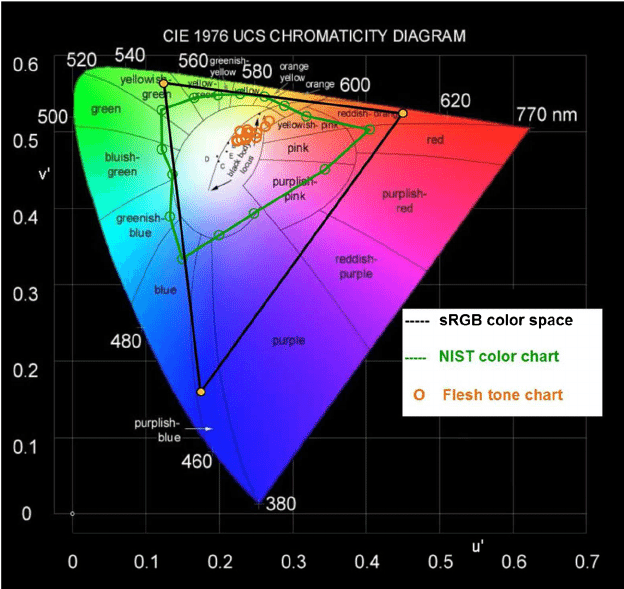
Range of colors chart used in NIST measurements
The National Institute of Standards and Technology measures color through a combination of sophisticated instrumentation and established standards:
1. Standards and Calibration
-
- Primary Standards: NIST maintains primary color standards, such as spectral reflectance and transmittance standards, that are traceable to international measurement systems.
- Calibration of Instruments: Instruments used for color measurement are calibrated using these standards to ensure accuracy and consistency.
2. Instrumentation
-
- Spectrophotometers: These instruments measure the intensity of light at different wavelengths. They are used to obtain the spectral reflectance or transmittance of a sample.
- Colorimeters: These are simpler instruments that measure color using a few broad wavelength bands. They are often used for less precise applications.
3. Measurement Process
-
- Sample Preparation: The sample to be measured is prepared according to specific protocols to ensure uniformity and consistency.
- Spectral Measurement: The spectrophotometer or colorimeter measures the light reflected or transmitted by the sample across the visible spectrum.
- Data Collection: The data collected includes the spectral power distribution, which indicates how much light is reflected or transmitted at each wavelength.
4. Data Analysis
-
- Color Spaces and Models: The raw spectral data is converted into color space coordinates (e.g., CIE XYZ, Lab) using mathematical models. These models account for human vision characteristics and provide a numerical representation of color.
- Comparison and Reporting: The measured color can be compared to standard references or reported in various formats depending on the application (e.g., color difference ΔE).
5. Quality Control and Assurance
-
- Repeatability and Reproducibility: NIST ensures the repeatability and reproducibility of color measurements by using rigorous quality control protocols.
- Uncertainty Analysis: The uncertainty associated with the measurements is analyzed and reported to provide a clear understanding of the precision of the measurements.
Example Instruments and Techniques
-
- Goniospectrophotometers: These measure the color of materials that change appearance with viewing angle.
- Integrating Spheres: These are used with spectrophotometers to measure diffuse reflectance or transmittance.
- Laser-based Systems: Advanced systems that use lasers for highly precise color measurements.
NIST’s methods are designed to provide highly accurate and reliable color measurements that can be used across a wide range of industries, including manufacturing, textiles, and digital imaging.
Standards Michigan: National Institute of Standards and Technology
The gems color wheel is useful to identify potential gems in specific colors for jewelers.
[✏️ suigemstone] pic.twitter.com/0sVHQgTWMr
— Massimo (@Rainmaker1973) September 11, 2024
The surprising invisibility effect of painting chicken wire blackpic.twitter.com/OlTFyahUyQ
— Massimo (@Rainmaker1973) October 17, 2024
They destroyed art,
they stole colors,
that’s why the world is depressed. pic.twitter.com/7ZYY4xBXwz— The Figen (@TheFigen_) August 22, 2025

Color Calculation Standard E3415
New Standard Will Aid in Color Calculation of Objects
ASTM Committee E12 on Color and Appearance
According to ASTM member Hugh Fairman, legacy standard E308 gathered data and pre-calculated weight sets for doing what is called “tristimulus integration,” which determines the actual color of a measured spectral reflectance or spectral power curve. While this standard is still useful in certain cases, a need has grown for the more updated practice described in E3415 to respond to interest in how illumination is perceived on painted surfaces.
Standards Michigan: ASTM International
Related:
A RAL number is part of a standardized color matching system developed by the RAL Deutsches Institut für Gütesicherung und Kennzeichnung (German Institute for Quality Assurance and Certification) used primarily in Europe. It is widely used for defining colors for paint, coatings, and plastics.
Powell
This content is accessible to paid subscribers. To view it please enter your password below or send mike@standardsmichigan.com a request for subscription details.
Harju County
This content is accessible to paid subscribers. To view it please enter your password below or send mike@standardsmichigan.com a request for subscription details.
New update alert! The 2022 update to the Trademark Assignment Dataset is now available online. Find 1.29 million trademark assignments, involving 2.28 million unique trademark properties issued by the USPTO between March 1952 and January 2023: https://t.co/njrDAbSpwB pic.twitter.com/GkAXrHoQ9T
— USPTO (@uspto) July 13, 2023
Welcome
Standards Michigan Group, LLC
455 East Eisenhower Parkway, Suite 300
Ann Arbor, MI 48108 USA
888-748-3670
DIRECTIONS
 |
 |
|
 |
 |
|
 |
 |
Layout mode
Predefined Skins
Custom Colors
Choose your skin color
Patterns Background
Images Background
error: Content is protected !!
Skip to content