Ball State University was founded in 1918 and was originally named the Eastern Indiana Normal School and primarily a teacher’s college. The university was renamed Ball State University in 1965, in honor of the five Ball brothers, who began by manufacturing and selling wooden jacketed tin cans. In 1884, the company introduced the Ball Improved Mason Jar, which became a popular way to preserve food.
The university is home to the Center for Middletown Studies, which conducts research on the social and cultural dynamics of small-town America.
Students at our DxHub powered by @aws_edu are designing an app for Veterans, with their input, to help connect them with volunteers based on Vets’ specific needs. Learn more about the DxHub collaboration with the public sector, including @SLDelta30, at https://t.co/IXLWcowwrNpic.twitter.com/0vuDQXawRk
PIRATE RADIO OFFICIAL TRAILER: Ensemble comedy, where the romance is between the young people of the 60s, and pop music.@IEEECampus
..”Young men and young women will always dream dreams and put those dreams into song”..https://t.co/7KmtlBFTI5pic.twitter.com/ZwzbAutPXj
The “Worldwide Swarthmore Radio Network” is Swarthmore College’s official campus radio station. It broadcasts out of the suburban Philadelphia borough of Swarthmore, Pennsylvania.
Prior to the 1970s, WSRN operated as a carrier signal broadcast to the campus of Swarthmore College only. The station went on the air with 10 watts on October 15, 1972. Following efforts by the Federal Communications Commission to encourage as many Class D stations as possible to increase power, a campaign was raised by the students of the college, and in the late 1970s, the FCC granted a license for a 110-watt, directional, transmission.
Programming has been eclectic from the 1970s on. Station programming is diverse; music spans “world,” hip hop, blues, folk, rock, pop, R & B, and classical. Talk and comedy programs comprise much of the weekend line-up. Notably “Funk” which ran from fall 2012 to spring 2014 Friday mornings from midnight to 2AM.
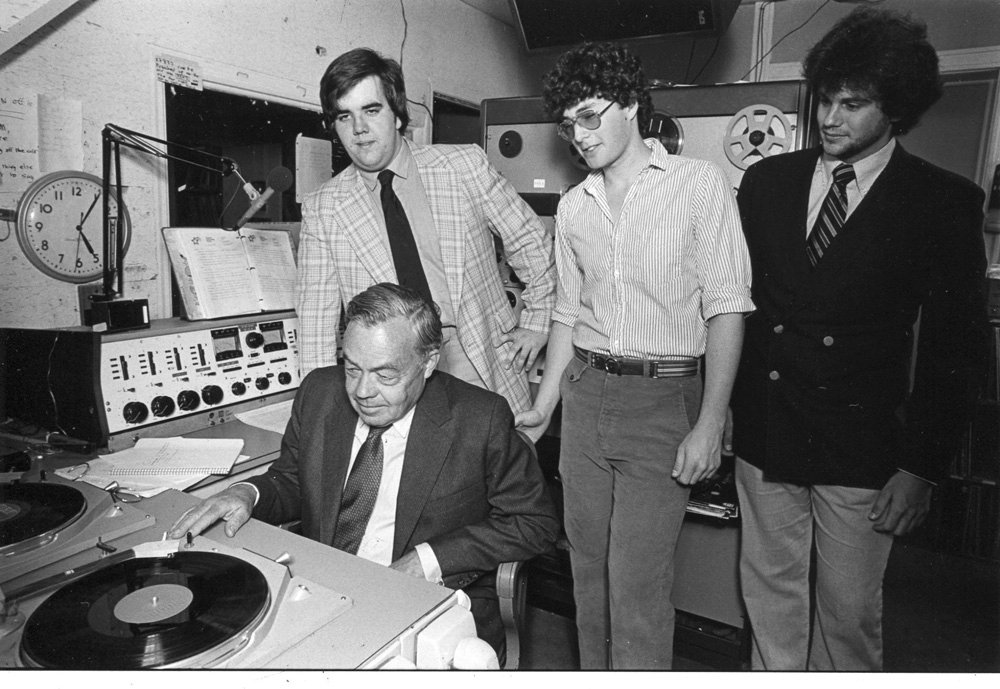
In 1986, the main on-air studio was completely refurbished, with a new control panel, turntables, microphones, and wiring installed. 1998 saw the rewiring and modernization of the production studio and the construction of an acoustically isolated sound studio connected to the production studio.
Students have always manned the soundboard, and so, during most summers, the station is dark. Following the COVID-19 pandemic, the radio station had periods of limited broadcasting. During the 2021-2022 academic year, a significant effort by students, faculty, staff, and community members was successfully carried out to get the station back up to an operational state. As of April 1, 2022, the station has resumed broadcasting.
Citizens of the Earth depend upon United States leadership in this technology for several reasons:
Development: The GPS was originally developed by the US Department of Defense for military purposes, but it was later made available for civilian use. The US has invested heavily in the development and maintenance of the system, which has contributed to its leadership in this area.
Coverage: The GPS provides global coverage, with 24 satellites orbiting the earth and transmitting signals that can be received by GPS receivers anywhere in the world. This level of coverage is unmatched by any other global navigation system.
Accuracy: The US has worked to continually improve the accuracy of the GPS, with current accuracy levels estimated at around 10 meters for civilian users and even higher accuracy for military users.
Innovation: The US has continued to innovate and expand the capabilities of the GPS over time, with newer versions of the system including features such as higher accuracy, improved anti-jamming capabilities, and the ability to operate in more challenging environments such as indoors or in urban canyons.
Collaboration: The US has collaborated with other countries to expand the reach and capabilities of the GPS, such as through the development of compatible navigation systems like the European Union’s Galileo system and Japan’s QZSS system.
United States leadership in the GPS has been driven by a combination of investment, innovation, collaboration, and a commitment to improving the accuracy and capabilities of the system over time.
The Timation Development Plan led to GPS. It uses the globe. The celestial transformation which was used to sell it to the Navy was based on celestial navigation which is based on the globe. pic.twitter.com/o75BgKgy4L
which National Public Radio service region is the most saturated? I will guess that it is Lower Penninsula Michigan which has about 10 university affiliated radio stations
Your hypothesis is a good one, but with one important qualification.
If by “most saturated” you mean the greatest concentration of NPR-affiliated stations per square mile, then Michigan’s Lower Peninsula is certainly among the most densely served regions in North America, especially because so many stations are licensed to universities. However, it is probably tied with or slightly behind a few regions such as New England and parts of North Carolina.
Lower Peninsula Michigan is unusual because of its university-based network
Within a day’s drive you can receive programming from numerous university-affiliated public radio stations, including:
Station
University
WUOM / Michigan Public
University of Michigan
WFUM
University of Michigan-Flint
WVGR
University of Michigan network
WKAR
Michigan State University
WEMU
Eastern Michigan University
WMUK
Western Michigan University
WCMU
Central Michigan University
WNMU
Northern Michigan University (Upper Peninsula)
WUCX
Delta College
WGVU
Grand Valley State University
Interlochen Public Radio
Interlochen Center for the Arts (educational institution)
Michigan Public itself operates a five-transmitter network serving roughly 80% of the population in the southern Lower Peninsula.
Other highly saturated regions
Some other areas rival Michigan:
Boston–Providence
WBUR (Boston University)
GBH
Rhode Island PBS/Radio
several nearby New England stations
North Carolina Research Triangle
WUNC (UNC)
WFDD (Wake Forest)
WNCU (North Carolina Central)
plus several statewide public radio services
Northern California
KQED
KALW
KCSM (College of San Mateo)
KCRW and others farther south
Minnesota
Minnesota Public Radio’s statewide network
university stations
strong regional overlap
Michigan’s distinctive feature
Michigan differs from most states because so many NPR member stations originated at public universities. The combination of:
University of Michigan
Michigan State
Eastern Michigan
Western Michigan
Central Michigan
Northern Michigan
Grand Valley State
Delta College
creates one of the largest concentrations of higher-education public broadcasting in the United States.
For your StandardsMich readership, an interesting observation is that this concentration reflects Michigan’s long-standing investment in public higher education. Few other states have such a dense network of university-affiliated public radio stations whose coverage areas overlap across a single peninsula. While it is difficult to declare a single “most saturated” NPR region without a formal coverage analysis, the Lower Peninsula of Michigan is a strong candidate and is almost certainly among the top few regions in North America.
suggest 10 terms of art to describe this condition
If you’re describing the unusually high concentration of public radio services in a region, especially one dominated by university licensees, here are several terms of art and coined phrases that could work for a StandardsMich article. Some are technical, while others are more journalistic or descriptive.
Term
Style
Meaning
Public Radio Corridor
Technical
Continuous band of overlapping public radio coverage.
NPR Belt
Journalistic
Region with an unusually high concentration of NPR stations.
Public Broadcasting Corridor
Planning
Geographic corridor with dense public broadcasting infrastructure.
University Radio Belt
Higher education
Area where universities dominate public radio broadcasting.
Broadcast Saturation Zone
Engineering
Region with extensive signal overlap from multiple stations.
Educational Broadcast Cluster
Academic
Concentration of educational broadcast licensees.
Public Media Cluster
Communications
Regional grouping of public media organizations.
Academic Broadcasting Network
Descriptive
Informal network created by numerous university stations.
Higher Education Radio Ecosystem
Contemporary
Emphasizes collaboration and institutional relationships.
Scholarly Airwaves
Literary
Highlights the educational and cultural character of the broadcasts.
For StandardsMich, I think these are particularly strong:
University Radio Belt
Public Radio Corridor
Educational Broadcast Cluster
Higher Education Radio Ecosystem
Scholarly Airwaves (for essays with a more literary tone)
You might also consider some Great Lakes-themed phrases that fit your site’s focus:
The Great Lakes Public Radio Belt
Michigan Public Radio Corridor
The Academic Airwaves of Michigan
The Great Lakes Knowledge Network
The Collegiate Broadcast Corridor
Among these, University Radio Belt is probably the most immediately understandable to readers, while Public Radio Corridor has a more formal, infrastructure-oriented feel that aligns well with your writing on standards, utilities, and higher education.
Whatever time it is where you are, the countdown is on! ⏰🌍
Swipe to see what time you’ll be tuning in from some of our previous host cities – Vancouver, Kingston, Delhi, Perth and Auckland – all part of the Commonwealth Games family. pic.twitter.com/WX7HOEXZ24
This content is accessible to paid subscribers. To view it please enter your password below or send mike@standardsmichigan.com a request for subscription details.
New update alert! The 2022 update to the Trademark Assignment Dataset is now available online. Find 1.29 million trademark assignments, involving 2.28 million unique trademark properties issued by the USPTO between March 1952 and January 2023: https://t.co/njrDAbSpwBpic.twitter.com/GkAXrHoQ9T




 v
v