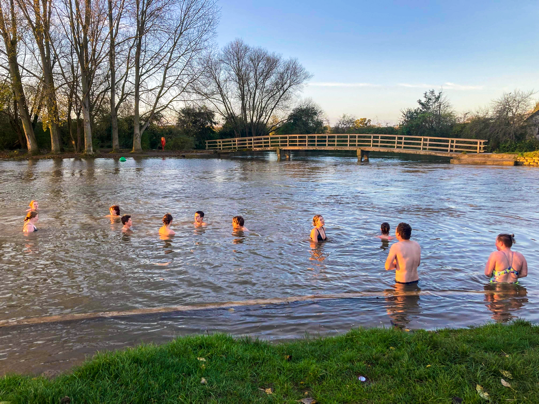
“Port Meadow is absolutely beautiful and a wonderful place to swim. We often swim in a different spot from other open water swimming groups in order to create a more relaxed environment – especially for our beginners. We do special beginners swims on Saturdays, to ease new members into the practise slowly and very carefully.
Safety is paramount, so I’ll walk them in to the water and they can immerse themselves as much as they want. We never allow anyone to jump or dive into cold water – the shock can cause a swimmer to gulp for air and subsequently ingest water; it’s always a gentle process.” — Ellie
Goat farming is an important source of livelihood for many small-scale farmers in developing countries, particularly in regions such as sub-Saharan Africa and South Asia. The FAO estimates that more than 90% of the world’s goats are raised in developing countries, where they provide a critical source of food and income for rural communities.
Overall, the global goat farming industry continues to grow, driven by increasing demand for goat meat and milk products, as well as the potential for sustainable agriculture practices.
Advantages:
Low start-up costs: Goat farming requires relatively low start-up costs compared to other types of agriculture. Goats are small animals that do not require much space, and they can be raised in a variety of environments, from small backyard farms to large commercial operations.
High productivity: Goats are known for their high reproductive rate, which allows farmers to increase their herd size quickly. They are also efficient at converting food into milk and meat, making them a profitable investment for farmers.
Multiple uses: Goats can be raised for meat, milk, and fiber, making them a versatile livestock option. Additionally, their manure can be used as fertilizer, and they can be used for weed control on farms and other properties.
Sustainable farming: Goat farming can be a sustainable agricultural practice, as goats do not require large amounts of feed or water, and they can be raised on marginal lands that are unsuitable for other types of agriculture.
Disadvantages:
Predation: Goats are vulnerable to predation by coyotes, dogs, and other predators, which can be a significant problem for farmers, especially in rural areas.
Disease susceptibility: Goats are susceptible to a variety of diseases, some of which can be difficult to diagnose and treat. Additionally, some diseases can be transmitted to humans, making it important for farmers to take precautions when handling their animals.
Market volatility: The demand for goat products can be volatile, and prices can fluctuate significantly based on supply and demand. This can make it challenging for farmers to predict their income and manage their finances.
Labor intensive: Goat farming can be labor-intensive, especially during kidding and milking seasons. This can make it difficult for farmers to manage their workload, especially if they have a large herd.
When you don’t have children or a significant other so get graduation photos done with your study subjects & absolute best pals ❤️
I despise having my photo taken & almost cancelled but decided I should suck it… although ended up in my dungarees for my favourite ones 😂 pic.twitter.com/0c6ZOBDEHI
Hi followers! It’s time to update my pinned tweet as I’ve finished my PhD at Reading in goat kid behaviour and welfare and…
I’m now a *permanent* lecturer at Harper Adams university!
Here I love to love to talk all things science, animals, crafts and smallholding life ☺️ pic.twitter.com/J9xQlLVgTi
This content is accessible to paid subscribers. To view it please enter your password below or send mike@standardsmichigan.com a request for subscription details.
This content is accessible to paid subscribers. To view it please enter your password below or send mike@standardsmichigan.com a request for subscription details.
Today our focus turns to outdoor electric deicing and snow melting wiring systems identified as suitable for the environment and installed in accordance with the manufacturer’s instructions. They work silently to keep snow load from caving in roofs and icicles falling from gutters onto pedestrian pathways.
While the voltage and ampere requirement of the product itself is a known characteristic, the characteristic 0f the wiring pathway — voltage, ampere, grounding, short circuit, disconnect and control — is relatively more complicated and worthy of our attention. Articles 426-427 of the National Electrical Code is the relevant part of the NEC
We hold Articles 427 in the middle of our priority ranking for the 2023 NEC. We find that the more difficult issues for this technology is the determination of which trade specifies these systems — architectural, electrical, or mechanical; covered in previous posts. Instead, most of our time will be spent getting IEEE consensus products in step with it, specifically ANSI/IEEE 515 and IEEE 844/CSA 293.
Comments on the Second Draft of the 2026 NEC will be received until April 18th.
We collaborate with the IEEE Education & Healthcare Facility Committee which meets online 4 times per month in European and American time zones. Since a great deal of the technical basis for the NEC originates with the IEEE we will also collaborate with IEEE Standards Coordinating Committee 18 whose members are charged by the IEEE Standards Association to coordinate NFPA and IEEE consensus products.
Issue: [19-151]
Category: Electrical, Energy
Colleagues: Mike Anthony, Jim Harvey, Kane Howard, Jose Meijer
100 day was filled with such fun! K, 1st and 2nd grade made their 100 day snack filled with 100 things. Then they rotated to do 100 day STEM activities, math activities, an art activity and of course gym activities! These students have grown so much in these 100 days! pic.twitter.com/aLwSPVWrpG
New update alert! The 2022 update to the Trademark Assignment Dataset is now available online. Find 1.29 million trademark assignments, involving 2.28 million unique trademark properties issued by the USPTO between March 1952 and January 2023: https://t.co/njrDAbSpwBpic.twitter.com/GkAXrHoQ9T