


King’s College Chapel
- Home Page 80

loading...

English for Technical Professionals
IEEE English for Technical Professionals is a 14-hour online learning program designed to provide non-native English speakers with a working knowledge of English techniques and vocabulary that are essential for working in today’s technical workplace.
IEEE English for Technical Professionals
“It is a trite but true observation, that examples work more forcibly on the mind than precepts: and if this be just in what is odious and blameable, it is more strongly so in what is amiable and praiseworthy. Here emulation most effectually operates upon us, and inspires our imitation in an irresistible manner. A good man therefore is a standing lesson to all his acquaintance, and of far greater use in that narrow circle than a good book.
But as it often happens that the best men are but little known, and consequently cannot extend the usefulness of their examples a great way; the writer may be called in aid to spread their history farther, and to present the amiable pictures to those who have not the happiness of knowing the originals; and so, by communicating such valuable patterns to the world, he may perhaps do a more extensive service to mankind than the person whose life originally afforded the pattern…”
— Henry Fielding “The History of the Adventures of Joseph Andrews and of his Friend Mr. Abraham” (1742)
Electropedia: The World’s Online Electrotechnical Vocabulary

History of the English Speaking Peoples
| Since so much of what we do in standards setting is built upon a foundation of a shared understanding and agreement of the meaning of words (no less so than in technical standard setting) that time is well spent reflecting upon the origin of the nouns and verbs of that we use every day. Best practice cannot be discovered, much less promulgated, without its understanding secured with common language. |
Hanging with grandad just like the old days 😂 pic.twitter.com/fQVarEQ5Iw
— Alexandra Churchill ✌🏼⭐️⭐️ (@churchill_alex) December 2, 2023
Virginia Woolf: pic.twitter.com/8IPw1Fmevk
— Dr. Maya C. Popa (@MayaCPopa) May 25, 2023
Cambridge: English language education in the era of generative AI
We must spread our accent further pic.twitter.com/qEc3Cqd2cH
— Midwest vs. Everybody (@midwestern_ope) April 3, 2025

Root Beer Olympics

“Standard Root Beer” is typically made using a combination of ingredients that include water, sugar, sassafras root or extract, and various other flavoring agents. Here’s a general overview of the process:
- Sassafras Flavoring: In traditional root beer recipes, sassafras root or extract is a key ingredient. However, it’s important to note that sassafras contains safrole, a compound that has been deemed potentially carcinogenic. For this reason, commercial root beers often use a safrole-free sassafras flavoring.
- Sweetener: Sugar is commonly used to sweeten root beer, although some recipes may use alternatives like corn syrup or honey. The amount of sweetener can vary based on personal preference.
- Water: Root beer typically starts with plain water as its base. The water is heated to dissolve the sweetener and other ingredients.
- Flavorings: Besides sassafras flavoring, root beer can include a range of other flavorings to create its distinct taste. These may include wintergreen, vanilla, anise, licorice, molasses, or other herbs and spices. The exact combination of flavors varies among different root beer recipes.
- Carbonation: Carbonation gives root beer its characteristic fizz. This can be achieved by using carbonated water or by introducing carbon dioxide gas into the mixture. In commercial production, carbonation is typically added during the bottling process.
- Yeast Fermentation (optional): Some traditional homemade root beer recipes involve a fermentation step. Yeast is added to the root beer mixture, which consumes the sugar and produces carbon dioxide as a byproduct. This creates a natural carbonation in the beverage. However, this step can also increase the alcohol content, so it’s important to be mindful of the fermentation duration.
- Bottling and Aging: Once the root beer is prepared, it is typically poured into bottles or kegs and sealed. Some recipes may recommend allowing the root beer to age for a certain period to develop the desired flavors.
It’s worth noting that the commercial production of root beer may involve different processes, as well as the use of artificial flavors, stabilizers, and preservatives to ensure consistency and shelf life. The specific recipe and production methods may vary among manufacturers.


Earth Energy Systems
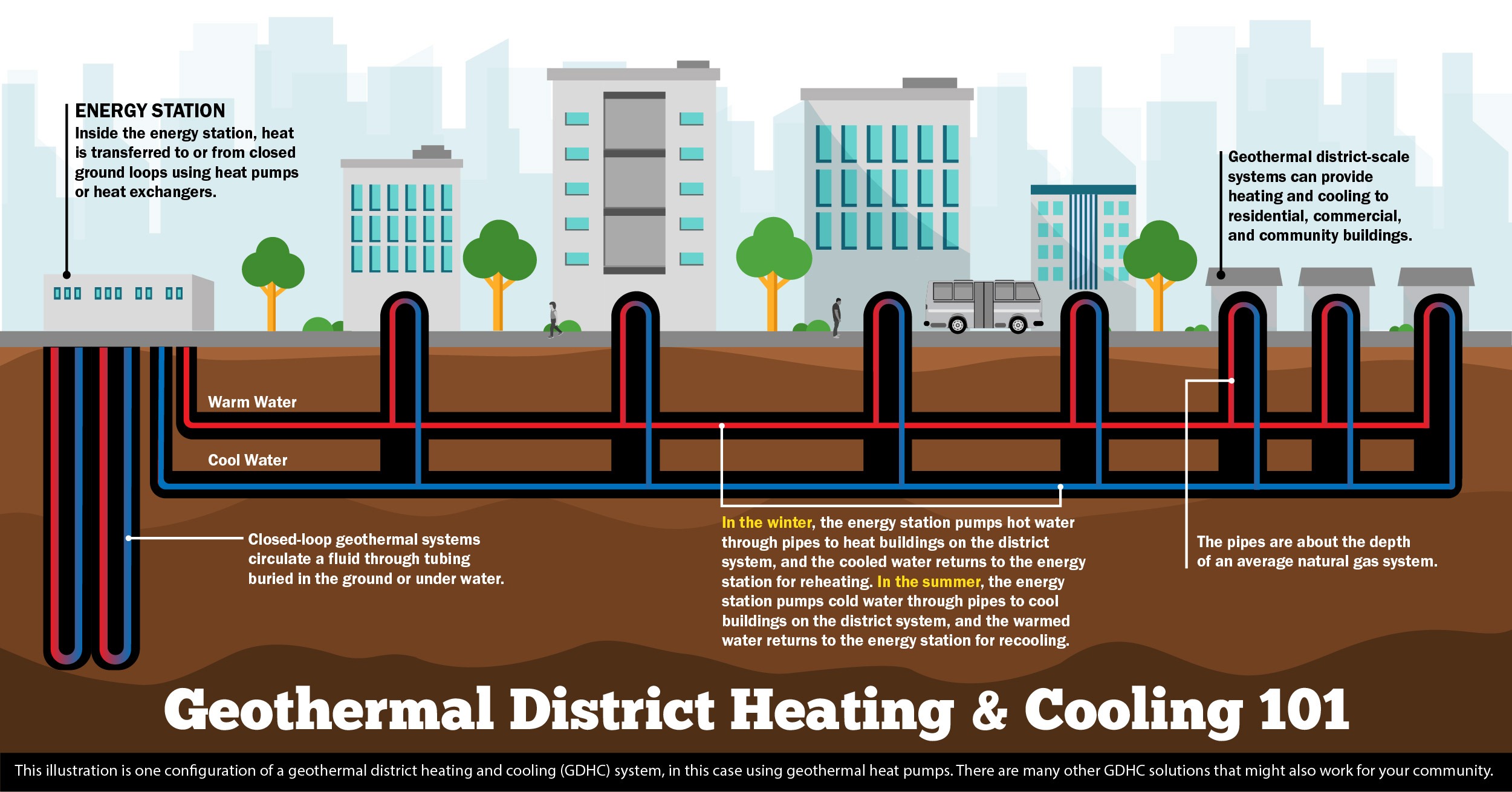
Geothermal systems cool buildings by leveraging the stable temperatures found beneath the Earth’s surface. A geothermal heat pump system consists of a ground loop, heat exchanger, and distribution system.
In cooling mode, the system extracts heat from the building and transfers it to the ground. The ground loop, typically composed of pipes buried horizontally or vertically, circulates a fluid that absorbs heat from the building’s interior. The fluid, warmed by this process, is then pumped through the ground loop where the Earth’s cooler temperatures absorb the heat, effectively dissipating it into the ground.
The cooled fluid returns to the heat pump, which distributes the now-cooler air throughout the building via the distribution system, such as ductwork. This process is highly efficient because the ground maintains a relatively constant temperature year-round, allowing the geothermal system to operate with less energy compared to traditional air-source cooling methods.
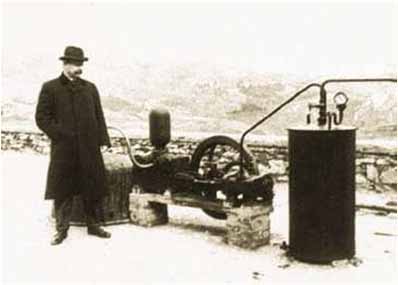
At the moment, though the technology has been made practical since Prince Piero Ginori Conti’s discovery in 1904, and has since tracked well in local building codes and environmental regulations, the bibliography for earth energy systems is nascent and relatively thin. One trade association is emerging from the gathering pace of applications and case studies: Closed-Loop/Geothermal Heat Pump Systems Design and Installation Standards
We maintain the IGSHPA catalog on the standing agenda of our Energy, Mechanical and Air Conditioning colloquia. See our CALENDAR for the next online meeting; open to everyone.

Partial Bibliography:
Handbook of Best Practices for Geothermal Drilling
Best Practices for Designing Geothermal Systems
Geothermal Direct Use Engineering and Design Guidebook
International Standards
ISO 13612-1:2014 – Heating and cooling systems in buildings — Method for calculation of the system performance and system design for heat pump systems — Part 1: Design and dimensioning.
-
- This standard covers the design and performance calculation of geothermal heat pump systems.
ISO 14823:2017 – Intelligent transport systems — Graphic data dictionary.
-
- While not specific to geothermal, this standard includes data relevant to various systems, including geothermal energy systems.
ISO 52000-1:2017 – Energy performance of buildings — Overarching EPB assessment — Part 1: General framework and procedures.
-
- This standard provides a general framework for assessing the energy performance of buildings, which includes geothermal systems.
IEC 61753-111-7:2014 – Fibre optic interconnecting devices and passive components – Performance standard – Part 111-7: Sealed closures for category S – Subterranean environments.
-
- Relevant for the installation of geothermal systems that include fiber optic components in subterranean environments.
North American Standards
CSA C448: Design and installation of earth energy systems.
ANSI/CSA C448 Series-16 – Design and Installation of Earth Energy Systems.
-
- This standard covers the design and installation of geothermal heat pump systems in the United States, providing guidelines on installation practices, materials, and system performance.
ASHRAE Standard 90.1 – Energy Standard for Buildings Except Low-Rise Residential Buildings.
-
- This standard sets the minimum energy efficiency requirements for the design and construction of buildings, including the installation of geothermal systems.
IGSHPA Standards – International Ground Source Heat Pump Association (IGSHPA) Standards.
-
- The IGSHPA develops standards for the design and installation of geothermal heat pump systems, with a focus on closed-loop systems.
NFPA 54 – National Fuel Gas Code.
-
- Although primarily focused on fuel gas systems, this standard may intersect with geothermal systems when they involve hybrid solutions that include gas heating.
EPA Standards for Geothermal Energy (40 CFR Part 144) – Underground Injection Control (UIC) Program.
-
- This standard regulates the injection of fluids into underground wells, relevant for geothermal systems that involve deep wells for heat exchange.
UL 1995 – Heating and Cooling Equipment.
-
- This standard applies to the safety of heating and cooling equipment, including geothermal heat pumps.

“Neptune’s Horses” 1919 | Walter Crane
Bernoulli’s Principle pic.twitter.com/EwXrssQBtw
— NERD (نَرْد) (@NERD2040) October 2, 2024

Jack Kilby
Who Invented the Integrated Circuit?
Jack Kilby is credited with inventing the integrated circuit.
In 1958, while at Texas Instruments, Kilby created the first working integrated circuit — a germanium device that combined a transistor, resistor, and capacitor on a single semiconductor chip. He received the Nobel Prize in Physics in 2000 for this achievement.
Robert Noyce (at Fairchild Semiconductor) independently developed a more practical silicon-based version in 1959 using the planar process. His design became the foundation for modern microchips.
Both are recognized as co-inventors of the integrated circuit:
- Kilby — concept and first demonstration
- Noyce — practical, manufacturable version
Their invention revolutionized electronics and enabled the entire digital age.
Jack Kilby is primarily credited with inventing the integrated circuit (IC).Key Details:In 1958, while working at Texas Instruments, Kilby developed the first working integrated circuit. It was a germanium-based device that combined multiple electronic components (transistor, resistor, capacitor) on a single piece of semiconductor material.
He demonstrated it in 1959 and received a U.S. patent for it.
For this achievement, Jack Kilby was awarded the Nobel Prize in Physics in 2000.
Important Note on Co-Inventor:Robert Noyce (at Fairchild Semiconductor) independently developed a more practical silicon-based integrated circuit in 1959 using the planar process. His version became the foundation for modern IC manufacturing. Noyce co-founded Intel Corporation.Both men are widely recognized as co-inventors of the integrated circuit:Kilby for the concept and first demonstration.
Noyce for the practical, manufacturable version.
Summary of Credit:Inventor
Year
Company
Contribution
Recognition
Jack Kilby
1958
Texas Instruments
First working IC (germanium)
Nobel Prize 2000
Robert Noyce
1959
Fairchild
Silicon planar IC (industry standard)
Co-credited, National Medal
The invention of the IC revolutionized electronics, enabling microchips, computers, smartphones, and virtually all modern technology. Kilby is the one most directly associated with the “invention” in historical accounts and the Nobel citation.

Hegemon Essex & Hauts-de-Seine Counties
Square D was founded in 1902 in Detroit, Michigan, by Bryson Dexter Horton and James B. McCarthy as McBride Manufacturing Company, focusing on electrical fuses. By 1908, it became Detroit Fuse and Manufacturing, adopting the iconic “Square D” logo—a “D” in a square—reflecting its Detroit roots.
Renamed Square D in 1917, the company pioneered safety switches and circuit breakers, growing significantly with 18,500 employees and $1.65 billion in sales by 1991. That year, after a competitive 10-week bidding process, French multinational Groupe Schneider S.A. acquired Square D for $2.23 billion, raising its offer from $1.96 billion to $88 per share.
The acquisition, approved by Square D’s board and the U.S. Justice Department, made Schneider Electric the world’s largest electrical distribution equipment manufacturer, integrating Square D’s innovative products into its global energy management portfolio.
Lorem ipsum

Belgian Buns & Tea
Paul Hollywood’s Belgian Buns | Bake Off Technical Challenge

BSI is a private company incorporated by the British Royal Charter, first awarded (to the British Engineering Standards Association) in 1929.
My daughter made Belgium buns.. want to try one? pic.twitter.com/rrmJopl0O2
— nicola h (@nkh12349) March 9, 2025
Did you know we have a number of programmes available with a January start date? Find out more about our programmes, scholarships and accommodation and join us in the new year – https://t.co/0sb2ziLGnK pic.twitter.com/kJopkWS8QH
— University of Aberdeen (@aberdeenuni) October 26, 2024

Sacred Heart Hall
This content is accessible to paid subscribers. To view it please enter your password below or send mike@standardsmichigan.com a request for subscription details.

1984
PART ONE
Chapter 1
It was a bright cold day in April, and the clocks were striking thirteen.
Winston Smith, his chin nuzzled into his breast in an effort to escape the
vile wind, slipped quickly through the glass doors of Victory Mansions,
though not quickly enough to prevent a swirl of gritty dust from entering
along with him.
The hallway smelt of boiled cabbage and old rag mats. At one end of it a
coloured poster, too large for indoor display, had been tacked to the wall.
It depicted simply an enormous face, more than a metre wide: the face of a
man of about forty-five, with a heavy black moustache and ruggedly handsome
features. Winston made for the stairs. It was no use trying the lift. Even
at the best of times it was seldom working, and at present the electric
current was cut off during daylight hours. It was part of the economy drive
in preparation for Hate Week. The flat was seven flights up, and Winston,
who was thirty-nine and had a varicose ulcer above his right ankle, went
slowly, resting several times on the way. On each landing, opposite the
lift-shaft, the poster with the enormous face gazed from the wall. It was
one of those pictures which are so contrived that the eyes follow you about
when you move. BIG BROTHER IS WATCHING YOU, the caption beneath it ran.
Inside the flat a fruity voice was reading out a list of figures which had
something to do with the production of pig-iron. The voice came from an
oblong metal plaque like a dulled mirror which formed part of the surface
of the right-hand wall. Winston turned a switch and the voice sank
somewhat, though the words were still distinguishable. The instrument
(the telescreen, it was called) could be dimmed, but there was no way of
shutting it off completely. He moved over to the window: a smallish, frail
figure, the meagreness of his body merely emphasized by the blue overalls
which were the uniform of the party. His hair was very fair, his face
naturally sanguine, his skin roughened by coarse soap and blunt razor
blades and the cold of the winter that had just ended.
Outside, even through the shut window-pane, the world looked cold. Down in
the street little eddies of wind were whirling dust and torn paper into
spirals, and though the sun was shining and the sky a harsh blue, there
seemed to be no colour in anything, except the posters that were plastered
everywhere. The black-moustachio’d face gazed down from every commanding
corner. There was one on the house-front immediately opposite. BIG BROTHER
IS WATCHING YOU, the caption said, while the dark eyes looked deep into
Winston’s own. Down at street level another poster, torn at one corner,
flapped fitfully in the wind, alternately covering and uncovering the
single word INGSOC. In the far distance a helicopter skimmed down between
the roofs, hovered for an instant like a bluebottle, and darted away again
with a curving flight. It was the police patrol, snooping into people’s
windows. The patrols did not matter, however. Only the Thought Police
mattered.
Behind Winston’s back the voice from the telescreen was still babbling away
about pig-iron and the overfulfilment of the Ninth Three-Year Plan. The
telescreen received and transmitted simultaneously. Any sound that Winston
made, above the level of a very low whisper, would be picked up by it,
moreover, so long as he remained within the field of vision which the metal
plaque commanded, he could be seen as well as heard. There was of course
no way of knowing whether you were being watched at any given moment. How
often, or on what system, the Thought Police plugged in on any individual
wire was guesswork. It was even conceivable that they watched everybody all
the time. But at any rate they could plug in your wire whenever they wanted to.
You had to live–did live, from habit that became instinct–in the
assumption that every sound you made was overheard, and, except in
darkness, every movement scrutinized.
Winston kept his back turned to the telescreen. It was safer; though, as he
well knew, even a back can be revealing. A kilometre away the Ministry of
Truth, his place of work, towered vast and white above the grimy landscape.
This, he thought with a sort of vague distaste–this was London, chief
city of Airstrip One, itself the third most populous of the provinces of
Oceania. He tried to squeeze out some childhood memory that should tell him
whether London had always been quite like this. Were there always these
vistas of rotting nineteenth-century houses, their sides shored up with
baulks of timber, their windows patched with cardboard and their roofs
with corrugated iron, their crazy garden walls sagging in all directions?
And the bombed sites where the plaster dust swirled in the air and the
willow-herb straggled over the heaps of rubble; and the places where the
bombs had cleared a larger patch and there had sprung up sordid colonies
of wooden dwellings like chicken-houses? But it was no use, he could not
remember: nothing remained of his childhood except a series of bright-lit
tableaux occurring against no background and mostly unintelligible.
The Ministry of Truth–Minitrue, in Newspeak [Newspeak was the official
language of Oceania. For an account of its structure and etymology see
Appendix.]–was startlingly different from any other object in sight. It
was an enormous pyramidal structure of glittering white concrete, soaring
up, terrace after terrace, 300 metres into the air. From where Winston
stood it was just possible to read, picked out on its white face in
elegant lettering, the three slogans of the Party:
WAR IS PEACE
FREEDOM IS SLAVERY
IGNORANCE IS STRENGTH
US academia has increasingly mirrored the dystopian control mechanisms in George Orwell’s 1984, particularly through the lens of Critical Race Theory (CRT) and its extensions into Diversity, Equity, and Inclusion (DEI) frameworks.
In Orwell’s novel, the Party enforces ideological conformity via Newspeak (a restricted language that limits thought), doublethink (holding contradictory beliefs), thoughtcrime (punishing unapproved ideas), and the rewriting of history to serve power.
CRT posits that racism is embedded in the structure of Western institutions. It rejects colorblindness and meritocracy as tools of “white supremacy,” framing individuals primarily by racial identity — oppressors versus the oppressed. In universities, this has evolved into mandatory trainings, curricula, and loyalty tests that prioritize “equity” (equal outcomes by group) over equality of opportunity.
Key Orwellian parallels include:
- Language control resembling Newspeak: terms like “systemic racism,” “white fragility,” “microaggressions,” and “anti-racism” redefine reality so that disagreement signals complicity in oppression.
- Doublethink: universities champion “diversity” while enforcing ideological uniformity, claiming to fight oppression while stigmatizing dissent as violence.
- Thoughtcrime via cancel culture: surveys show high rates of self-censorship, with dissenting scholars facing social ostracism, investigations, or professional consequences.
History is reframed — America’s founding reduced to perpetual racial hierarchy — echoing the Ministry of Truth. Standpoint epistemology elevates “lived experience” of favored groups over empirical evidence and universal reason.
This agenda undermines academia’s core purpose: the pursuit of truth through open debate and evidence. Instead of rigorous inquiry, power — framed as “punching up” — dictates acceptable thought, eroding liberal education’s commitment to individualism and free expression.
New update alert! The 2022 update to the Trademark Assignment Dataset is now available online. Find 1.29 million trademark assignments, involving 2.28 million unique trademark properties issued by the USPTO between March 1952 and January 2023: https://t.co/njrDAbSpwB pic.twitter.com/GkAXrHoQ9T
— USPTO (@uspto) July 13, 2023
Welcome
Standards Michigan Group, LLC
455 East Eisenhower Parkway, Suite 300
Ann Arbor, MI 48108 USA
888-748-3670
DIRECTIONS
 |
 |
|
 |
 |
|
 |
 |
Layout mode
Predefined Skins
Custom Colors
Choose your skin color
Patterns Background
Images Background
error: Content is protected !!
Skip to content