International Fire Code

Loading
loading...

International Fire Code

January 15, 2026
mike@standardsmichigan.com

No Comments

2024 International Fire Code | Free Access

Crosswalk: NFPA Fire Code and ICC International Fire Code

2024 GROUP A PROPOSED CHANGES TO THE I-CODES based on Committee Action Hearings October 2024

2024 GROUP A PROPOSED CHANGES TO THE I-CODES

2024/2025/2026 ICC CODE DEVELOPMENT SCHEDULE

ICC BCAC | Comments to be presented at October Hearings

Noteworthy Proposals:

IFC 1010.27 Locking arrangements, PDF page 252

IFC 1020.2 Corridor Fire Resistance Ratings. PDF page 356

IFC 915 More Carbon Monoxide Detection Systems, PDF page 1156

IBC 917 Mass notification for Group E occupancies, PDF page 1176

IFC 5701 More Process Hazard Analysis, PDF page 1571

The transcript (Complete Monograph) of Committee Actions should be available by September 5th.

Committee Action Hearings on Proposed Changes: October 23-31 Long Beach, California

“A Square with Imaginary Buildings” | Hendrik van Steenwijck (1614)

LIVE: I-Code Group B Public Comment Hearings

Higher Education Laboratories

“Waking Effectiveness of Alarms for Adults Who Are Hard of Hearing” 2007  Victoria University, Australia

Health Facilities: Navigating IBC and NFPA differences


Posted February 14, 2023

Free access to the latest edition of the IFC is linked below:

2021 International Fire Code

Following the ICC Group A revision cycle public consultation on the 2024 International Fire Code will begin.  The ICC will announce the development schedule sometime in 2022.

We limit our resources simply tracking the proposals that run through Group E (Educational) and Group I (Institutional) occupancies in the Group A suite with closer attention to the state they are adopted whole cloth or with local exceptions.  In many cases, IFC adoption by state and local authorities is delayed by one or more previous code revisions.  This delay in adoption may be necessary in order for jurisdictions to evaluate the impact of changes upon the region under their authority.

Public safety budgets historically support the local and state fire marshal and his or her staff.   The revenue stream of many trade associations originates from membership, conference attendance, training and certification enterprises that service the public sector stakeholder.   Manufacturer sponsorship of trade association conferences is noteworthy.

Unless there is an idea, or proposed regulation that has run off the rails (either in terms of rigor or cost increase) — we place fire safety in the middle of our ranking of priorities.  With gathering pace, we find many fires safety goals being met with electrotechnologies where we place our highest priority.
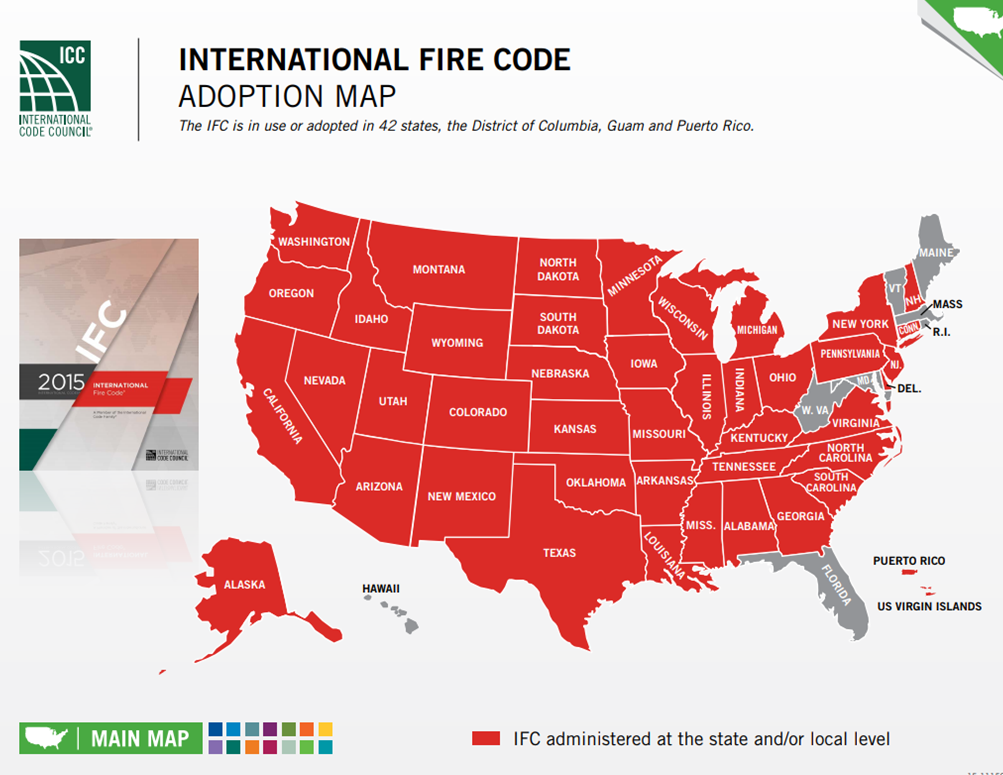
Click on image for more information. The map is updated by expert agencies frequently so we recommend a web search for an update.

Significant code changes rarely happen within a 3-year cycle so it is wise to follow ideas as they travel through the agendas of technical committees through several cycles as administered by the Fire Code Action Committee.

The ICC posts the transcripts of public proposals, technical committee responses to public proposals, public response to the technical committee response and the final balloting in a fair and reasonable fashion as can be seen in the transcripts linked below:

2021 International Fire Code Proposed Changes

2021 International Fire Code Public Comment Agenda 

A search on the terms “classroom” or “school” in any of the documents above offers granular insight into the trend of current thinking.   We find fire extinguishers placement a perennial concern across several standards suites.   You will note the careful consideration of proposals for use of the mass notification systems, now integrated into fire alarm systems and their deployment in active shooter situations.

The transcripts reveal detailed understanding and subtlety.

“The Country School” | Winslow Homer

There are many issues affecting the safety and sustainability of the education facility industry.  We add value to the industry because of our cross-cutting perspective on the hundreds of “silos”created by the competition (and sometimes cooperation) among accredited, consortia and open-source standards developers.  We have the door open every day at 11 AM Eastern time to enlighten understanding of them all.  We also host a breakout teleconference every month to drill into the specifics of standards action on fire safety for the real assets of school districts, colleges and universities.  See our CALENDAR for the next online meeting.

Finally, we persist in encouraging education industry facility managers (especially those with operations and maintenance data) to participate in the ICC code development process.  You may do so by CLICKING HERE.

The ICC Group B Code Meetings will be hosted soon and open to the public:   

International Code Council 2022 Group B Public Comment Agenda (September 14-21 Kentucky International Convention Center)

The Group B tranche is largely focused on energy, structural, residential and existing building concepts but all of the titles cross-reference the IFC in some way so it is wise to follow how the concepts re-arrange and cross-reference themselves with each cycle.


Issue: [16-169]

Category: Architectural, Facility Asset Management, Space Planning

Colleagues: Mike Anthony,  Casey Grant, Joshua Evolve, Marcelo Hirschler


More

2021/2022 ICC CODE DEVELOPMENT SCHEDULE

FINAL ACTION RESULTS ON THE 2018 PROPOSED CHANGES TO THE INTERNATIONAL CODES – GROUP A

2018 GROUP A PROPOSED CHANGES TO THE I-CODES COLUMBUS COMMITTEE ACTION HEARINGS

2018 GROUP A PUBLIC COMMENT AGENDA | INTERNATIONAL BUILDING CODE

2018 GROUP A PUBLIC COMMENT AGENDA | INTERNATIONAL FIRE CODE

2018 REPORT OF THE COMMITTEE ACTION HEARINGS ON THE 2018 EDITIONS OF THE GROUP A INTERNATIONAL CODES




History & Horizon

January 14, 2026
mike@standardsmichigan.com
No Comments

Our engagement with the ISO catalog began in 2008 at the University of Michigan and, after the 2016 reorganization, was transferred to Standards Michigan, LLC.  We start the year reviewing where our voice was heard (with attendance at meetings in Europe) and in written response to calls for public comment.  With link to research grant applications for faculty and students.

Research and education

Children’s Rights Management

Educational organization management systems

Healthcare Organization Management

Laboratory Design

Risk Management for Youth & School Trips

Human Resource Management

Facility Management

Sustainable cities & communities

Social Responsibility

Energy Management Systems

ISO Research Grant 2021

Student Competition / Standards for Digital Transformation


Standards Australia

January 14, 2026
mike@standardsmichigan.com
, ,
No Comments

Department of Industry, Science and Resources

Evolution of the standards system in Australia is tracking the evolution of the United States standards system administered by the American National Standards Institute. In many economic sectors adherence to Australian Standards is mandated by legislation, however, access to the standards are often cost prohibitive, particularly to small business and sole traders.

Principal petitioner Andrew Gardso, an electrical engineer, states,

“This in essence will force small organisations and sole traders out of business or necessitate services being performed without having access to these standards.”

Access to Standards Australia Construction codes can cost more than $2673 for three years’ access to the National Construction Code set of standards.  A petition to the Australian parliament’s House of Representatives seeks free or affordable access to essential standards that govern the safety and consistency of products services and systems, including design and construction.

Wiring Rules

Vertical Transportation Experience

Sheep and Wool

Survey and Analysis of Current End-User Data Analytics Tool Support

Elevatorpedia

Net Zero Initiative

Three ways Artificial Intelligence is transforming agriculture and food


*

Incorporation by Reference

Canadian Parliament Debate on Standards Incorporated by Reference


2029 National Electrical Code Panel 5

January 13, 2026
mike@standardsmichigan.com
No Comments

Electrical Safety Stack

Brown University Electrical Design Criteria | Information Technology Resources Policy

The University of Michigan has supported the voice of the United States education facility industry since 1993 — the second longest tenure of any voice in the United States.  That voice has survived several organizational changes but remains intact and will continue its Safer-Simpler-Lower Cost-Longer Lasting priorities on Code Panel 3 in the 2029 Edition.

Today, during our customary “Open Door” teleconference we will examine the technical concepts under the purview of Code Panel 3; among them:

Article 200 Use and Identification of Grounded Conductors

Article 250 Grounding and Bonding

Article 270 Higher voltage grounding and bonding

Article 750 Lower voltage grounding and bonding

Annex D Example D14

IEEE-IAS/PES JTCC Representative: Daleep Mohla

Public Input on the 2029 Edition will be received until April 9, 2026.

Related:
  • Since the lifespan of educational buildings make the building core and shell susceptible to multiple changes not typically associated with commercial buildings, additional pathways should be placed in areas where the core and shell components of the facility are likely to re-main for extended periods of time
  • It is recommended that all areas of an educational building have wireless coverage unless prohibited

Application of Big Data in Power System Reform

January 13, 2026
mike@standardsmichigan.com
No Comments


Application of Big Data in Power System Reform

Abstract:  Power grid operation and maintenance decision-making reform is an important part of power system reform. With the construction of massive historical quasi real-time data management platform, the reform of power system is also advancing. However, in the face of massive data explosion, the business level and business logic become disorganized and redundant. Based on the actual situation of Shenzhen Power Supply Bureau, the sg-erp data center is composed of structured data center, massive data center, unstructured data center and power grid GIS data center. With the unprecedented growth of business application data, the data center can improve business logic and promote power system reform. The experimental results show that big data technology has a broad application prospect in the reform of power industry.

CLICK HERE for complete paper

Smart Grid Blockchains

Power Management For Data Centers Challenges And Opportunities

Digital Agonistes

January 12, 2026
mike@standardsmichigan.com
No Comments

Today at the usual hour we explore how Best Practice Case Studies on the use of cell phones in K-12 schools “might” evolve into a de-facto standard for all school districts.  Use the login credentials at the upper right of our home page.

Case studies evolve into general consensus standards through a multi-stage, evidence-driven process:

  1. Discovery & Proof-of-Concept (individual success)
    A few organizations implement an innovative approach and achieve dramatically better results.
  2. Validation & Replication (early adopters)
    Other organizations study the cases, replicate the approach, and publish similar positive outcomes → credibility grows.
  3. Widespread Discussion & Refinement (community phase)
    Conferences, journals, consultants, and industry groups analyze, critique, and refine the practice. Variations emerge and the strongest elements survive.
  4. Pattern Recognition & Codification (framework stage)
    Thought leaders and associations identify common success factors, create frameworks, guidelines, and maturity models.
  5. Institutionalization (consensus stage)
    Major standards bodies (ISO, NIST, ITIL, COBIT, etc.), regulators, or dominant industry players formalize the practice into official standards, certifications, or audit requirements.
  6. Taken-for-Granted Status
    The former “innovative case study” becomes the default expectation — “this is how things are done.”

Timeframe: typically 5–15 years, depending on industry pace and evidence strength.


Readings:

IEEE: How to use effectively smartphone in the classroom

IEEE: Possibilities and Challenges in Mobile Learning for K-12 Teachers: A Pilot Retrospective Survey Study

IEEE: Acceptable Use of Technology in Schools: Risks, Policies, and Promises

IEEE: A Review of the Repercussions of Mobile Phones and the Internet on Education

Broadband Access for Hospitals & Students

January 12, 2026
mike@standardsmichigan.com
,
No Comments


FCC WAIVES RURAL HEALTH CARE AND E-RATE PROGRAM GIFT RULES TO PROMOTE CONNECTIVITY FOR HOSPITALS AND STUDENTS DURING CORONAVIRUS PANDEMIC 

WASHINGTON, March 18, 2020—The Federal Communications Commission today announced important changes to the Rural Health Care (RHC) and E-Rate programs that will make it easier for broadband providers to support telehealth and remote learning efforts during the coronavirus pandemic. Specifically, the FCC’s Wireline Competition Bureau has waived the gift rules until September 30, 2020 to enable service providers to offer, and RHC and ERate program participants to solicit and accept, improved connections or additional equipment for telemedicine or remote learning during the coronavirus outbreak.

Federal Communications Commission Headquarters | Washington, D.C.


More

Low Power FM (LPFM) Broadcast Radio Stations

.

Layout mode
Predefined Skins
Custom Colors
Choose your skin color
Patterns Background
Images Background
Standards Michigan
error: Content is protected !!
Skip to content