“Faith of Our Fathers” is a hymn written in 1849 by Frederick William Faber, a Catholic priest, to honor the steadfast faith of Catholic martyrs, particularly in England during times of persecution. Set to the tune “St. Catherine,” it celebrates the enduring legacy of faith passed down through generations, emphasizing resilience against adversity. The lyrics reflect themes of sacrifice, courage, and devotion, urging believers to uphold their faith despite challenges.
Originally Catholic, the hymn has been adapted by various Christian denominations, symbolizing a universal call to remain steadfast in spiritual conviction, inspired by ancestral faithfulness.
On Saturday, in honor of Pier Giorgio Frassati and Carlo Acutis Canonizations, seminarians celebrated a Sun Rise Mass on our campus presided by our Vice Rector, Fr. Francis Bitterman. pic.twitter.com/iGfQWJDGBn
…”Your children are not your children. They are the sons and daughters of Life’s longing for itself. They come through you but not from you, And though they are with you yet they belong not to you.
You may give them your love but not your thoughts, For they have their own thoughts. You may house their bodies but not their souls, For their souls dwell in the house of tomorrow,
This content is accessible to paid subscribers. To view it please enter your password below or send mike@standardsmichigan.com a request for subscription details.
This content is accessible to paid subscribers. To view it please enter your password below or send mike@standardsmichigan.com a request for subscription details.
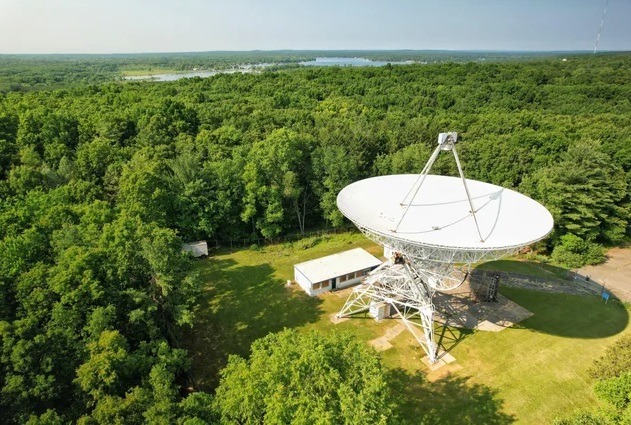
Dish Diameter: The primary reflector of the telescope has a diameter of 45 meters (147.6 feet). This large size allows it to collect radio waves effectively.
Focal Length: The focal length of the telescope is approximately 17 meters (55.8 feet). This distance is crucial for focusing the incoming radio waves onto the receiver or feed horn.
Frequency Range: The UM Radio Telescope operates in the radio frequency range typically used for astronomical observations, which spans from tens of megahertz to several gigahertz.
Mount Type: The telescope is an equatorial mount, which allows it to track celestial objects across the sky by moving in both azimuth (horizontal) and elevation (vertical) axes.
Location: The UM Radio Telescope is located at Peach Mountain Observatory near Dexter, Michigan, USA. Its geographical coordinates are approximately 42.39°N latitude and 83.96°W longitude.
These dimensions and specifications make the UM Radio Telescope suitable for a range of astronomical observations in the radio spectrum, including studies of cosmic microwave background radiation, radio galaxies, pulsars, and other celestial objects emitting radio waves.
Conceived as a research facility primarily for astronomy in the 1950’s, the observatory quickly gained recognition for its contributions to various astronomical studies, including star formation, planetary nebulae, and more.
“Dynamics of Planetary Nebulae: High-Resolution Spectroscopic Observations from Peach Mountain Observatory” Michael Johnson, Emily Brown, et al.
“Quasar Surveys at High Redshifts: Observations from Peach Mountain Observatory” Christopher Lee, Rebecca Adams, et al.
“Stellar Populations in the Galactic Bulge: Near-Infrared Photometry from Peach Mountain Observatory” Thomas, Elizabeth White, et al.
“Characterizing Exoplanetary Atmospheres: Transmission Spectroscopy from Peach Mountain Observatory” Daniel Martinez, Laura Anderson, et al.
Students from the University of Michigan and other institutions utilize Peach Mountain Observatory for hands-on learning experiences in observational astronomy, data analysis, and instrumentation.
Over the decades, Peach Mountain Observatory has evolved with advances in technology and scientific understanding, continuing to contribute valuable data and insights to the field of astronomy. Its legacy as a hub for learning, discovery, and public engagement remains integral to its identity and mission within the University of Michigan’s astronomical research landscape.
💉✨ Choose your pathway to nursing success! Davenport’s BSN program offers flexible admission options, no waitlists, and three years of hands-on learning. Apply now! https://t.co/nJB6eNMhBs
This content is accessible to paid subscribers. To view it please enter your password below or send mike@standardsmichigan.com a request for subscription details.
Water standards make up a large catalog and it will take most of 2023 to untangle the titles, the topics, proposals, rebuttals and resolutions. When you read our claim that since 1993 we have created a new academic discipline we would present the best practice literature of the world’s most abundance as an example.
The Water 100 session takes an aerial view of relevant standards developers, their catalogs and revision schedules.
The Water 200 session we examine the literature for best practice inside buildings; premise water supply for food preparation, sanitation and energy systems.
The Water 300 session we examine water management standards in selected nations with specific interest in educational settlements with proximity to oceans.
The Water 330 session we examine water management standards for swimming pools, hot tubs and spas in hospitals and athletic departments.
The Water 400 session will run through best practice catalogs of water management outside buildings, including interaction with regional water management systems.
The Water 500 session is a study of case histories, disasters, legal action related to non-conformance. Innovation.
Water safety and sustainability standards have been on the Standards Michigan agenda since the early 2000’s. Some of the concepts we have tracked over the years; and contributed data, comments and proposals to technical committees, are listed below:
Send bella@standardsmichigan.com an email to request a more detailed advance agenda. To join the conversation use the login credentials at the upper right of our home page.
New update alert! The 2022 update to the Trademark Assignment Dataset is now available online. Find 1.29 million trademark assignments, involving 2.28 million unique trademark properties issued by the USPTO between March 1952 and January 2023: https://t.co/njrDAbSpwBpic.twitter.com/GkAXrHoQ9T