Abstract: In today’s digital landscape, organizations depend on intricate information systems to manage sensitive data, maintain operations, and ensure business continuity. As these systems become more complex, the need for effective risk management strategies grows. Improving facilities, student satisfaction, event attendance, and sustainability are great successes in operational policies, procedures, and event management. Additionally, the sports building serves a diverse community, including students, faculty, staff, and external guests, supporting daily recreation, varsity athletics, and large-scale events. Therefore, this study presents a focused risk management approach based on the NIST Cybersecurity Framework (CSF 2.0) for athletics centers in sports facilities, such as indoor game spaces, fitness centers, and outdoor game spaces, at academic institutions. Thus, this study aims to evaluate asset management practices and identify physical and logical vulnerabilities by conducting in-depth interviews with students, coaches, and other supporting staff, and by gathering firsthand insights into operational workflows, physical security measures, and system-level safeguards. These qualitative findings, combined with realistic frameworks, form the foundation of analysis. In conclusion, sports operations and this study underscore the institution’s commitment to technical reliability, risk awareness, and corresponding mitigation, as well as 24/7 assistant services.
Today we run through recent action in fire safety best practice literature. Even though fire safety technologies comprise about 2-4 percent of a new building budget, the influence of the fire safety culture dominates all aspects campus safety; cybersecurity of public safety communication technology for example.
A small sample of the issues we have tracked in the past: (2002-2023). Items in RED indicate success in reducing cost with no reduction in safety (i.e. successful rebuttal, typically market-making by incumbents)
Limiting vendor lock-in (promote interoperability) in building additions.
Limiting the tendency to lowball first cost in order to achieve vendor lock-in later in the facility life-cycle
Scalability of fire safety professional certification
Sprinklering of off-campus student housing
Advocating central (or campus district) fire pump systems
One of the newer issues to revisit over the past few years is the fire safety of tents. Many colleges and universities are setting up large commercial tents outside buildings (within range of Wi-Fi) for students to congregate, study and dine. We are also seeing back and forth on fire safety in theatrical performance venues in the International Code Council building safety catalog.
We approach these titles with an eye toward driving risk-informed, performance requirements that reduce risk and cost for the user interest; while recognizing the responsibility of competitor stakeholders. It is not a friendly space for the user-interest who seeks to optimally resolve the competing requirements of safety and economy. Vertical incumbents completely dominate this domain.
We break down our coverage of laboratory safety and sustainability standards thus:
Laboratories 100 covers a broad overview of the safety and sustainability standards setting catalogs; emphasis on titles incorporated by reference into public safety laws.
Laboratories 200 covers laboratory occupancies primarily for teaching
Laboratories 300 covers laboratories in healthcare clinical delivery.
Laboratories 400 covers laboratories for scientific research; long since creating the field of environmental health and safety in higher education and a language (and acronyms of its own: CSHEMA)
In the most recent fiscal year, the National Institutes of Health had a budget of approximately $47.7 billion. A substantial portion of this budget is allocated to research at colleges and universities. Specifically, about 83% of NIH’s funding, which translates to roughly $39.6 billion, is awarded for extramural research. This funding is distributed through nearly 50,000 competitive grants to more than 2,500 universities, medical schools, and other research institutions across the United States
The cost to build a “standard” classroom runs about $150 to $400 per square foot; a scientific research laboratory about $400 to $1200 per square foot.
Laboratories 500 is broken out as a separate but related topic and will cover conformity and case studies that resulted in litigation. Both Laboratories 200 and 400 will refer to the cases but not given a separate colloquium unless needed.
At the usual time. Use the login credentials at the upper right of our home page.
“Evaluating the Efficacy of Laboratory Hazard Assessment Tools for Risk Management in Academic Research Laboratories” – This study from 2021 evaluated the effectiveness of various laboratory hazard assessment tools in academic research laboratories, and found that a combination of tools and approaches may be most effective for managing risks.
“A Framework for Assessing Laboratory Safety Culture in Academic Research Institutions” – This 2020 study developed a framework for assessing laboratory safety culture in academic research institutions, which can help identify areas for improvement and promote a culture of safety.
“Enhancing Laboratory Safety Culture Through Peer-to-Peer Feedback and Coaching” – This 2020 study found that peer-to-peer feedback and coaching can be an effective way to enhance laboratory safety culture, as it encourages open communication and feedback among colleagues.
“Assessing the Effectiveness of Laboratory Safety Training Programs for Graduate Students” – This 2019 study evaluated the effectiveness of laboratory safety training programs for graduate students, and found that interactive and hands-on training was more effective than traditional lecture-based training.
“Improving Laboratory Safety Through the Use of Safety Climate Surveys” – This 2018 study found that safety climate surveys can be an effective way to improve laboratory safety, as they provide insight into employee perceptions of safety culture and identify areas for improvement.
These recent research findings suggest that laboratory safety culture can be improved through a variety of approaches, including hazard assessment tools, peer-to-peer feedback and coaching, interactive training, and safety climate surveys. Some of these findings will likely set the standard of care we will see in safety standards incorporated by reference into public safety regulations.
Related:
November 29, 2021
Today we break down the literature setting the standard of care for the safety and sustainability of instruction and research laboratories in the United States specifically; and with sensitivity to similar enterprises in research universities elsewhere in the world. We will drill into the International Code Council Group A titles which are receiving public input until January 10, 2022.
Join us by clicking the Daily Colloquia link at the upper right of our home page.
The original University of Michigan Workspace for [Issue 13-28] in which we advocate for risk-informed eyewash and emergency shower testing intervals has been upgraded to the new Google Sites platform: CLICK HERE
Related:
September 20, 2021
Today we break down the literature setting the standard of care for the safety and sustainability of instruction and research laboratories in the United States specifically; and with sensitivity to similar enterprises in research universities elsewhere in the world.
Join us by clicking the Daily Colloquia link at the upper right of our home page.
May 10, 2021
Today we will poke through a few proposals for the 2021/222 revision of the International Code Council’s Group A Codes. For example:
IFC § 202 et. al | F175-21| Healthcare Laboratory Definition
IBC § 202 et. al | E7-21| Collaboration Room
IBC § 1110.3 et. al | E143-21| Medical scrub sinks, art sinks, laboratory sinks
. . .
IFGC § 403, etl al| G1-21| Accessibility of fuel gas shut off valves
IBC § 307 Tables | G36-21| For hazardous materials in Group B higher education laboratory occupancies
IBC § 302.1 et. al | G121-21| Separation from other nonlaboratory areas for higher education laboratories
And about 20 others we discussed during the Group A Hearings ended last week. We will have until July 2nd to respond. The electrotechnology proposals will be referred to the IEEE Education & Healthcare Facilities Committee which is now preparing responses to this compilation by Kimberly Paarlberg.
March 15, 2021
Today we break down action in the literature governing the safety and sustainability of instruction and research laboratories in the United States specifically; but also with sensitivity to similar enterprises in research universities elsewhere in the world. “Everyone” has an iron in this fire:
…and ISEA, AWWA, AIHA, BIFMA, CLSI, LIA, IAPMO, NSF, UL etc. among ANSI accredited standards developing organizations…
..and addition to NIST, Federal code of Regulations Title 29, NIH, CDC, FEMA, OSHA etc
…and state level public health regulations; some of them adapted from OSHA safety plans
Classroom and offices are far simpler. Laboratories are technically complicated and sensitive area of concern for education communities not only responsible for the safety of instructional laboratories but also global communities with faculty and staff that must simultaneously collaborate and compete. We have been tip-toeing through the technical and political minefields for nearly 20 years now and have had some modest success that contributes to higher safety and lower costs for the US education community.
Colloquium open to everyone. Use the login credentials at the upper right of our home page.
Today at the usual hour we sort through the NFPA stack for fire safety system aspects during renovation, alteration, or rehabilitation of buildings. Two sections come to mind:
Chapter 43 (NFPA 101): Building Rehabilitation
NFPA 241: Safeguarding Construction, Alteration, and Demolition Operations
Use the login credentials at the upper right of our home page.
The Life Safety Code addresses those construction, protection, and occupancy features necessary to minimize danger to life from the effects of fire, including smoke, heat, and toxic gases created during a fire. It is widely incorporated by reference into public safety statutes; typically coupled with the consensus products of the International Code Council. It is a mighty document — one of the NFPA’s leading titles — so we deal with it in pieces; consulting it for decisions to be made for the following:
(1) Determination of the occupancy classification in Chapters 12 through 42.
(2) Determination of whether a building or structure is new or existing.
(3) Determination of the occupant load.
(4) Determination of the hazard of contents.
There are emergent issues — such as active shooter response, integration of life and fire safety systems on the internet of small things — and recurrent issues such as excessive rehabilitation and conformity criteria and the ever-expanding requirements for sprinklers and portable fire extinguishers with which to reckon. It is never easy telling a safety professional paid to make a market for his product or service that it is impossible to be alive and safe. It is even harder telling the dean of a department how much it will cost to bring the square-footage under his stewardship up to the current code.
The 2021 edition is the current edition and is accessible below:
Public input on the 2027 Revision will be received until June 4, 2024. Public comment on the Second Draft 2027 Revision will be received until March 31, 2026.
Since the Life Safety Code is one of the most “living” of living documents — the International Building Code and the National Electric Code also move continuously — we can start anywhere and anytime and still make meaningful contributions to it. We have been advocating in this document since the 2003 edition in which we submitted proposals for changes such as:
• A student residence facility life safety crosswalk between NFPA 101 and the International Building Code
• Refinements to Chapters 14 and 15 covering education facilities (with particular attention to door technologies)
• Identification of an ingress path for rescue and recovery personnel toward electric service equipment installations.
• Risk-informed requirement for installation of grab bars in bathing areas
• Modification of the 90-minute emergency lighting requirements rule for small buildings and for fixed interval testing
• Modification of emergency illumination fixed interval testing
• Table 7.3.1 Occupant Load revisions
• Harmonization of egress path width with European building codes
There are others. It is typically difficult to make changes to stabilized standard though some of the concepts were integrated by the committee into other parts of the NFPA 101 in unexpected, though productive, ways. Example transcripts of proposed 2023 revisions to the education facility chapter is linked below:
Since NFPA 101 is so vast in its implications we list a few of the sections we track, and can drill into further, according to client interest:
Chapter 3: Definitions
Chapter 7: Means of Egress
Chapter 12: New Assembly Occupancies
Chapter 13: Existing Assembly Occupancies
Chapter 16 Public Input Report: New Day-Care Facilities
Chapter 17 Public Input Report: Existing Day Care Facilities
Chapter 18 Public Input Report: New Health Care Facilities
Chapter 19 Public Input Report: Existing Health Care Facilities
Chapter 28: Public Input Report: New Hotels and Dormitories
Chapter 29: Public Input Report: Existing Hotels and Dormitories
Chapter 43: Building Rehabilitation
Annex A: Explanatory Material
As always we encourage front-line staff, facility managers, subject matter experts and trade associations to participate directly in the NFPA code development process (CLICK HERE to get started)
NFPA 101 is a cross-cutting title so we maintain it on the agenda of our several colloquia —Housing, Prometheus, Security and Pathways colloquia. See our CALENDAR for the next online meeting; open to everyone.
Issue: [18-90]
Category: Fire Safety, Public Safety
Colleagues: Mike Anthony, Josh Elvove, Joe DeRosier, Marcelo Hirschler
The International Code Council (ICC) introduced dedicated provisions for higher education laboratories in 2018. This includes Section 428 in the International Building Code (IBC) (laboratory suites in Group B occupancies) and the new Chapter 38 in the International Fire Code (IFC). These provisions allow colleges/universities to use “laboratory suites” (instead of stricter control areas) with higher maximum allowable quantities (MAQs) of hazardous materials, without triggering a high-hazard (Group H) occupancy classification, provided enhanced fire safety, separation, ventilation, emergency power, and other requirements are met.
§
The 2027 revision of the IBC is in production and will be released for public use in early 2027.
Safety and sustainability concepts for research and healthcare delivery cut across many disciplines and standards suites and provides significant revenue for most research universities. The International Code Council provides free access to current editions of its catalog of titles incorporated by reference into public safety law. CLICK HERE for an interactive edition of Chapter 38 of the 2021 International Fire Code.
During today’s colloquium we will examine consultations for the next edition in the link below:
We encourage our colleagues to participate directly in the ICC Code Development process. The next revision of the International Fire Code will be undertaken accordingly to next ICC Code Development schedule; the timetable linked below:
We encourage directly employed front-line staff of a school district, college or university that does not operate in a conformance/compliance capacity — for example, a facility manager of an academic unit — to join a committee. Not the Fire Marshall. Not the Occupational Safety Inspector. Persons with job titles listed below:
Fire Safety System Designer
Fire Alarm Technician (Shop Foreman)
Building Commissioner
Electrical, Mechanical Engineer
Occupational Safety Engineer
These subject matter experts generally have a user-interest point of view.
Contact Kimberly Paarlberg (kpaarlberg@iccsafe.org) for information about how to do so.
Anglosphere (United States, United Kingdom, Canada, Australia, New Zealand) ~ $39.2T (or ~33% of GGDP)
United States GDP $30.8T (or about 26% of GGDP)
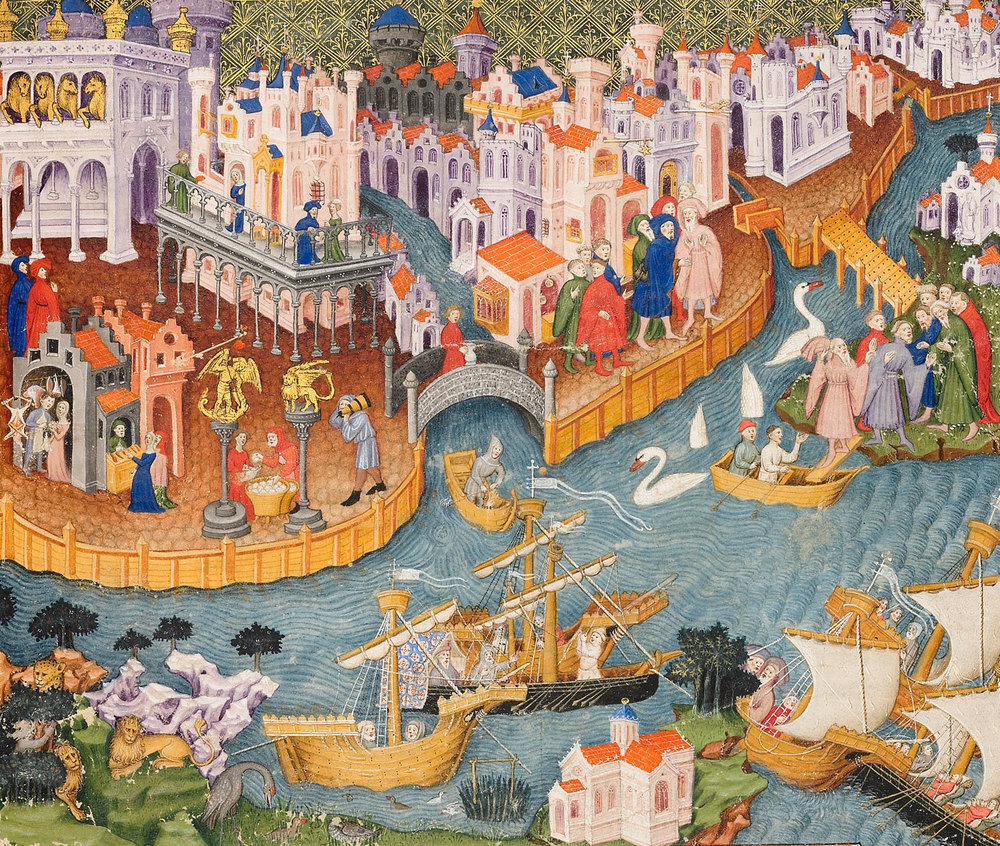
“Livres des Merveilles du Monde” 1300 | Marco Polo | Bodleian Libraries, University of Oxford
Today we break down consultations on titles relevant to the technology and management of the real assets of education communities in the United States specifically; but with sensitivity to the global education markets where thousands of like-minded organizations also provide credentialing, instruction, research, a home for local fine arts and sport.
“Even apart from the instability due to speculation, there is the instability due to the characteristic of human nature that a large proportion of our positive activities depend on spontaneous optimism rather than on a mathematical expectation, whether moral or hedonistic or economic. Most, probably, of our decisions to do something positive, the full consequences of which will be drawn out over many days to come, can only be taken as the result of animal spirits — a spontaneous urge to action rather than inaction, and not as the outcome of a weighted average of quantitative benefits multiplied by quantitative probabilities. Enterprise only pretends to itself to be mainly actuated by the statements in its own prospectus, however candid and sincere that prospectus may be. Only a little more than an expedition to the South Pole is it based on an exact calculation of benefits to come. Thus if the animal spirits are dimmed and the spontaneous optimism falters, leaving us to depend on nothing but a mathematical expectation, enterprise will fade and die; — though fears of loss may have a basis no more reasonable than hopes of profit had before.”
Extended Versions Certain standards are required to be read in tandem with another standard, which is known as a reference (or parent) document. The extended version (EXV) of an IEC Standard facilitates the user to be able to consult both IEC standards simultaneously in a single, easy-to-use document.
A partial list of projects with which we have been engaged as an active participant; starting with the original University of Michigan enterprise in the late 1990’s and related collaborations with IEEE and others: (In BOLD font we identify committees with open consultations requiring a response from US stakeholders before next month’s Hello World! colloquium)
IEC/TC 8, et al System aspects of electrical energy supply
We collaborate with the appropriate ANSI US TAG; or others elsewhere in academia. We have begun tracking ITU titles with special attention to ITU Radio Communication Sector.
main(){printf("hello, world\n");}
We have collaborations with Rijksuniversiteit Groningen, Sapienza – Università di Roma, Universität Zürich, Universität Potsdam, Université de Toulouse. Universidade Federal de Itajubá, University of Windsor, the University of Alberta, to name a few — most of whom collaborate with us on electrotechnology issues. Standards Michigan and its 50-state affiliates are (obviously) domiciled in the United States. However, and for most issues, we defer to the International Standards expertise at the American National Standards Institute
* A “Hello, World!” program generally is a computer program that outputs or displays the message “Hello, World!”. Such a program is very simple in most programming languages (such as Python and Javascript) and is often used to illustrate the basic syntax of a programming language. It is often the first program written by people learning to code. It can also be used as a sanity test to make sure that a computer language is correctly installed, and that the operator understands how to use it.
Much economic activity in the global standards system involves products — not interoperability standards. Getting everything to work together — safely, cost effectively and simpler — is our raison d’etre.
Manufacturers, testing laboratories, conformance authorities (whom we call vertical incumbents) are able to finance the cost of their advocacy — salaries, travel, lobbying, administration — into the cost of the product they sell to the end user (in our cases, estate managers in educational settlements). To present products — most of which involve direct contact with a consumer — at a point of sale it must have a product certification label. Not so with systems. System certification requirements, if any, may originate in local public safety requirements; sometimes reaching into the occupational safety domain.
Our readings of the intent of this technical committee is to discover and promulgate best practice for “systems of products” — i.e. ideally interoperability characteristics throughout the full span of the system life cycle.
Standardization in the field of network management in interconnected electric power systems with different time horizons including design, planning, market integration, operation and control. SC 8C covers issues such as resilience, reliability, security, stability in transmission-level networks (generally with voltage 100kV or above) and also the impact of distribution level resources on the interconnected power system, e.g. conventional or aggregated Demand Side Resources (DSR) procured from markets.
SC 8C develops normative deliverables/guidelines/technical reports such as:
– Terms and definitions in area of network management, – Guidelines for network design, planning, operation, control, and market integration – Contingency criteria, classification, countermeasures, and controller response, as a basis of technical requirements for reliability, adequacy, security, stability and resilience analysis, – Functional and technical requirements for network operation management systems, stability control systems, etc. – Technical profiling of reserve products from DSRs for effective market integration. – Technical requirements of wide-area operation, such as balancing reserve sharing, emergency power wheeling.
Individuals who are interested in becoming a participant or the TAG Administrator for SC 8C: Network Management are invited to contact Adelana Gladstein at agladstein@ansi.org as soon as possible.
This opportunity, dealing with the system aspects of electrical energy supply (IEC TC 8), should at least interest electrical engineering research faculty and students involved in power security issues. Participation would not only provide students with a front-row seat in power system integration but faculty can collaborate and compete (for research money) from the platform TC 8 administers. We will refer it to the IEEE Education & Healthcare Facilities Committee which meets online 4 times monthly in European and American time zones.
New update alert! The 2022 update to the Trademark Assignment Dataset is now available online. Find 1.29 million trademark assignments, involving 2.28 million unique trademark properties issued by the USPTO between March 1952 and January 2023: https://t.co/njrDAbSpwBpic.twitter.com/GkAXrHoQ9T