“Indians Playing Lacrosse on the Ice” 1934 Yale University Art Gallery
The literature for designing, building and maintaining sport and recreation related spaces in education settlements cuts across so many safety and sustainability risk aggregations that, starting 2024, we begin breaking up the topic according to four seasons; mindful that not all seasons are present in all settlements at all times of the year and in different age groups.
After athletic arena life safety obligations are met (governed legally by NFPA 70, NFPA 101, NFPA 110, the International Building Code and possibly other state adaptations of those consensus documents incorporated by reference into public safety law) business objective standards may come into play.For almost all athletic facilities, the consensus documents of the Illumination Engineering Society[1], the Institute of Electrical and Electronic Engineers[2][3] provide the first principles for life safety. For business purposes, the documents distributed by the National Collegiate Athletic Association inform the standard of care for individual athletic arenas so that swiftly moving media production companies have some consistency in power sources and illumination as they move from site to site. Sometimes concepts to meet both life safety and business objectives merge.
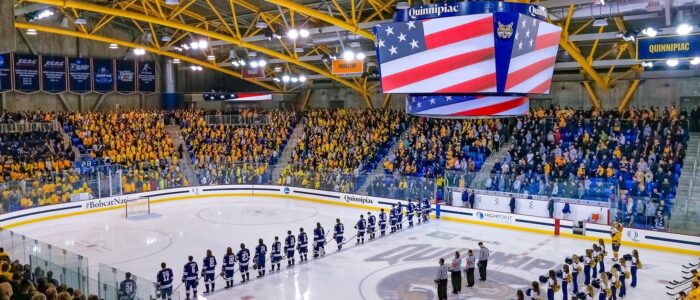
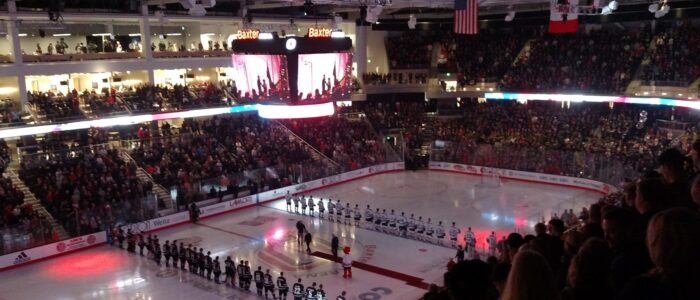
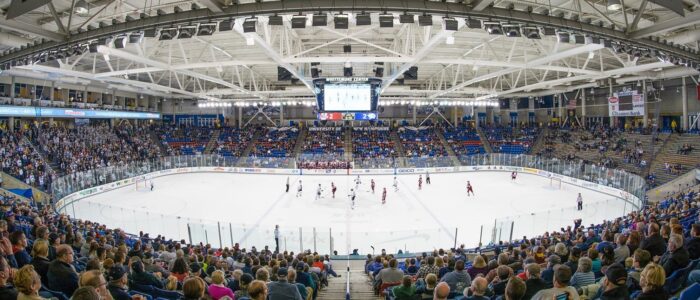
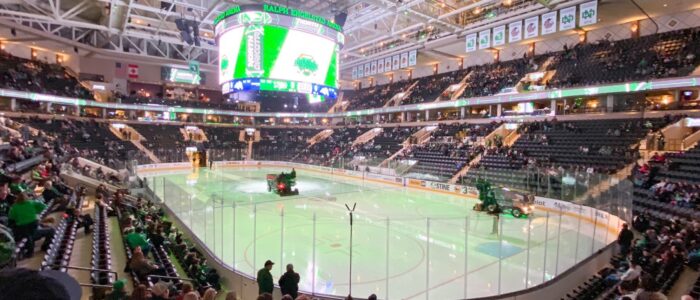
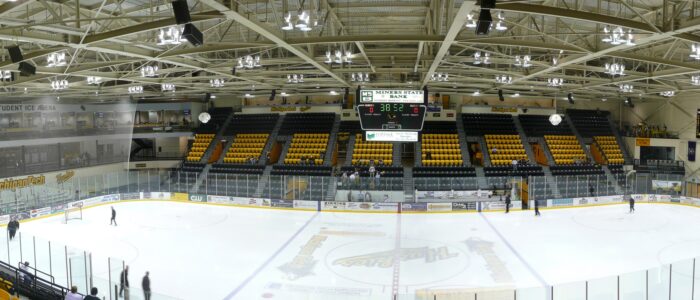
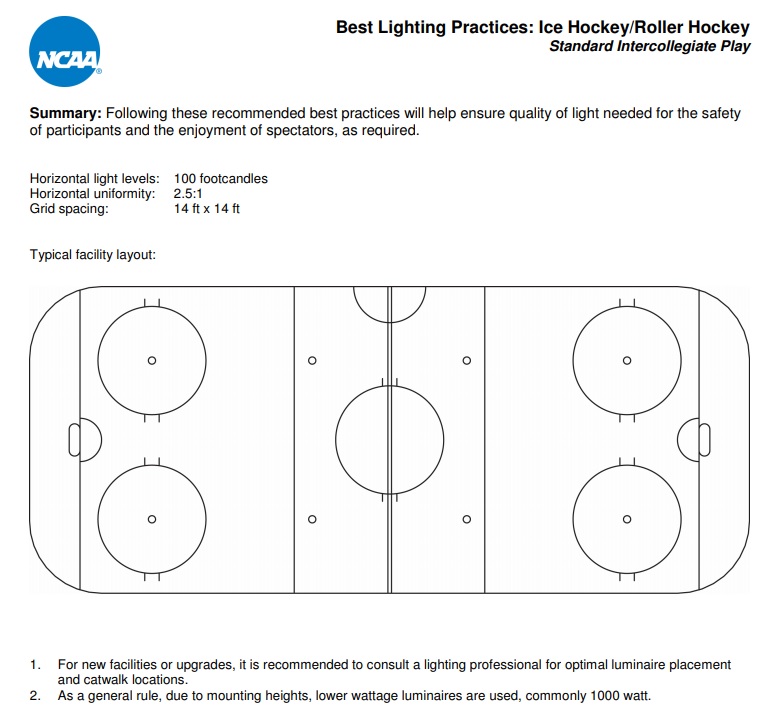
During hockey season the document linked below provides information to illumination designers and facility managers:
Athletic programs are a significant source of revenue and form a large part of the foundation of the brand identity of most educational institutions in the United States. We focus primarily upon the technology standards that govern the safety, performance and sustainability of these enterprises. We collaborate very closely with the IEEE Education & Healthcare Facilities Committee where subject matter experts in electrical power systems meet 4 times each month in the Americas and Europe.
See our CALENDAR for our next colloquium on Sport facility codes and standards. We typically walk through the safety and sustainability concepts in play; identify commenting opportunities; and find user-interest “champions” on the technical committees who have a similar goal in lowering #TotalCostofOwnership.
Issue: [15-138]*
Category: Electrical, Architectural, Arts & Entertainment Facilities, Athletics
Colleagues: Mike Anthony, Jim Harvey, Jack Janveja, Jose Meijer, Scott Gibbs
LEARN MORE:
[1] Illumination Engineering Handbook
[2] IEEE 3001.9 Recommended Practice for Design of Power Systems for Supplying Lighting Systems for Commercial & Industrial Facilities
[3] IEEE 3006.1 Power System Reliability
* Issue numbering before 2016 dates back to the original University of Michigan codes and standards advocacy enterprise
This content is accessible to paid subscribers. To view it please enter your password below or send mike@standardsmichigan.com a request for subscription details.
The larger part of using the global standardization system to make the real assets of educational settlements safer, simpler, lower-cost and longer-lasting is to make every effort to use those spaces and occupancies effectively. Today we examine a few case studies and explore possibilites mapped in safety and sustainability catalogs of standards developers whose titles become the basis for government regulation. Use the login credentials at the upper right of our home page at the usual hour.
The topic is necessarily cross-cutting and technologically interdisciplinary so we draw from the syllabi of colloquia we previously covered.
Here are 10 current trends in the construction of K-12 education facilities in the United States, based on recent industry insights and developments. These trends reflect a focus on safety, sustainability, technology, and evolving educational needs, drawn from sources like architectural firms, construction reports, and educational design analyses.
Enhanced Security Systems Schools are prioritizing advanced security measures, such as wearable panic devices for staff, access control systems, secure vestibules, surveillance technology, and remote hallway gate controls. Many districts are proactively upgrading security as standalone projects rather than waiting for renovations, aiming to create safer environments without highly visible fortifications. For example, Solomon-Solis Cohen Elementary in Philadelphia integrates park-like settings with security features to balance safety and community appeal.
Flexible and Adaptable Learning Spaces Traditional static classrooms are being replaced with modular, flexible spaces that support diverse teaching styles and learning needs. These include movable partitions, demountable walls, and multi-purpose areas like learning stairs, which serve as seating or presentation spaces. Schools like Warsaw High School use learning stairs as dynamic hubs for collaboration, allowing easy reconfiguration for group work, individual study, or CTE programs.
Sustainability and Net-Zero Energy Design Schools are adopting eco-friendly designs, such as energy-efficient HVAC systems, solar panels, and green materials, to achieve net-zero energy goals. The transition to electric vehicle (EV) bus fleets with charging infrastructure is also growing, as seen in districts incrementally upgrading transportation facilities. These designs educate students about sustainability while reducing operational costs.
Improved Indoor Air Quality and HVAC Upgrades With 38% of U.S. public schools built before 1970, upgrading HVAC systems is a priority to improve air quality and prevent health issues like mold. The American Society of Civil Engineers noted in 2021 that 41% of districts need HVAC updates in at least half their schools, costing billions. Post-COVID, schools are using federal relief funds to enhance ventilation, as seen in Clark County School District’s UL Verified Ventilation mark.
Career and Technical Education (CTE) and STEAM Facilities There’s a resurgence in CTE and STEAM (Science, Technology, Engineering, Arts, Mathematics) spaces, with schools building specialized labs for robotics, welding, automotive, and filmmaking. For instance, Merrillville Community School Corporation added a 57,000-square-foot CTE addition with state-of-the-art labs. These spaces prepare students for skilled trades and tech careers, reflecting a shift away from college-only pathways.
Technology Integration and Wi-Fi Optimization Schools are designing comprehensive Wi-Fi coverage using predictive modeling to eliminate dead zones, ensuring access for all users (students, staff, parents). Classrooms are equipped with IT infrastructure for digital learning, including VR/AR tools and BIM (Building Information Modeling) for design precision. Santa Ana High School’s transformation of a library into a digital media lab exemplifies this trend.
Health and Wellness-Focused Design Designs prioritize mental and physical well-being with natural lighting, ergonomic furniture, and outdoor learning spaces like gardens or courtyards. The “One Health” movement, cited by PBK Architects, emphasizes environments where students and buildings are holistically healthy. Twin Buttes High School in North Dakota incorporates food sovereignty programs with greenhouses and culinary labs to promote wellness.
Community-Centric Facilities Schools are being designed as community hubs, hosting events and serving as emergency shelters or voting places. Flexible designs allow spaces to be used by the community year-round, generating revenue. For example, Eddy & Debbie Peach Elementary School includes outdoor art and science labs that double as community spaces, fostering engagement and connection.
Resilient and Durable Construction New builds and renovations use resilient materials to withstand high-traffic use and extreme weather, adhering to updated building codes for fire resistance and accessibility. Designers assess existing structures for “good bones” to repurpose them cost-effectively, as seen in HED’s redesign of Santa Monica High School with adaptable, demountable walls.
Collaborative Design with Stakeholder Input Construction projects increasingly involve teachers, parents, and students in the planning process through public meetings and surveys to align facilities with community needs. Transparent communication, as emphasized by Bryan Construction, ensures designs reflect educational goals, such as sustainable curricula or flexible spaces, enhancing teacher and student satisfaction.
Though founded in 1978, the APA does not publish dedicated standards or guidelines specifically for college/university campus planning. It is a membership-based non-profit organization with revenue coming from “program services” — membership, conferences and certification services. Today we review its participation in the expanding discussion about homeschooling and new neighborhood planning.
§
§
Campus physical planning is more commonly addressed by organizations like the Society for College and University Planning (SCUP), and scholarly literature (e.g., in the Journal of the American Planning Association) notes limited APA focus on higher education facilities compared to K-12 schools.
Do Texas public schools exist to serve the school district? Or do they exist to serve all the children and families in the community? Here is the list of schools discriminating against homeschoolers by not allowing those students to participate in UIL. #txlege…
Group E occupancy covers buildings (or portions thereof) used for educational purposes by six or more persons at any time through the 12th grade.
This includes:
Elementary schools — Kindergartens through high schools (primary classification for academic instruction).
Day care facilities — Specifically for more than five children older than 2½ years of age receiving educational, supervision, or personal care services for fewer than 24 hours per day.
Key exceptions and notes:
Facilities with five or fewer children (any age) in day care → classify as part of the primary occupancy or as Group R-3 (if in a dwelling unit).
Day care during religious functions in places of worship → classifies as part of the primary occupancy (often Group A-3).
Accessory religious educational rooms or auditoriums with occupant loads <100 → classify as Group A-3.
Colleges and universities do not fall under Group E; higher education facilities typically classify as Group B (Business) for classrooms, offices, and labs, with assembly spaces (e.g., lecture halls, auditoriums) as Group A if they meet assembly criteria.
Section 308: Institutional Group I (Relevant to Day Care – Group I-4)
Section 308 defines Institutional Group I occupancies overall, with Group I-4 specifically addressing day care facilities requiring custodial care.
Group I-4 includes buildings occupied by more than five persons of any age who receive custodial care (supervision and assistance due to age or incapacity) for fewer than 24 hours per day, provided by non-relatives outside the home.
This explicitly covers:
Adult day care.
Child day care (particularly when occupants need assistance in emergencies).
For child day care:
Facilities serving more than five children 2½ years of age or younger → generally Group I-4.
Exception allowing reclassification to Group E: If serving more than five but no more than 100 children ≤2½ years old, care rooms are on the level of exit discharge, and each care room has a direct exterior exit door.
Other notes:
Five or fewer persons receiving custodial care → classifies as part of the primary occupancy or Group R-3 (if in a dwelling unit).
Care during religious functions → classifies as part of the primary occupancy.
Elementary schools and colleges do not fall under Section 308; elementary schools are Group E (as above), and colleges are typically Group B.
These classifications in the 2024 IBC remain consistent with prior editions (e.g., 2021). Local amendments may apply, so verify with the authority having jurisdiction. For the exact text, consult the official ICC digital codes.
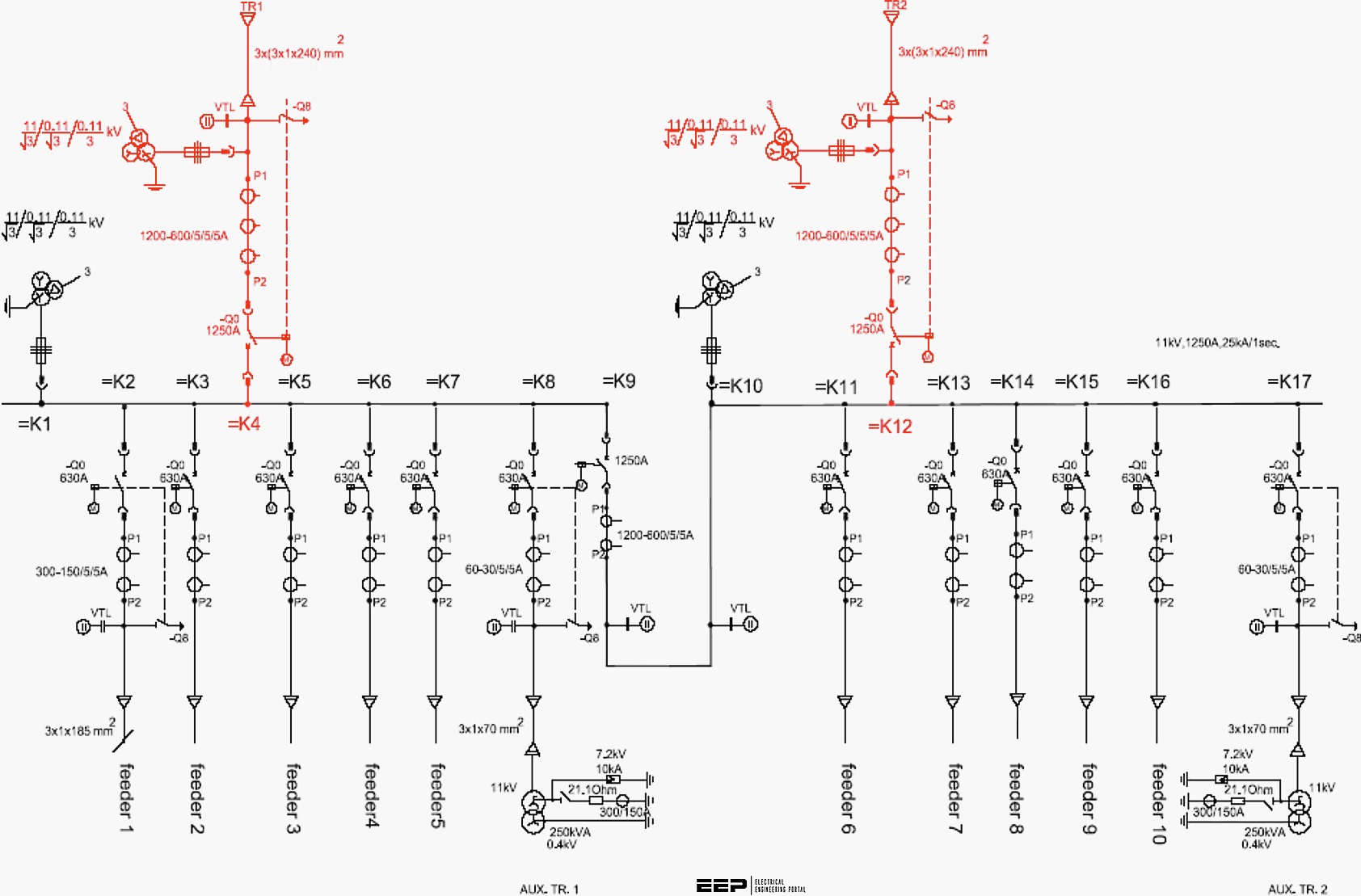
Today at 16:00 UTC we review best practice for engineering and installing the point of common coupling between an electrical service provider its and an purchasing — under the purview of NEC CMP-10.
Use the login credentials at the upper right of our home page.
The relevant passages of the National Electrical Code are found in Article 230 and Article 495. We calibrate our attention with the documents linked below. These are only representative guidelines:
We are in the process of preparing new (original, and sometimes recycled) proposals for the 2026 National Electrical Code, with the work of Code Panel 10 of particular relevance to today’s topic:
First Draft Meetings: January 15-26, 2024 in Charleston, South Carolina
Electrical meter billing standards are generally regulated at the state or local level, with guidelines provided by public utility commissions or similar regulatory bodies. These tariff sheets are among the oldest in the world. There are some common standards for billing and metering practices, including:
Meter Types: There are various types of meters used to measure electricity consumption, including analog (mechanical) meters, digital meters, and smart meters. Smart meters are becoming more common and allow for more accurate and real-time billing.
Billing Methodology:
Residential Rates: Most residential customers are billed based on kilowatt-hours (kWh) of electricity used, which is the standard unit of energy.
Demand Charges: Some commercial and industrial customers are also subject to demand charges, which are based on the peak demand (the highest amount of power drawn at any one point during the billing period).
Time-of-Use Rates: Some utilities offer time-of-use (TOU) pricing, where electricity costs vary depending on the time of day or season. For example, electricity may be cheaper during off-peak hours and more expensive during peak hours.
Meter Reading and Billing Cycle:
Monthly Billing: Typically, customers receive a bill once a month, based on the reading of the electricity meter.
Estimation: If a meter reading is not available, some utilities may estimate usage based on historical patterns or average usage.
Smart Meter Readings: With smart meters, some utilities can provide daily or even hourly usage data, leading to more precise billing.
Meter Standards: The standards for electrical meters, including their accuracy and certification, are set by national organizations like the National Institute of Standards and Technology (NIST) and the American National Standards Institute (ANSI). Meters must meet these standards to ensure they are accurate and reliable.
Utility Commission Regulations: Each state has a utility commission (such as the California Public Utilities Commission, the Texas Public Utility Commission, etc.) that regulates the rates and billing practices of electricity providers. These commissions ensure that rates are fair and that utilities follow proper procedures for meter readings, billing cycles, and customer service
Large University “Utilities”. Large colleges and universities that generate and distribute some or all of their electric power consumption have developed practices to distribute the cost of electricity supply to buildings. We will cover comparative utility billing practices in a dedicated colloquium sometime in 2025.
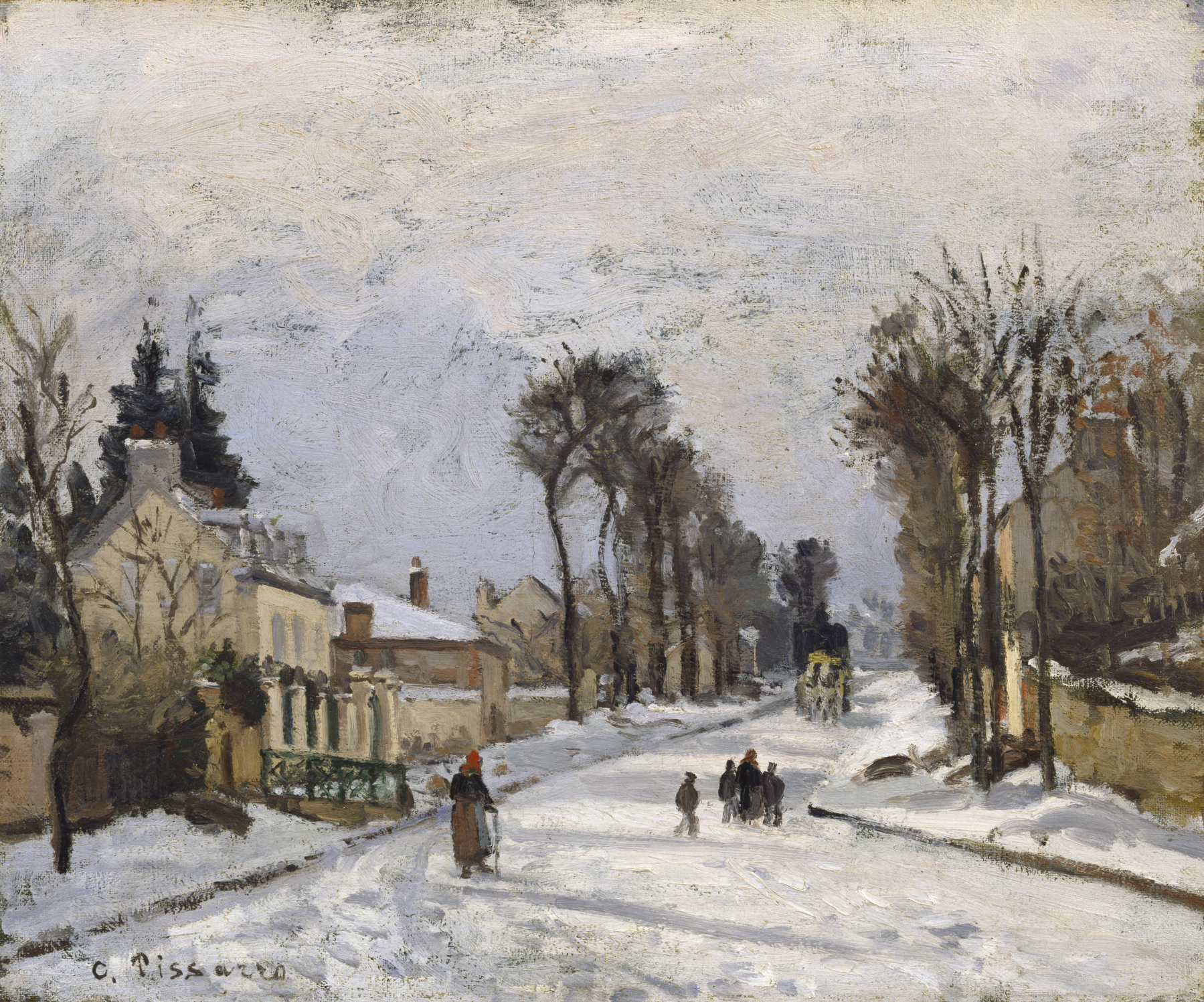
“Road to Versailles at Louveciennes” 1869 Camille Pissarro
Heat tracing is a process used to maintain or raise the temperature of pipes and vessels in order to prevent freezing, maintain process temperature, or ensure that products remain fluid and flow through the system properly. Without electric heat tracing; much of the earth would be uninhabitable.
Heat tracing works by using an electric heating cable or tape that is wrapped around the pipe or vessel, and then insulated to help retain the heat. The heating cable is connected to a power source and temperature control system that maintains the desired temperature by regulating the amount of heat output from the cable. Heat tracing is commonly used in industrial applications where temperature control is critical, such as in chemical plants, refineries, and oil and gas facilities.
There are several types of heat tracing, including electric heat tracing, steam tracing, and hot water tracing, each of which have their own unique advantages and disadvantages. The selection of the appropriate type of heat tracing depends on the specific application and the required temperature range, as well as factors such as cost, maintenance, and safety considerations.
It is a surprisingly large domain with market-makers in every dimension of safety and sustainability; all of whom are bound by state and federal regulations.
Join us at 16:00 UTC with the login credentials at the upper right of our home page.
— The Catholic University of America (@CatholicUniv) January 14, 2025
There have been several recent innovations that have made it possible for construction activity to continue through cold winter months. Some of the most notable ones include:
Heated Job Site Trailers: These trailers are equipped with heating systems that keep workers warm and comfortable while they take breaks or work on plans. This helps to keep morale up and prevent cold-related health issues.
Insulated Concrete Forms (ICFs): ICFs are prefabricated blocks made of foam insulation that are stacked together to form the walls of a building. The foam insulation provides an extra layer of insulation to keep the building warm during cold winter months.
Warm-Mix Asphalt (WMA): WMA is a type of asphalt that is designed to be used in colder temperatures than traditional hot-mix asphalt. This allows road construction crews to work through the winter months without having to worry about the asphalt cooling and becoming unusable.
Pneumatic Heaters: These heaters are used to warm up the ground before concrete is poured. This helps to prevent the concrete from freezing and becoming damaged during the winter months.
Electrically Heated Mats: These mats are placed on the ground to prevent snow and ice from accumulating. This helps to make the job site safer and easier to work on during the winter months.
Overall, these innovations have made it possible for construction crews to work through the winter months more comfortably and safely, which has helped to keep projects on schedule and minimize delays.
New update alert! The 2022 update to the Trademark Assignment Dataset is now available online. Find 1.29 million trademark assignments, involving 2.28 million unique trademark properties issued by the USPTO between March 1952 and January 2023: https://t.co/njrDAbSpwBpic.twitter.com/GkAXrHoQ9T