
Poland Secondary
- Home Page 223

Crêpes de babeurre au fruits frais
This content is accessible to paid subscribers. To view it please enter your password below or send mike@standardsmichigan.com a request for subscription details.

Crumpets
This content is accessible to paid subscribers. To view it please enter your password below or send mike@standardsmichigan.com a request for subscription details.

The perilous quest for equal results in academia
Organizational charts are often considered internal documents, and the specific format can vary widely based on organizational culture, preferences, and specific needs. Organizations may develop their own standards based on industry best practices, legal requirements, and internal considerations. Depending on the industry, there may be associations that provide guidelines tailored to that particular sector. The HR sector has a few:
Society for Human Resource Management (SHRM): SHRM provides resources and best practices for human resource professionals, including guidance on organizational structure and charts.
Project Management Institute (PMI): PMI may offer insights into organizational structures, especially in the context of project management.
International Organization for Standardization (ISO): ISO develops international standards for various aspects, including some related to organizational structures. However, these standards are not specific templates for organizational charts.
There are generally accepted principles and standards for constructing organizational charts, but the specific format and details can vary depending on the organization’s size, structure, and industry. Here are some common guidelines for creating organizational charts:
Top-Down Hierarchy: The chart typically follows a top-down hierarchy, with the highest-ranking positions at the top and lower-ranking positions below.
Clear Reporting Lines: Clearly define reporting lines to represent the chain of command and authority within the organization.
Position Titles and Names: Include position titles and, if space allows, the names of individuals holding those positions.
Consistency: Maintain consistency in the layout, shapes, and formatting of boxes and lines throughout the chart.
Departments and Divisions: Use different colors, shading, or grouping to represent different departments or divisions within the organization.
Clarity and Simplicity: Keep the chart clear and simple to understand. Avoid unnecessary complexity that might confuse viewers.
Use of Lines: Connect positions with straight or diagonal lines to represent reporting relationships. Dotted lines are sometimes used for indirect or dotted-line reporting.
Position of Support Staff: Support staff (such as human resources, IT, etc.) may be placed in a separate section or integrated within the chart, depending on the organization’s preference.
Employee Information: Depending on the sensitivity of the information and organizational culture, include only essential information about employees (names, titles) or provide more details like photos and contact information.
Updates: Regularly update the organizational chart to reflect any changes in personnel, structure, or reporting relationships.
It’s important to note that these are general guidelines, and the specific requirements for an organizational chart can vary widely based on the organization’s needs and preferences. Some organizations may prefer a more detailed chart, while others may opt for a simpler representation.

A fully dimensioned exploration of human resource standards — and approaches to lowering cost — cannot be without an understanding of present practice, and prevailing opinion about present practice.
Harvard University:
University of California Berkeley
Columbia University:
Hillsdale College:

The Mind Boggles
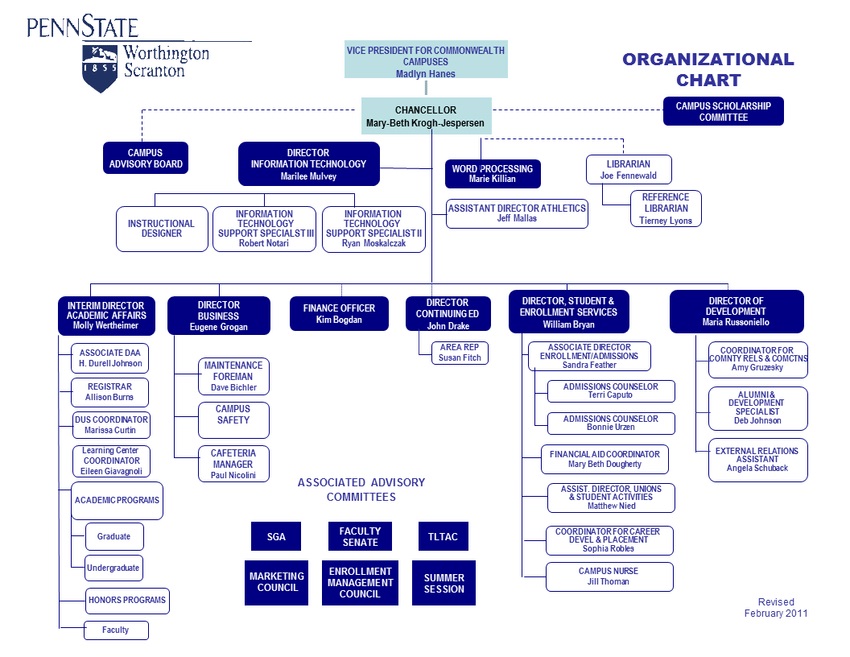
Pennsylvania State University — also known as Penn State — is a public state-related land-grant research university with campuses that are spread throughout Pennsylvania. It was founded in 1855 as the Farmers’ High School of Pennsylvania and became the country’s only land-grant institution eight years later in 1863.
Though the university is not a member of the Ivy League, Penn State is a major research university and is sometimes referred to as one of the so-called “Public Ivies”, a publicly-funded research institution that provides a comparable quality of education to Ivy League institutions. In addition to its land-grant designation, Penn State also participates in the sea-grant, sun-grant, and space-grant; one of only four institutions (alongside Cornell, Oregon State, and Hawai’I at Mānoa) to do so.
Penn State is a “state-related” university and forms part of Pennsylvania’s Commonwealth System of Higher Education. Although the university receives funding from the Commonwealth of Pennsylvania and is connected to the state via its board of trustees, it is entirely independent and does not fall under the control of the state.
Organimi: Penn State University’s Organizational Structure
Human Resources, perhaps aptly, is a large domain, likely the largest and, for the most part, outside our wheelhouse. As we continue our journey explore ways to make the physical surroundings of educational settlements of all sizes safer, simpler, lower-cost and longer lasting. it is fitting that we understand the pathways the flow of money takes. Feel free to join us during our office hours any day to “take a poke at the HR dragon”
The Pennsylvania State University is a multi-campus public university system in the state of Pennsylvania, USA. As of my last knowledge update in January 2022, here is a list of campuses in the Penn State system:
- University Park State College (312 buildings on just one campus)
- Abington – Abington
- Altoona – Altoona
- Beaver – Monaca
- Behrend – Erie
- Berks – Reading
- Brandywine – Media
- DuBois – DuBois
- Fayette – Uniontown
- Greater Allegheny – McKeesport
- Harrisburg – Middletown
- Hazleton – Hazleton
- Lehigh Valley – Center Valley
- Mont Alto – Mont Alto
- New Kensington – New Kensington
- Schuylkill – Schuylkill Haven
- Shenango – Sharon
- Wilkes-Barre – Lehman
- Worthington Scranton – Dunmore
- York – York





Christmas Tea

A Christmas theme tea ceremony was organized by the IMS Unison University School of Hospitality Management on Christmas Eve academic and industry guests. The students prepared tea snacks on the theme with a brief cultural presentation.
The special guests, Mr. Harkaran Singh, General Manager – Hotel Hyatt Regency, Dehradun, and Mr. Anil Talukdar, Director of a renowned hotel management institute, over the warmth of the tea, delivered a message of hope and happiness to hospitality students who have braved this pandemic gloom and are now geared up for the new year ahead.
Messages to hospitality students were conveyed by the Vice-Chancellor and the Deans of various schools for braving this pandemic and continuing their academic journey by borrowing warmth from the Christmas spirit. Students exhibited a brief cultural show followed by tea and snacks.
The event proceedings were moderated by Mr. Sumit Pratap, Assistant Professor-SoHM.
Canteen
This content is accessible to paid subscribers. To view it please enter your password below or send mike@standardsmichigan.com a request for subscription details.
New update alert! The 2022 update to the Trademark Assignment Dataset is now available online. Find 1.29 million trademark assignments, involving 2.28 million unique trademark properties issued by the USPTO between March 1952 and January 2023: https://t.co/njrDAbSpwB pic.twitter.com/GkAXrHoQ9T
— USPTO (@uspto) July 13, 2023
Standards Michigan Group, LLC
2723 South State Street | Suite 150
Ann Arbor, MI 48104 USA
888-746-3670
DIRECTIONS
 |
 |
|
 |
 |
|
 |
 |