‘The Barber of Seville’ by Luis Alvarez Catalá
Codes, standards and licensing for barbering schools and cosmetology academies are governed by local regulations; or local adaptations of national standards-setting organizations.
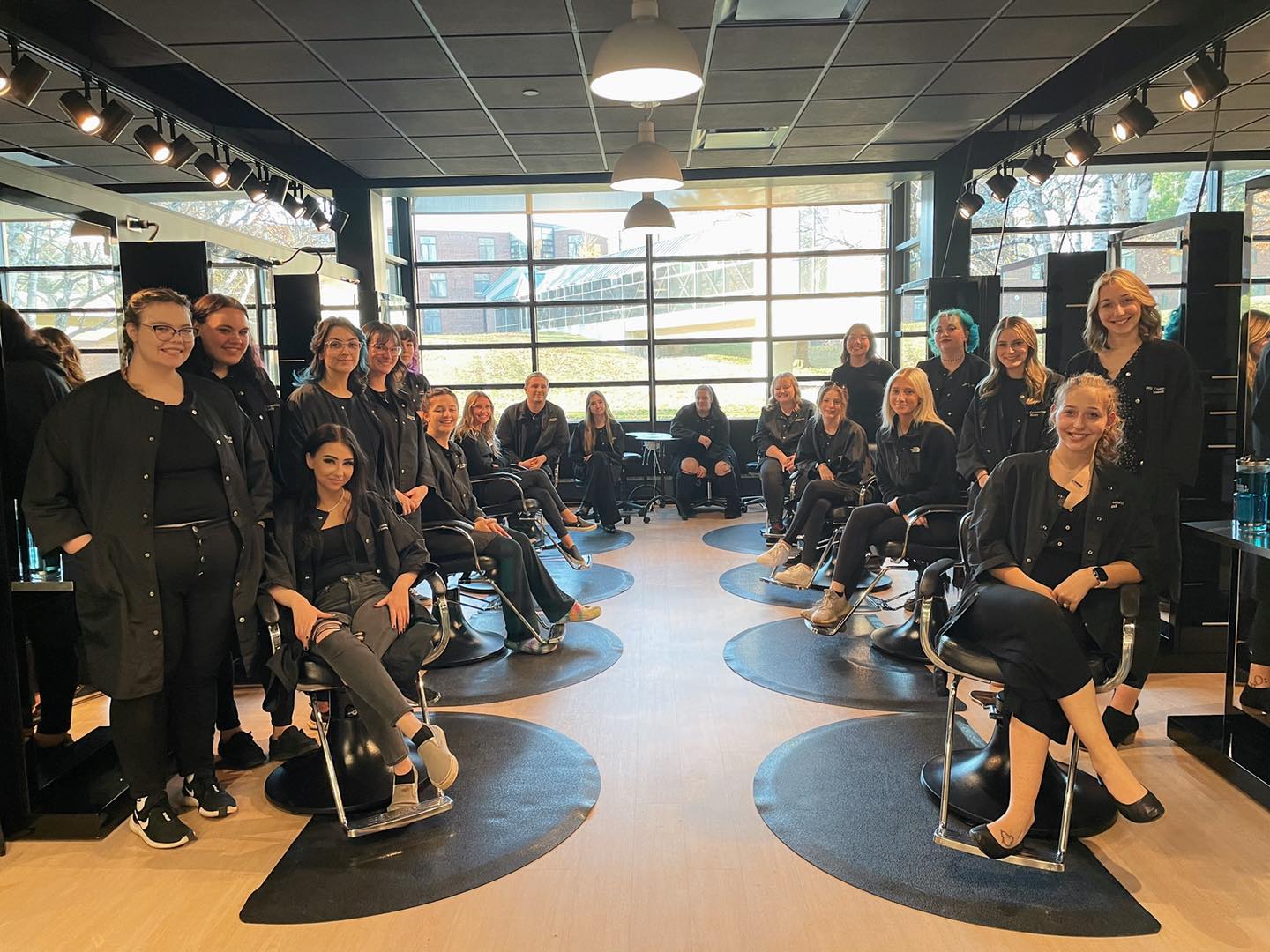
Northern Michigan University | Marquette County
- Minimum Floor Space
- Schools must provide adequate space for instruction and practice. For example, California requires a minimum of 3,000 square feet for cosmetology schools (which often include barbering), with at least 2,000 square feet dedicated to working, practice, and classroom areas. Additional space (e.g., 30 square feet per student beyond the first 50) may be required as enrollment increases.
- Rooms for practical work must be sized appropriately, such as at least 14 feet wide for one row of barber chairs or 20 feet for two rows (California standard).
- Ceiling Height
- Practice and classroom areas often require a minimum ceiling height, such as 9 feet, to ensure proper ventilation and comfort (e.g., California Building Code).
- Floor Finish
- Floors in areas like restrooms or workspaces must be made of nonabsorbent materials (e.g., tile) to facilitate cleaning and maintain hygiene.
- Separation from Other Uses
- Barbering schools must be distinct entities, not combined with residential spaces or unrelated businesses (e.g., Nevada’s NAC 643.500).
- Compliance with Local Building and Zoning Codes
- Facilities must adhere to local ordinances for construction, occupancy, and zoning, ensuring the building is structurally sound and legally permitted for educational use (e.g., Virginia’s 18VAC41-20-270).
- Accessibility
- Buildings must comply with accessibility standards (e.g., ADA in the U.S.), providing ramps, wide doorways, and accessible restrooms.
This Pennsylvania barbershop is helping children build their confidence, paying young customers $3 to read stories aloud while getting a haircut deserves unlimited retweets..
— Kevin W. (@Brink_Thinker) April 16, 2025
Occupational Safety and Health Administration: Bloodborne Pathogen Safety Standards
Westfield High School now offers a 4-year barbering program — first of its kind in Spring ISD. Read more about this pathway to career success at https://t.co/xLEvktuPWW pic.twitter.com/opBmeGGxhN
— Spring ISD (@SpringISD) October 4, 2021
- Fire Safety
- Compliance with the State Uniform Fire Prevention and Building Code (e.g., New York’s 19 NYCRR Parts 600-1250) or equivalent, including fire exits, extinguishers, and alarms.
- Emergency exits must be clearly marked and unobstructed.
- Electrical Safety
- All electrical equipment (e.g., clippers, dryers) must be regularly inspected (e.g., PAT testing in some regions) to prevent shocks or fires.
- Ventilation and Temperature Control
- Adequate ventilation systems are required to maintain air quality and a safe working temperature, protecting students and instructors from fumes or overheating.
- First Aid and Emergency Preparedness
- A stocked first aid kit must be available, and schools should have protocols for handling accidents or emergencies.
- Equipment Safety
- Tools and workstations (e.g., chairs, sinks) must be maintained in good condition to prevent injuries. Hazardous tools like razor-edged implements for callus removal are often prohibited (e.g., California regulations).
- Occupational Safety
- Compliance with OSHA (Occupational Safety and Health Administration) or state equivalents, such as Virginia’s Department of Labor and Industry standards, to protect against workplace hazards like chemical exposure or repetitive strain.
Haircut at Santisimo Sacramento Trade School. Best cut ever! Bill at State Street Barber Shop remains N. America’s #1 pic.twitter.com/1OFajjBOs2
— Coach Harbaugh (@CoachJim4UM) May 16, 2015
Hygiene
- Sanitation of Facilities
- Schools must be kept clean and sanitary at all times, including floors, walls, furniture, and workstations (e.g., Virginia’s 18VAC41-20-270).
- Disinfection of Tools
- Each student or instructor must have a wet disinfection unit at their station for sterilizing reusable tools (e.g., combs, shears) after each use. Disinfectants must be EPA-registered and bactericidal, virucidal, and fungicidal.
- Single-use items (e.g., razor blades) must be discarded after each client in a labeled sharps container.
- Hand Hygiene
- Practitioners must wash hands with soap and water or use hand sanitizer before services (e.g., Texas Rule 83.102).
- Client Protection
- Sanitary neck strips or towels must be used to prevent capes from contacting clients’ skin directly (e.g., California regulations).
- Services cannot be performed on inflamed, broken, or infected skin, and practitioners with such conditions on their hands must wear gloves.
- Product Safety
- Cosmetic products containing FDA-banned hazardous substances are prohibited, and all products must be used per manufacturer instructions (e.g., Virginia’s 18VAC41-20-270).
- Waste Management
- Proper disposal of soiled items (e.g., hair clippings) and hazardous waste (e.g., blades) is required, often daily or after each client.
- Health Department Compliance
- Schools must follow state health department guidelines and report inspection results (e.g., Virginia requires reporting to the Board of Barbers and Cosmetology).
- Self-Inspection
- Annual self-inspections must be documented and retained for review (e.g., Virginia mandates keeping records for five years).
This teacher saw one of his students waiting to get a haircut and stumbled upon a simple solution: Reading.
Now, the Barbershop Books program is changing lives: pic.twitter.com/yiluRPhHPk
— The Root (@TheRoot) April 1, 2018
Discussion
- State-Specific Variations: Always consult your state’s barbering or cosmetology board for exact requirements. For instance, Texas (TDLR) emphasizes signage and licensing display, while California focuses on detailed sterilization methods.
- Inspections: Schools are subject to regular inspections by state boards or health departments to ensure compliance.

Cosmetology (as time allows)
Posting this cause I passed all my tests and got my 1600 hours IM A COSMETOLOGIST/BARBER NOW 👏👏👏 pic.twitter.com/CmEXVtOrk4
— ᴊᴇss ʜᴇss🦥 (@jjesshess) June 8, 2019
Got my hair done from a friend who is in cosmetology school today & she did so good!! pic.twitter.com/KEtWWpNueZ
— Megan Groat (@megs_mohrhard) March 20, 2025
He changes his life by touching the desent and victimized disabled person.
— Enezator (@Enezator) April 7, 2025